**The Engineers Behind the Venera 13 Lander Did Not Anticipate a Long Lifespan**
The engineers who developed the Venera 13 lander over years encountered tough conditions. They aimed for it to withstand one of the most harshly destructive environments in the solar system — the surface of Venus, known for its lead-melting temperatures and atmospheric pressure comparable to being 900 meters underwater. The lander was strengthened with an insulated titanium pressure shell, pre-chilled electronics, and various thermal protection methods conceived by Soviet engineering. However, the mission’s intended lifespan on the surface was only thirty-two minutes.
This thirty-two-minute duration was not an optimistic projection; it reflected how long engineers presumed the probe would operate before succumbing to Venus’s atmosphere.
On March 1, 1982, Venera 13 successfully landed on Venus. It functioned for 127 minutes, during which it took two color photographs. These became the first color images captured from any planet other than Earth and, more than forty years later, still stand as the only color images of Venus’s surface ever taken by humans.
**Understanding What Venus Truly Is**
To appreciate Venera 13’s success, one must comprehend the environment into which the lander descended.
Venus is frequently depicted as Earth’s twin due to its comparable size, mass, and composition of rock and metal. However, the atmosphere sets the two apart. Venus is shrouded by a thick layer of carbon dioxide mingled with sulfuric acid clouds, creating the most extreme greenhouse effect in the solar system.
The surface temperature consistently measures 465 degrees Celsius, regardless of location or time, rendering Venus one of the hottest locations in the solar system. The atmospheric pressure is 89 times that of Earth, akin to the depth reached at a submarine’s crush depth. The extremely dense atmosphere consists of roughly 96.5 percent carbon dioxide, causing the gentle winds to behave like flowing currents.
Deploying any probe on this surface is quite challenging. Transmitting data back from Venus surpasses the difficulty faced with Mars or the Moon. The extreme conditions of Venus pose serious obstacles.
**Two Hours in a Hostile Environment**
Launched in October 1981 from Baikonur, Venera 13 traveled through space for four months, arriving at Venus in early March 1982.
The descent lasted just over an hour. The lander separated from its carrier, entered the atmosphere at nearly 11 kilometers per second, and gradually slowed down through aerobraking, parachutes, and a disc-shaped aerodynamic brake. It touched down in Phoebe Regio at 7.5 degrees south latitude on a smooth basaltic plain.
Seconds after landing, pyrotechnic charges exploded the lens covers off the cameras. One cover ended up in the camera’s view and appears in the images taken — a remnant of Soviet engineering on another world’s surface.
The lander then commenced its mission. Its scanning cameras captured images line by line using red, green, and blue filters. A mechanical arm retrieved a soil sample, placing it in a sealed chamber held at 30 degrees Celsius and 0.05 atmospheres — essential conditions for the lander’s X-ray fluorescence spectrometer.
The spectrometer examined the sample while the cameras scanned and the transmitter relayed data. Engineers, who expected a 30-minute operation, kept receiving telemetry.
Even at the two-hour point, Venera 13 continued to operate.
Ultimately, at two hours and seven minutes, it stopped functioning.
**What the Images Revealed**
Venera 13’s photographs are among the most extraordinary images in planetary science.
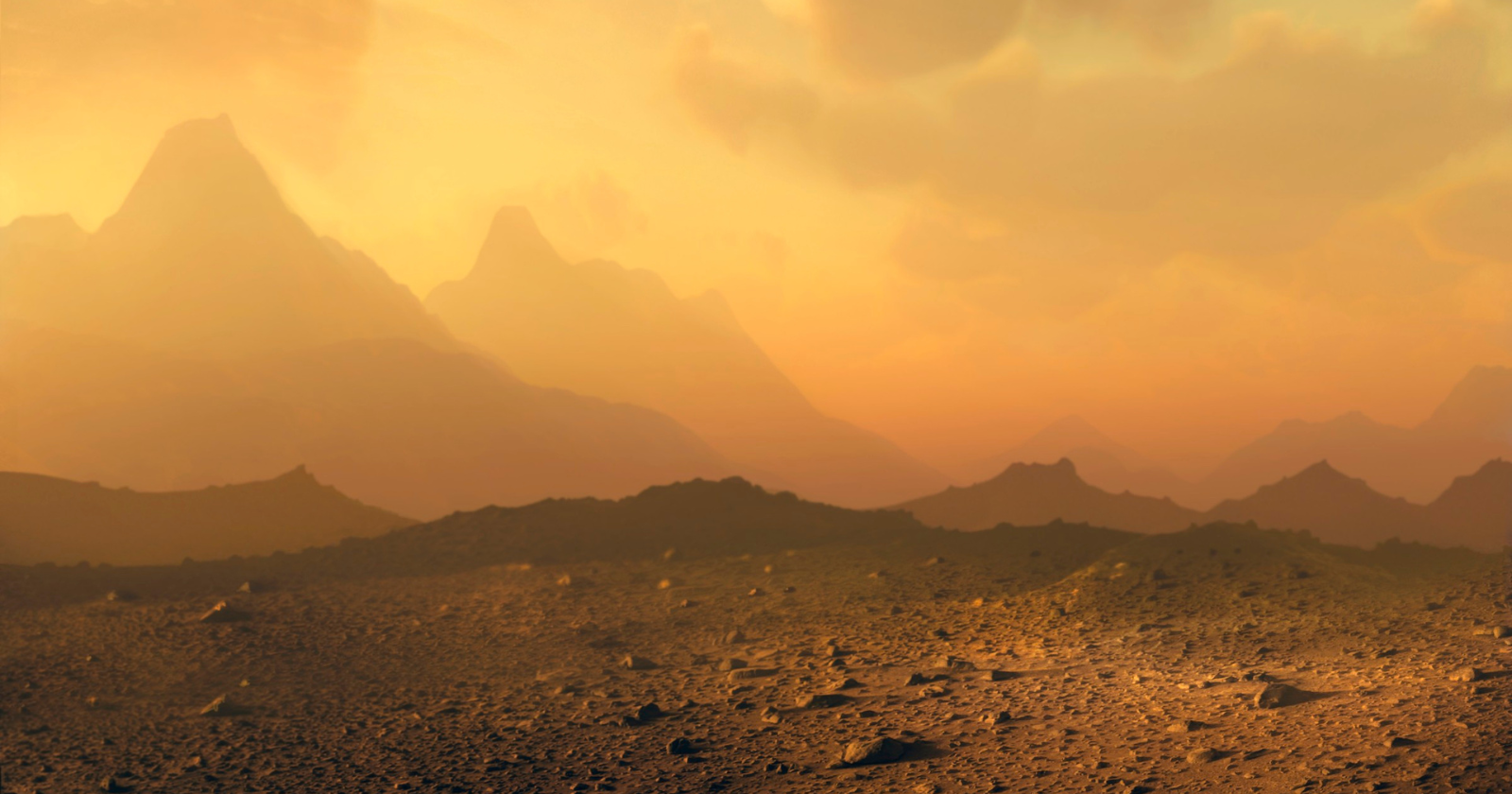
They showcase a rocky expanse that, at first glance, resembles a volcanic region in Iceland or Hawaii. Dark basalt slabs cover the ground, interspersed with fine sediment. Parts of the lander, including its landing platform, lens cover, and sampling arm, are visible in the images.
Above, the sky showcases a muted, soft orange tint — the effect of the thick CO2 atmosphere filtering sunlight into an alien radiance. The light is adequate for visibility, akin to an overcast late afternoon on Earth, yet distinctly otherworldly.
The chemical analysis confirmed what the images indicated. Venera 13 landed on volcanic basalt similar to Earth’s oceanic crust but enriched in potassium. Venera 14, which landed four days later 950 kilometers away, collected a different type of basalt sample. Both landers established Venus as a volcanic landscape shaped by ascending molten rock.
**What Remains Unexplored**
The images from Venera 13 in 1982 are still the only color photographs of Venus’s surface. Since the Vega mission wrapped up in 1985, no spacecraft has landed on Venus. The technical difficulties posed by Venus and the focus on Mars exploration have left its surface largely uncharted for four decades.
NASA’s DAVINCI mission and the European Space Agency’s EnVision are slated to return to Venus in the 2030s, some of which include brief surface components. These will offer the first new surface visual data since