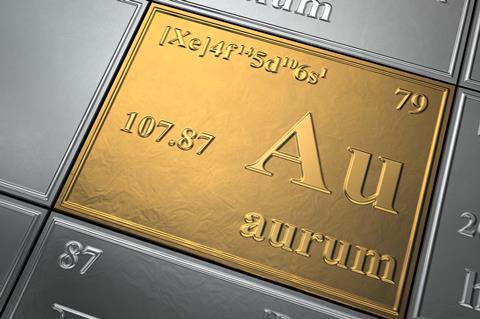
‘The question of whether a metal can genuinely serve as a true proton acceptor for a C–H donor has persistently been a debated and unresolved matter in chemistry,’ states Jun Chen from the Fujian Institute of Research on the Structure of Matter in China. In pursuit of answers to this inquiry, Chen and his team performed spectroscopic investigations on gold complexes and found that these entities exhibit hydrogen bonds as robust as those created by O–H and N–H groups. Grasping these interactions could empower chemists to develop improved catalysts or host–guest systems that depend on molecular recognition.
Gold serves as an optimal hydrogen bond acceptor, attributed to relativistic effects that contract the 6s orbital, which concentrates electron density and enhances its directionality for superior interaction with a hydrogen bond donor. Indeed, gold atoms frequently establish hydrogen bonds with conventional donors, including O–H, N–H, and F–H. However, achieving a concrete C–H···Au bond proves difficult, as the interaction is feebler, and in numerous instances, these atoms are merely in proximity rather than forming a direct bond.
Recent spectroscopic investigations of gas-phase gold anions associated with acetonitrile molecules have enabled Chen and his colleagues to delve deeper into these interactions. ‘[The cyanide group in acetonitrile] increases the C–H acidity without engaging with the metal, permitting us to effectively isolate and characterize the complex,’ Chen remarks.
Photoelectron spectroscopy and computational assessments indicated that the bond strength of the C–H···Au bond was approximately 0.50eV, with Chen noting that this is ‘entirely comparable to many traditional O–H or N–H anion hydrogen bonds’. ‘This directly contests the widespread belief that only strongly polarized, standard X–H groups can function as efficient hydrogen bond donors to metal anions,’ he asserts.
Further examination revealed that electrostatic interactions contributed about 60% to the overall interaction, whereas dispersion and induction effects played minimal roles (26% and 16%, respectively).
‘Determining whether C–H groups can create hydrogen bonds with metals is significant since even weak metal–ligand interactions may affect structure, stability, and reactivity,’ remarks Helgard Raubenheimer from Stellenbosch University in South Africa. This encompasses aspects like molecular arrangement, conformational tendencies, and the durability of intermediates, he elaborates.
Chen further notes that such non-covalent interactions are also engaged in transition-metal catalysis, for instance, and comprehending these bonds could assist chemists in crafting superior catalysts. Nonetheless, Raubenheimer points out that ‘these systems remain considerably idealized and their applicability to typical catalytic circumstances is likely to be limited’.
‘For heavier elements, like gold, the differentiation between hydrogen bonding and other weak interactions is not always distinctly defined,’ asserts Raubenheimer. ‘The principal value lies less in assigning a precise label to the interaction and more in providing dependable quantitative insight into its strength and fundamental nature.’