**New Discoveries Regarding Triple Bonds in Heavier Atoms Highlight Quantum Intricacies**
Recent findings by researchers in the United States have revealed fascinating irregularities in the characteristics of triple bonds, especially among heavier atoms, where relativistic quantum influences gain prominence. This research, centered on the CBi⁻ anion, has paved the way for new insights into molecular orbital interactions, questioning established concepts of chemical bonding in such dense atoms.
**Conventional Bonding Compared to Relativistic Effects**
In standard chemistry, it is understood that chemical bonds form through the overlap of valence electron orbitals between atoms. Generally, s or p orbitals from atoms combine linearly to form σ and π molecular orbitals. A typical triple bond consists of a σ orbital along with two π orbitals, each occupied by paired electrons with opposite spins. However, this conventional understanding presumes a distinction between the angular momentum of an orbital and the spin of an electron.
As electron speeds near that of light, a phenomenon more prevalent in heavier atoms due to increased nuclear charge, these distinct elements interact strongly through a mechanism known as spin–orbit coupling. This coupling allows σ and π orbitals with the same total angular momentum to merge, resulting in alterations to traditional bonding theories.
**Unveiling Molecular Orbital Interactions**
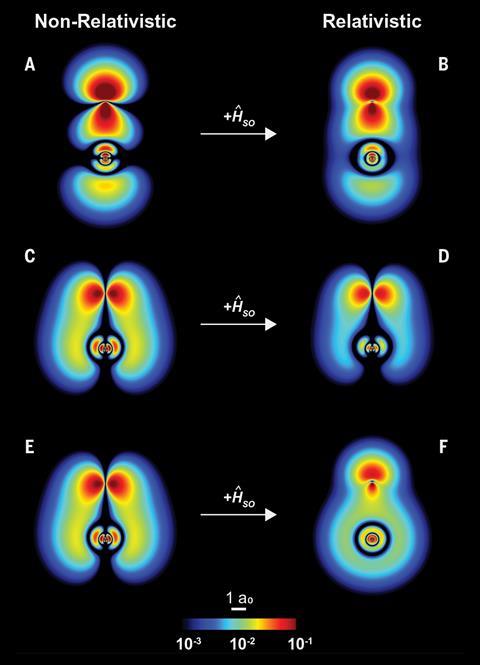
The research led by physical chemist Lai-Sheng Wang at Brown University utilized cryogenically cooled, angle-resolved photoelectron spectroscopy to investigate the shapes of electronic orbitals within the CBi⁻ anion. By exposing the anion to photons and detecting the emitted electrons, the team reconstructed images of molecular orbitals. The anticipated mixing of σ and π orbitals was confirmed; however, an unforeseen discrepancy emerged: the two π orbitals, which were expected to be identical, displayed notable differences.
Wang’s student, Deniz Kahraman, observed this anomaly. Lacking precedent in current literature, this phenomenon initiated a significant exploration into basic bonding tenets. Follow-up experiments confirmed the initial findings, leading Wang to collaborate with theoretician Kirk Peterson.
Peterson’s theoretical models clarified that differing angular momentum values caused the variations in orbitals. The π orbital with angular momentum ½ mixed with the σ orbital due to their shared total angular momentum, resulting in bonds exhibiting characteristics of both σ and π types. In contrast, the π orbital with angular momentum ³⁄₂ was not involved in this mixing. Peterson’s calculations indicated a subtle yet visually significant incorporation of σ character into the π-½ orbital.
**Prospective Directions and Theoretical Consequences**
This revelation underscores the importance of ongoing research into the behavior of π orbitals and their interplay in heavier atoms. The team’s future endeavors include investigating lighter elements within the same periodic group to identify the shift point where π-½ orbitals start to visibly embody traditional π traits. Furthermore, they plan to examine how unoccupied σ orbitals might affect the splitting of π orbitals.
Prominent quantum chemist Pekka Pyykkö praised the study for its innovation and thorough approach. However, he remarked that these observations are consistent with earlier theories suggesting that spin–orbit coupling complicates covalent bonding, as introduced by Kenneth S Pitzer several decades ago. These findings represent a meaningful advancement toward a comprehensive understanding of chemical bonding influenced by relativistic quantum mechanics in heavier elements.