**Space Does Not Initiate at a Specific Boundary**
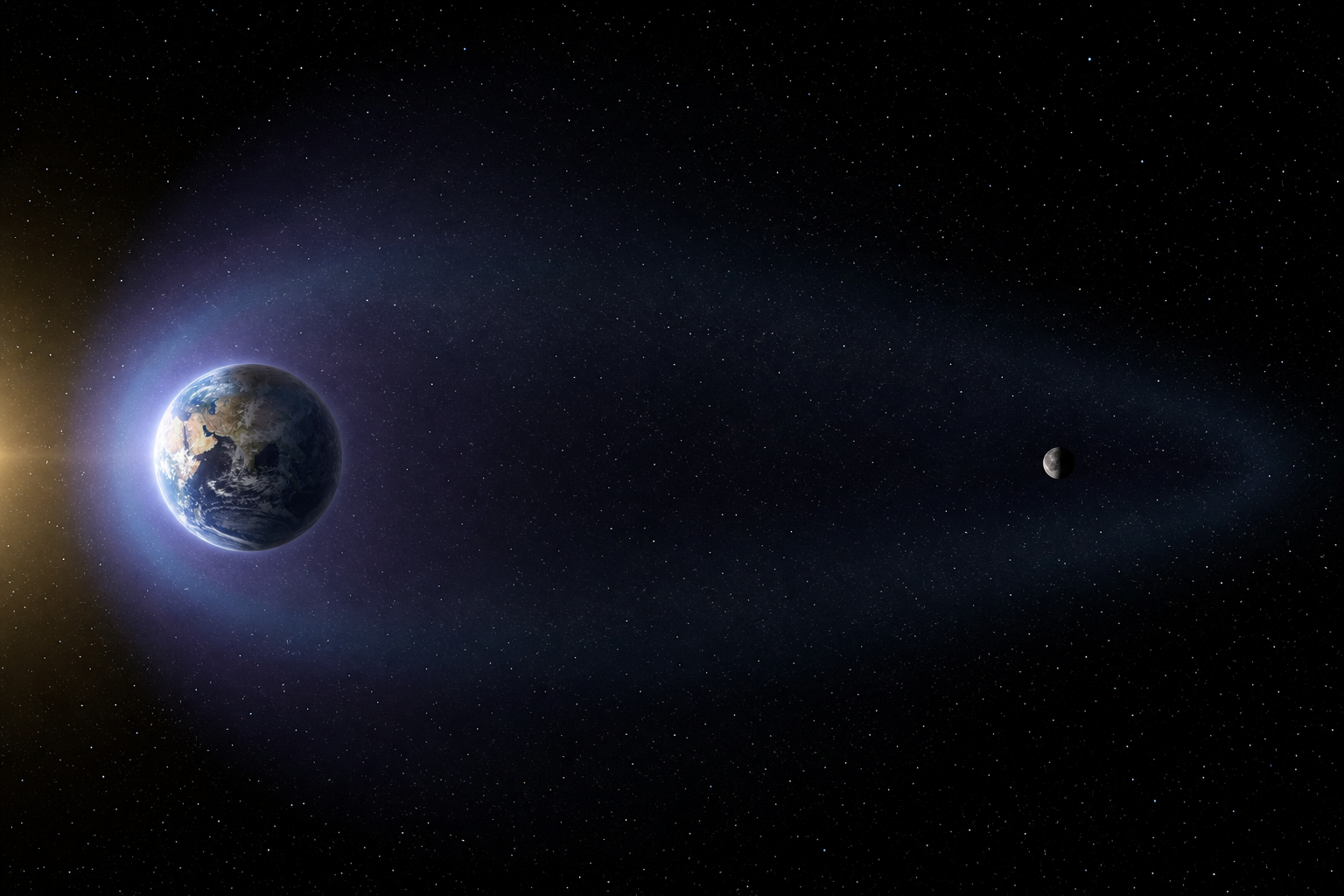
Space does not begin at a specific location where Earth’s atmosphere terminates. Rather, the density of the atmosphere gradually decreases until the exosphere merges into interplanetary space. As per ESA-NASA’s Solar and Heliospheric Observatory (SOHO), Earth’s geocorona extends no less than 630,000 kilometers from Earth, exceeding the Moon’s average distance of 384,400 kilometers. While Apollo astronauts visited the Moon, they stayed within this expansive atmosphere, in a hard vacuum.
**Unseen by the Unaided Eye**
The Moon’s location within Earth’s geocorona indicates it is enveloped by thin neutral hydrogen atoms. This hydrogen produces ultraviolet radiation known as Lyman-alpha glow, creating a geocorona visible exclusively through ultraviolet observation, rather than standard photography.
**The Atmosphere Gradually Expands**
From sea level, atmospheric pressure diminishes as altitude increases, passing through layers such as the troposphere, stratosphere, and thermosphere, ultimately reaching the exosphere, where molecules disperse freely. Hydrogen predominates in the exosphere, creating Earth’s geocorona that can be observed in far-ultraviolet light but remains invisible to the unaided eye.
**Enlightening Research and Observations**
SOHO, positioned near the Sun-Earth L1 point, has detected the geocorona extending well beyond the lunar orbit. Solar radiation compresses the dayside while stretching the nightside, leading to a mere 0.2 hydrogen atoms per cubic centimeter in the vicinity of the Moon’s nightside.
**Historical Context and Contemporary Observations**
Apollo 16 used a far-ultraviolet camera on the lunar surface to document Earth’s geocorona, establishing a basis for its comprehension. The 2025 Carruthers Geocorona Observatory, named in honor of the Apollo camera designer, will continue to monitor alterations in the exosphere shaped by solar activity.
**Space vs. Atmosphere**
“The atmosphere” denotes a distribution of particles, while “Space” is a clearly defined operational category. The Karman line at 100 kilometers signifies the entrance into space for record purposes. Even at this delineation, remnants of the atmosphere remain, influencing satellites and the ISS due to thermal drag.
**Layered Atmospheric Viewpoints**
The Moon possesses an exosphere with gases such as helium generated from surface interactions. Thus, an Apollo astronaut was situated within both Earth and the Moon’s exospheres along with interplanetary space. These layers represent populations of particles rather than distinct boundaries of the atmosphere.
**Importance and Impact**
Charting Earth’s geocorona aids in comprehending atmospheric loss and offers context for ultraviolet astronomy by providing a background separation. While not directly detrimental for exploration, geocoronal particles emphasize that the Moon resides within a diminishing atmospheric halo. Apollo astronauts found themselves in a significant vacuum, well within space’s legal and operational confines, yet surrounded by a vast, scientifically intriguing geocorona.