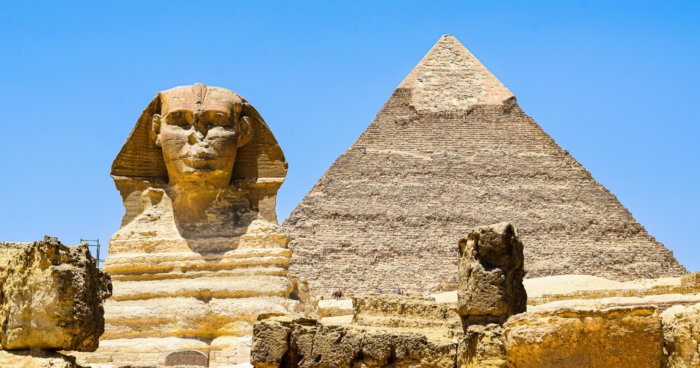
The notion of ancient history is often relegated, in many people’s perceptions, into a singular, flat compartment.
Cleopatra resides within this compartment. The Great Pyramid of Giza is contained there. So are Julius Caesar, Stonehenge, Alexander the Great, Ramesses, and the Trojan War, along with the initial pharaohs of Egypt. If you were to ask the majority of individuals to arrange these entities chronologically, most could likely manage that, at least approximately. However, if you inquired about the precise chronological distances between them, in specific years, very few would succeed.
This is the point where the compression occurs. The mental compartment of ancient history is mainly indistinct internally. Items within are merely old. The precise intervals between them — spanning hundreds or thousands of years — are condensed into a unified sense of antiquity that views the entire compartment as approximately one temporal group.
The Great Pyramid of Giza disrupts this compression in a particular manner, and the method in which it does so merits a careful exploration.
The pyramid and Stonehenge
The Great Pyramid was finished around 2560 BCE, during Pharaoh Khufu’s reign from the Fourth Dynasty. This is a precise date, determined through decades of Egyptological studies utilizing royal lists, radiocarbon dating of organic materials discovered in the pyramid’s construction, and cross-referencing with records from neighboring civilizations.
Conversely, Stonehenge was constructed in phases over approximately fifteen centuries. The earliest earthworks — including the original ditch, the bank, and wooden posts — began around 3000 BCE, several hundred years prior to the pyramid. The renowned standing stones, both sarsens and bluestones, were erected around 2500 BCE, roughly concurrent with the pyramid’s construction.
However, Stonehenge underwent modifications and additions for another thousand years following that. The site’s final documented construction phase — a series of pits identified as the Y and Z holes, excavated around the sarsen circle — was completed around 1520 BCE.
By the time those concluding pits were excavated at Stonehenge, the Great Pyramid had already reached the age of 1,040 years.
That figure warrants reflection. Contemplate how distant 1,000 CE seems to you today — the era of medieval monarchs, William the Conqueror, the zenith of the Byzantine Empire, and the earliest European cathedrals. That is the historical distance of the Great Pyramid from the last Bronze Age Britons who were enhancing Stonehenge. Khufu had been deceased for forty generations. The Old Kingdom of Egypt had fallen, been restored as the Middle Kingdom, collapsed again, and transitioned into the New Kingdom under a completely different lineage of pharaohs.
The Bronze Age Britons completing Stonehenge were utterly unaware of these events. They were merely concluding their own ancient endeavor on the opposite side of the continent.
The pyramid and Cleopatra
This is the moment when the compression truly shatters.
Cleopatra VII, the final reigning sovereign of Ptolemaic Egypt, was born in 69 BCE and died in 30 BCE. When she traversed Alexandria — or visited the Giza plateau, as she likely did — the Great Pyramid had already existed for over 2,500 years.
This roughly mirrors the span between the birth of Christ and the present day.
Envision standing in proximity to something finished a full 500 years before Christ’s birth. Something older to you than the entire duration of the Christian timeline. Something so ancient that in all the recorded history you studied, it has merely stood there, embodying antiquity. This reflects the temporal relationship Cleopatra held with the Great Pyramid.
She was not gazing at a newly erected monument. She was not observing a structure crafted by her great-great-grandfather’s civilization. She was examining a structure that predated her historical consciousness by 2,530 years.
Now