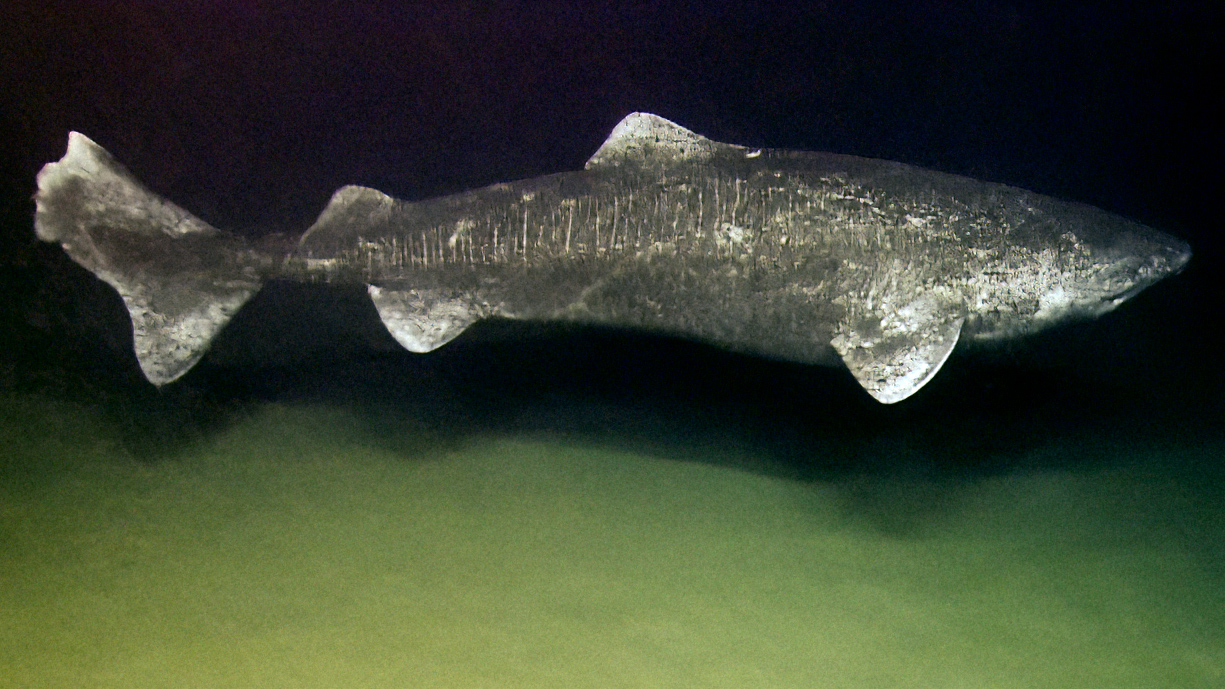
A Greenland shark doesn’t appear to be designed for speed. It navigates through frigid northern waters with a rounded body, a sluggish tail movement, and the leisurely pace of a creature whose existence is tallied more in centuries than in seasons.
This perception isn’t just visual. In a 2012 research published in the Journal of Experimental Biology, Yuuki Watanabe and his team found Greenland sharks swimming at an average cruising velocity of around 0.34 meters per second, with a maximum tailbeat frequency that is lower than that of other fish of similar size. Roughly converted, that average equates to just over 1.2 kilometers per hour.
Most pedestrians on a street would outpace it. A frequently referenced preferred walking speed for adults is about 1.4 meters per second, or approximately 5 kilometers per hour, although this can vary with factors like age, body size, and environment. A 2011 review in Gait & Posture placed typical adult walking speeds within that range across multiple studies.
The shark’s lack of speed alone would be enough to make it notable. However, the deeper revelation lies in its age. The figures regarding age and maturity are primarily based on a singular direct ageing study, rather than a tidy birth record. The findings are robust enough to warrant consideration, but they should be interpreted as approximations with considerable uncertainty, rather than as an exact date of birth.
In 2016, Julius Nielsen and his team reported in Science that Greenland sharks could be the oldest known vertebrates. By employing radiocarbon dating on eye-lens tissue from 28 female sharks, the researchers estimated that the largest individual in the cohort was approximately 392 years old, with a range of plus or minus 120 years. The same publication approximated sexual maturity to be around 156 years.
The Slow Shark Dilemma
The Greenland shark, Somniosus microcephalus, is part of the sleeper sharks, a label that perfectly fits its public image. It resides in the chilly North Atlantic and Arctic waters, frequently in shadowy or deep environments where direct observation proves challenging.
The species profile from the Florida Museum defines the Greenland shark as a large, heavy-bodied species linked to cold, deep water, and notes that it has been discovered containing fish, seals, and other organisms in its stomach. This combination presents a conundrum: how does such a slow swimmer hunt animals that should effortlessly outrun it?
Watanabe’s 2012 study clarified the issue. The researchers discovered that Greenland sharks are slow in both absolute terms and relative to their body size and water temperature. They proposed that the sharks may prey on dormant seals or heavily depend on scavenging, although the precise ratio of hunting to scavenging remains elusive.
This serves as a useful correction to the simplified idea. Slow does not equate to harmless, feeble, or biologically uncomplicated. A sluggish shark can still function effectively as a predator and scavenger if it is well-suited to its environment. In freezing waters, under low illumination, with prey that may rest or descend, speed isn’t the only strategy for survival.
How Do You Determine the Age of a Shark Without a Birthday?
Determining the age of a Greenland shark isn’t akin to ageing a tree. There are no convenient rings to tally in a cut trunk, and these creatures are too long-lived and isolated for direct lifetime observation. Many fish can be aged using hard components like otoliths, but sharks lack these bony ear structures.
Nielsen’s team opted for the eye lens instead. The inner proteins of the lens are deposited early in life and maintain remarkable stability. By analyzing radiocarbon in these tissues, the researchers could utilize the mid-20th-century “bomb pulse” from nuclear testing as a temporal marker, then integrate the carbon data with shark length and growth models.
This method yields estimations, not exact ages. Hence, the 392-year figure should not be rounded off as certainty. The oldest shark was estimated to be approximately four centuries old, but the uncertainty range was significant enough to be noteworthy. Nevertheless, the lower end of the range still identifies an animal of incredible age.
The maturity estimate might be even more critical for the future of the species. A female that may not produce offspring until about 150 years old follows a life history pattern that is nearly the opposite of fast-breeding animals. If adults are removed, replacement occurs at a sluggish pace. Very sluggish.
Centuries Alter the Conservation Discussion
Longevity can imply resilience. For a population, it often signifies the contrary. Species that grow slowly, reach maturity late, and spawn new adults only after lengthy intervals can be severely impacted by fishing pressures, even when the catch doesn’t seem significant by standard measures.
The IUCN Red List currently classifies the Greenland shark as Vulnerable. Historically, it was hunted for its liver oil, and today it can still be accidentally captured. Climate change and shifting Arctic ecosystems introduce additional uncertainties, especially for an organism whose life cycle is so prolonged that rapid environmental alterations can condense several generations of sharks into one human lifetime.
This is the uncomfortable reality of the four-century fact. An individual