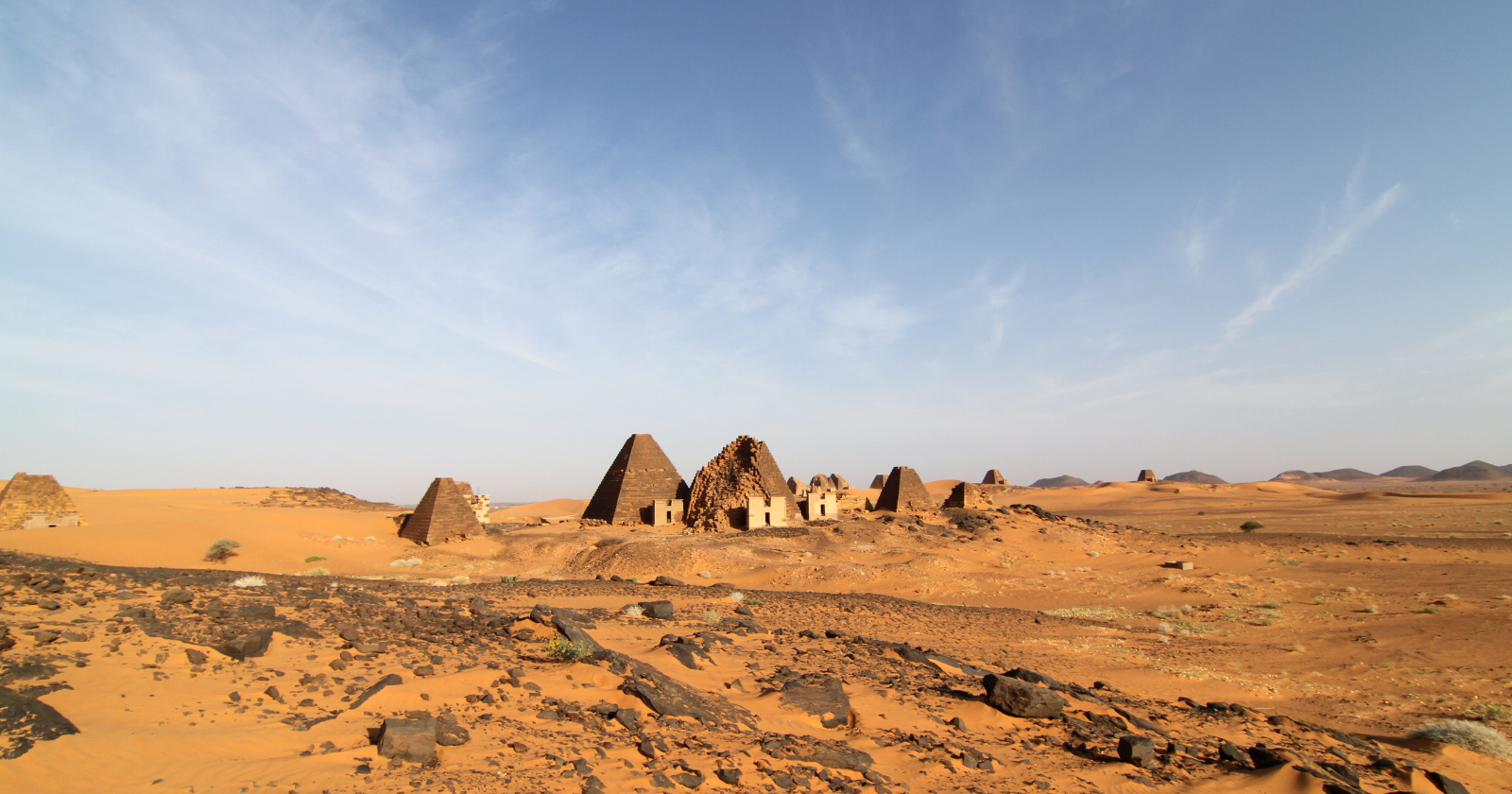
When picturing a pyramid, the first image that likely comes to mind is Giza: its vast golden inclines, accompanied by camels, and the legendary Sphinx. Interestingly, what rarely shows up in these images is Sudan, the southern neighbor of Egypt, which contains one of the highest concentrations of pyramids worldwide.
The precise count of pyramids in Sudan fluctuates based on the criteria used for counting and the level of structural deterioration. A study by archaeologist Friedrich Hinkel uncovered evidence of over 220 pyramid structures within Sudan’s six primary Kushite royal cemeteries alone, not including other types such as mastabas. In contrast, ascertaining the number of pyramids in Egypt is more intricate. Egyptologist David Lightbody indicated to Live Science that the frequently mentioned figure of 118 is “likely in the right ballpark,” though there are differing opinions on what constitutes a pyramid.
This data confirms a generally accurate comparison: Sudan possesses more ancient pyramids than Egypt, even if the exact ratio is somewhat unclear. According to archaeologist and site manager Mahmoud Suliman at Meroë, the area is “the largest assembly of pyramids globally.”
Who Really Constructed Them
The pyramids in Sudan were not built by Egyptian settlers but are attributed to the Kingdom of Kush, a Nubian civilization that thrived along the central Nile. The Kushite state existed in various incarnations for centuries, with Meroë emerging as the kingdom’s center from around the eighth century BC to the fourth century AD.
Kush was far more than a peripheral entity adjacent to Egypt. In the eighth century BC, its rulers expanded northward into Egypt. Initially dominating Upper Egypt, Kushite influence eventually covered the entire nation. The British Museum notes that they conquered Egypt in the eighth century BC and held sway for over a century.
Often referred to as the Black Pharaohs, the Kushite rule over Egypt was not a single, definitive conquest executed in 747 BC. Piye, whose reign is generally placed around 747–716 BC, brought a large part of Egypt under Kushite rule. Following Piye, his successor Shabaka reestablished Kushite dominance over Egypt, declaring himself its ruler.
The timing is a remarkable point. Egypt’s illustrious era of royal pyramid building had ended well before this period: the Metropolitan Museum of Art observes that Egyptian pyramid construction peaked during the Fourth Dynasty in the third millennium BC. By the New Kingdom, commencing around 1550 BC, pharaohs favored large rock-cut tombs, particularly in the Valley of the Kings.
Centuries later, Kushite leaders returned to Nubia for pyramid-shaped burials. Piye was buried beneath a pyramid at El-Kurru around 716 BC, and his heirs continued this practice at several locations, as noted by the British Museum.
Steeper, Smaller, Stranger
Upon standing in front of a Meroitic pyramid, the differences from those at Giza are immediately apparent. The Sudanese pyramids boast narrow bases with steeply sloped sides. A study of Meroë