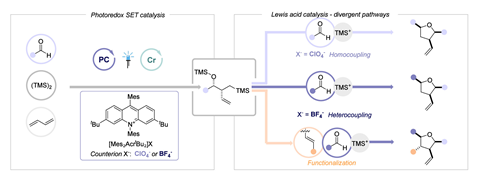
A recently identified cyclisation reaction presents a flexible strategy for the synthesis of highly substituted tetrahydrofuran (THF) units. This stereoselective process, created by Frank Glorius and his group at the University of Münster, adeptly constructs intricate THF rings from basic building blocks in a single-pot method, offering considerable promise for drug discovery and high-throughput synthesis.
Saturated heterocycles, such as THF, serve as crucial motifs in pharmaceutical chemistry due to their spatially varied interactions with biological targets. Despite their significance, the synthesis of these structurally elaborate units poses challenges, with most polysubstituted variants being produced separately.
The Glorius group fortuitously stumbled upon the generation of polysubstituted THFs while investigating a silyl radical-mediated technique intended for producing allylic alcohols from aldehydes and alkenes. Instead, the remaining trace of silyl reagent in the mix facilitated cyclisation into a di-substituted THF. “It was quite accidental, but we recognized it as a much more general and modular platform for synthesizing this impactful motif,” remarks Yan-Bo Li, a postdoctoral researcher in the Glorius lab.
Further research, supported by computational chemist Kendall Houk from UCLA, uncovered that tweaking the reaction conditions could result in tri- and tetra-substituted structures by incorporating multiple aldehydes and an alkene. The team found that changing the counterion of the photocatalyst could either allow or hinder cyclisation, thus enabling modifications before the final cyclisation stage into a THF ring, as detailed by Colin Stein, a contributing PhD student.
This sequence’s robustness is remarkable, as it supports a wide array of functional groups and complex structures, including drug-derived or natural product aldehydes, with high yields. David Williams, an organic chemist at Indiana University, commends the modular synthesis and its extensive applicability.
The team’s high-throughput screening generated a collection of 73 unique polysubstituted THFs from 12 electrophiles, underscoring the reaction’s potential for exploring various chemical landscapes relevant to drug discovery. Sherry Chemler from the University of Buffalo believes the strength of the methodology lies in its ability to form multiple bonds in a single operation.
In a proof-of-concept experiment, the team accomplished a formal synthesis of the antifungal compound monocerin, successfully generating a key intermediate in one step with excellent stereocontrol. Their current focus is on creating an enantioselective variant with chiral ligands, aspiring to enhance efforts in both total synthesis and discovery chemistry.
This unanticipated cyclisation signifies a significant advancement, offering a generalized tool for building complex THF units and progressing methodologies in pharmaceutical research.