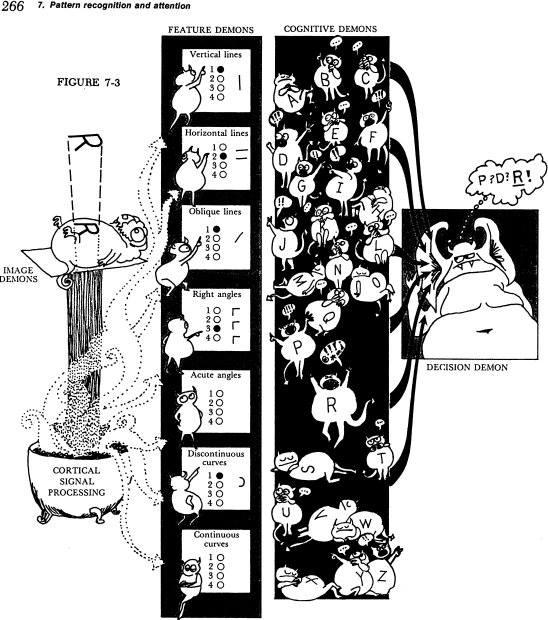
Oliver Selfridge was a pivotal individual in the advancement of artificial intelligence. In 1959, he proposed the idea of ‘pandemonium architecture,’ where a network of simple units executing specialized roles could work together to achieve intricate cognitive tasks. This groundbreaking concept significantly influenced the inception of neural networks, which serve as the backbone of contemporary machine learning.
The pandemonium model gained traction thanks to its delightful illustrations by Leanne Hinton, showcased in Lindsey & Norman’s 1977 textbook ‘Human Information Processing’. These drawings, although referred to by some as resembling ‘a child’s nightmare,’ have also been cherished for their warm portrayal of demons.
In addition to his AI contributions, Selfridge wrote four children’s books, went through three marriages, and played a key role in revealing the NSA’s Echelon program. While the pandemonium model is widely recognized, illustrator Leanne Hinton’s connection is not as well known. Although attempts were made to reach out to her for validation and permission to share the illustrations, these endeavors were met with failure.