Back in 2010, the University of Cambridge and the National Maritime Museum at Greenwich initiated a six-year research initiative called “The Board of Longitude 1714–1828: Science, Innovation and Empire in the Georgian World.” Spearheaded by Simon Schaffer from Cambridge and Richard Dunn and Rebekah Higgitt from Greenwich, this partnership sought to uncover the historical importance of the British Board of Longitude throughout the Georgian period. The venture was bolstered by postdoctoral researchers Alexi Baker and Nicky Reeves, alongside doctoral candidates Katy Barrett, Eóin Phillips, and Sophie Waring, with Katherine McAlpine acting as the Engagement Officer.
During its course, this initiative gained recognition for its exceptional history of science blog, which documented the team’s advancements and endeavors. In addition to the creation of three doctoral dissertations, two of which are still unpublished, and several scholarly papers, the team produced a range of monographs. Among the significant publications were Richard Dunn’s “Navigational Instruments” (2016), the edited compilation “Navigational Enterprises in Europe and Its Empires” by Richard Dunn and Rebekah Higgitt (2015), and Rebekah Higgitt’s “Maskelyne Astronomer Royal” (2014). Katy Barrett’s doctoral dissertation culminated in the publication of “Looking for Longitude: A Cultural History” (2022).
Dunn and Higgitt also curated a prominent exhibition at the National Maritime Museum, which transformed into a global tour, culminating in the esteemed book “Finding Longitude: How Ships, Clocks and Stars Helped Solve the Longitude Problem” (2014).
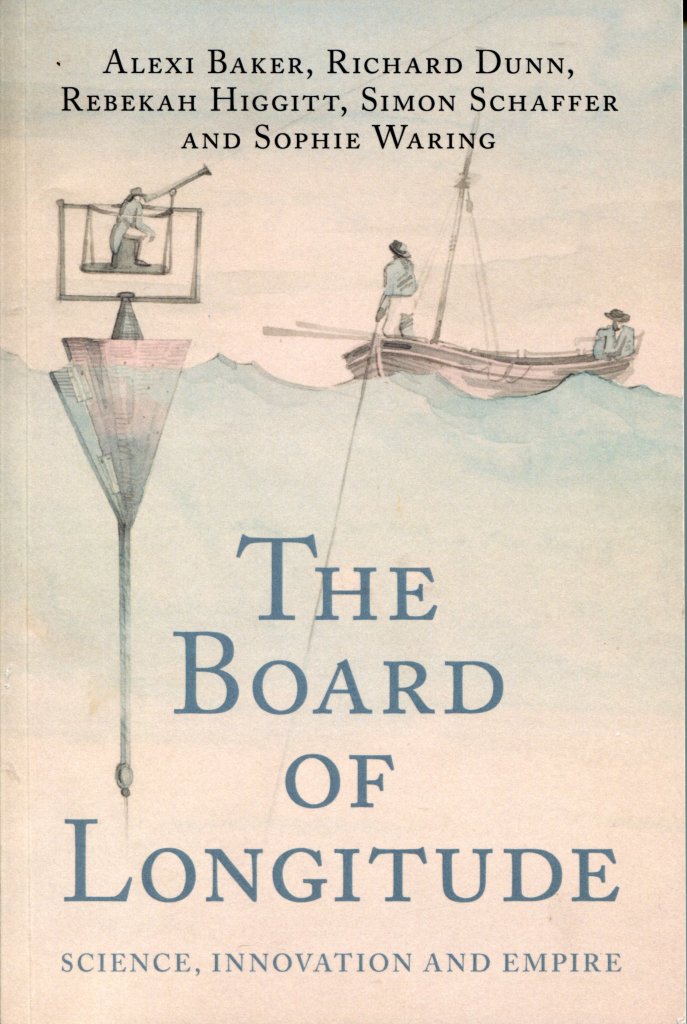
In 2025, the all-encompassing final report from this significant research project was released, entitled “The Board of Longitude: Science Innovation and Empire.” Penned by Alexi Baker, Richard Dunn, Rebekah Higgitt, Simon Schaffer, and Sophie Waring, this volume aimed to thoroughly investigate the historical influence of the British Board of Longitude. Although it provided an in-depth examination, the authors admitted in the introduction that many questions persisted and that additional research would be beneficial.
The book begins with an elaborate six-page timeline of the British pursuit of longitude, acting as an instructive index of the themes discussed. The introduction offers a thought-provoking summary of the historical backdrop, sources, and historiography of the Board, preparing the reader for the subsequent chapters. These chapters, while forming a unified narrative, are designed to function independently, providing concise, accurate introductions to specific episodes or elements of the British longitude narrative.
The structure of the book adopts a chronological framework following the initial activities of the Commissioners and the evolution of the Board of Longitude, supplemented by in-depth examinations of particular aspects of the Board’s work. Each chapter is carefully researched and well-composed, featuring grayscale illustrations, tables, and a comprehensive glossary, bibliography, and index.
The authors have significantly enriched maritime history through this project and the resulting publication. While they concede that the research is not all-encompassing, the findings presented here lay the groundwork for future inquiry and serve as a benchmark for historical research projects, proving essential for anyone interested in this topic.