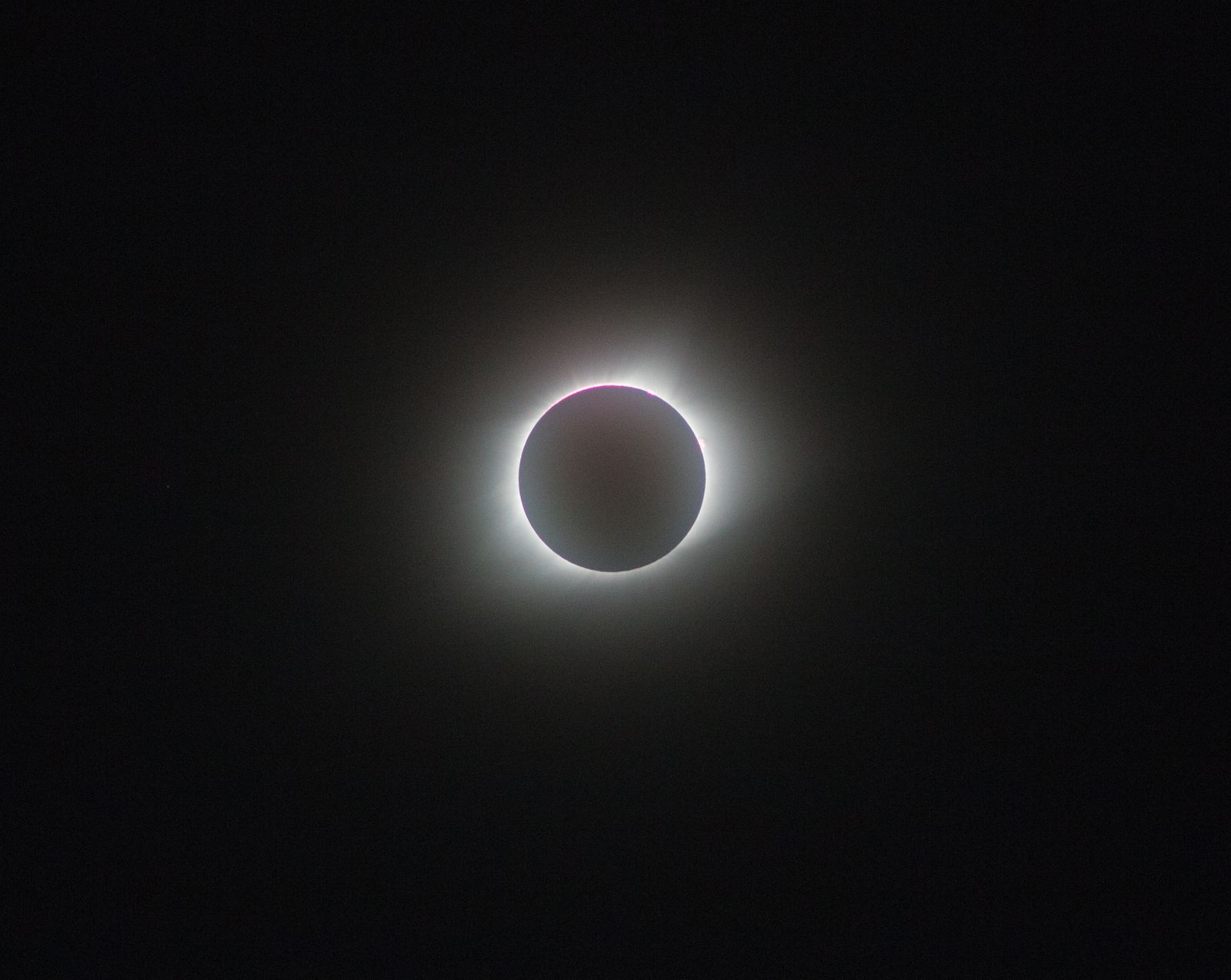
On the morning of August 18, 1868, a French astronomer by the name of Pierre Janssen found himself in the coastal town of Guntur, located in Andhra Pradesh on India’s southeastern coast, observing the Moon traverse the Sun’s face. He had journeyed from France for a totality duration lasting several minutes. In his grasp was a spectroscope — a brass device akin to a small telescope that dispersed incoming light via a prism into a spectrum of narrow lines. As the sky darkened and the solar corona illuminated around the Moon’s black disk, Janssen directed his prism toward a vast red loop of gas erupting from the Sun’s border. In the resulting spectrum, near the yellow band typically occupied by sodium, a second bright yellow line emerged at a wavelength of approximately 587 nanometers. It corresponded to nothing found on Earth.
He had just discovered helium. This element would not be extracted from terrestrial rock in a laboratory setting for another twenty-seven years.
## A prism, a prominence, and a line that didn’t match
Janssen’s instrument functioned based on a principle that was only nine years old at the time. In 1859, German physicist Gustav Kirchhoff demonstrated that every chemical element, when subjected to intense heat, emits light at a specific set of wavelengths — a barcode signature unique to that element. Direct a spectroscope at a sodium lamp, and a specific yellow doublet at 589 nanometers will be observed. Aim it at hydrogen, and red, blue-green, and violet lines will appear, consistently in the same positions. Kirchhoff’s discovery indicated that starlight, theoretically, carried the chemical makeup of the star that generated it. Astronomers no longer required a sample; they needed merely a prism.
The 1868 eclipse served as the first significant test of that concept in an active solar observation, as [Science Friday recounts in its history of the element](https://www.sciencefriday.com/articles/the-origin-of-the-word-helium/). Janssen’s spectroscope detected the blazing prominences that burst from the Sun’s surface — arcs of plasma taller than the Earth’s diameter. Upon analyzing their light, the anticipated hydrogen lines were present. However, the unexpected yellow line, nearby to sodium’s but clearly distinct, was absent.
He was so astounded by the visibility of that line that he hypothesized it might be discernible without the aid of an eclipse — that the Moon’s shadow had only made identification simpler. The following morning, under typical Indian daylight, he redirected the spectroscope to the Sun’s edge once more. The line remained.
## Two men, 5,000 miles apart, pursuing the same yellow hue
While Janssen was setting up in Guntur, a British astronomer named Joseph Norman Lockyer was conducting similar research from London. Lockyer had not traveled to observe the eclipse. He dedicated months to designing a spectroscope adept enough to detect solar prominences in broad daylight — no Moon needed. Later in 1868, Lockyer independently identified the same unusual yellow line, at virtually the same wavelength.
He compared the line’s location against every known element at the time and concluded, as [Massive Science describes in its history of eclipse discoveries](https://massivesci.com/articles/eclipse-citizen-science-einstein-feddersen/), that the origin must be an element present in the Sun but not yet recognized on Earth. He termed it helium, derived from *helios*, the Greek term for the Sun.
This coincidence emerged as one of the great minor dramas of nineteenth-century science. The letters from both men arrived at the French Academy of Sciences around the same period, and the Academy acknowledged both contributors. A commemorative medal was later minted featuring both their likenesses.
## Why a chemist wouldn’t engage with it for 27 years
To contemporary ears, discovering an element within the Sun seems like the conclusion of the narrative. In 1868, it was closer to a whisper. Most chemists dismissed the yellow line for nearly three decades. An element that existed solely in the Sun, inferred from a single spectral feature 150 million kilometers away, felt awkward to a discipline grounded in beakers, precipitates, and atomic weights measured on a scale. Helium could not be weighed. It could not be contained in a bottle. One could only observe a bright line through a prism.
The deadlock resolved in 1895. Scottish chemist William Ramsay was analyzing a uranium-rich mineral known as cleveite. When he treated it with acid, a gas bubbled forth. Ramsay passed the gas through his own spectroscope, anticipating nitrogen. Instead, he discovered the yellow line at 587 nanometers — the same signature Janssen had recorded during the Indian eclipse. He dispatched a sealed sample to Lockyer for verification. The spectroscopic analysis confirmed the presence of helium.
Twenty-seven years after the element