**Unveiling the Piezochiral Effect: A Milestone in Material Science**
In a remarkable advancement in science, teams from Germany and the UK have discovered an unusual material that can modify its chirality when exposed to physical stress. This newly observed phenomenon, called the piezochiral effect, offers exciting possibilities for transforming enantioselectivity control in catalysis, presenting a powerful tool for chemical synthesis.
Chirality, a crucial principle in chemistry, particularly in biochemistry and pharmacology, significantly impacts the efficiency and reduction of waste in chemical processes. The 2021 Nobel Prize in Chemistry honored David MacMillan and Benjamin List for their groundbreaking contributions to asymmetric catalysis, which enables selective isomer production in chemical reactions.
Despite its significance, adjusting the chirality of existing materials has proven to be a daunting task. Conventional strain engineering, commonly employed to alter electrical, magnetic, and mechanical properties, has not previously succeeded in affecting chirality, as the direction of strain does not readily correlate with the distinct handedness associated with chirality.
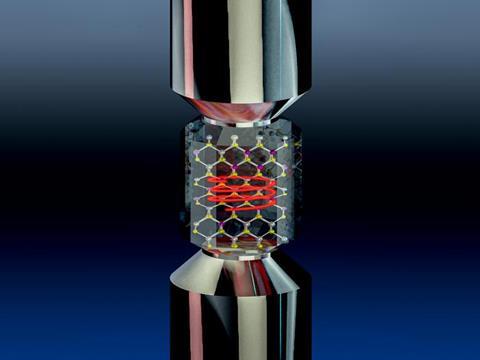
This research, spearheaded by condensed matter physicists Andrea Cavalleri at the Max Planck Institute and Paolo Radaelli at the University of Oxford, revealed that terahertz electromagnetic pulses can temporarily change the chirality of boron phosphate crystals. Expanding their findings to mechanical manipulation, they applied static tension or compression on silver gallium sulfide and effectively recorded polarization rotation indicative of changes in chirality.
Cavalleri notes that the crux of their discovery lies in the balanced regions of alternating chirality within crystals, similar to antiferromagnetic materials. Static strain disrupts this balance, imparting a net chirality to the crystal. The team identified additional crystals, including gallium(II) selenide and lithium triborate, that may demonstrate comparable behavior.
Cavalleri foresees significant implications for catalysis, suggesting that strain-induced chirality inversion could allow a single substrate to switch between generating right- and left-handed molecules, depending on the applied stress.
Aldo Romero, a computational materials scientist, commends the discovery’s potential for immediate use in developing sensitive strain sensors, noting the minimal force needed compared to piezoelectric materials. He expects that, with further exploration, this progress could lay the groundwork for precise chirality control in catalytic processes.
In summary, the piezochiral effect presents new possibilities in material science, with the potential to transform various domains by offering accurate control over chirality—a vital element in the efficiency and specificity of chemical reactions. As research advances, this breakthrough may result in significant improvements in catalysis and beyond.