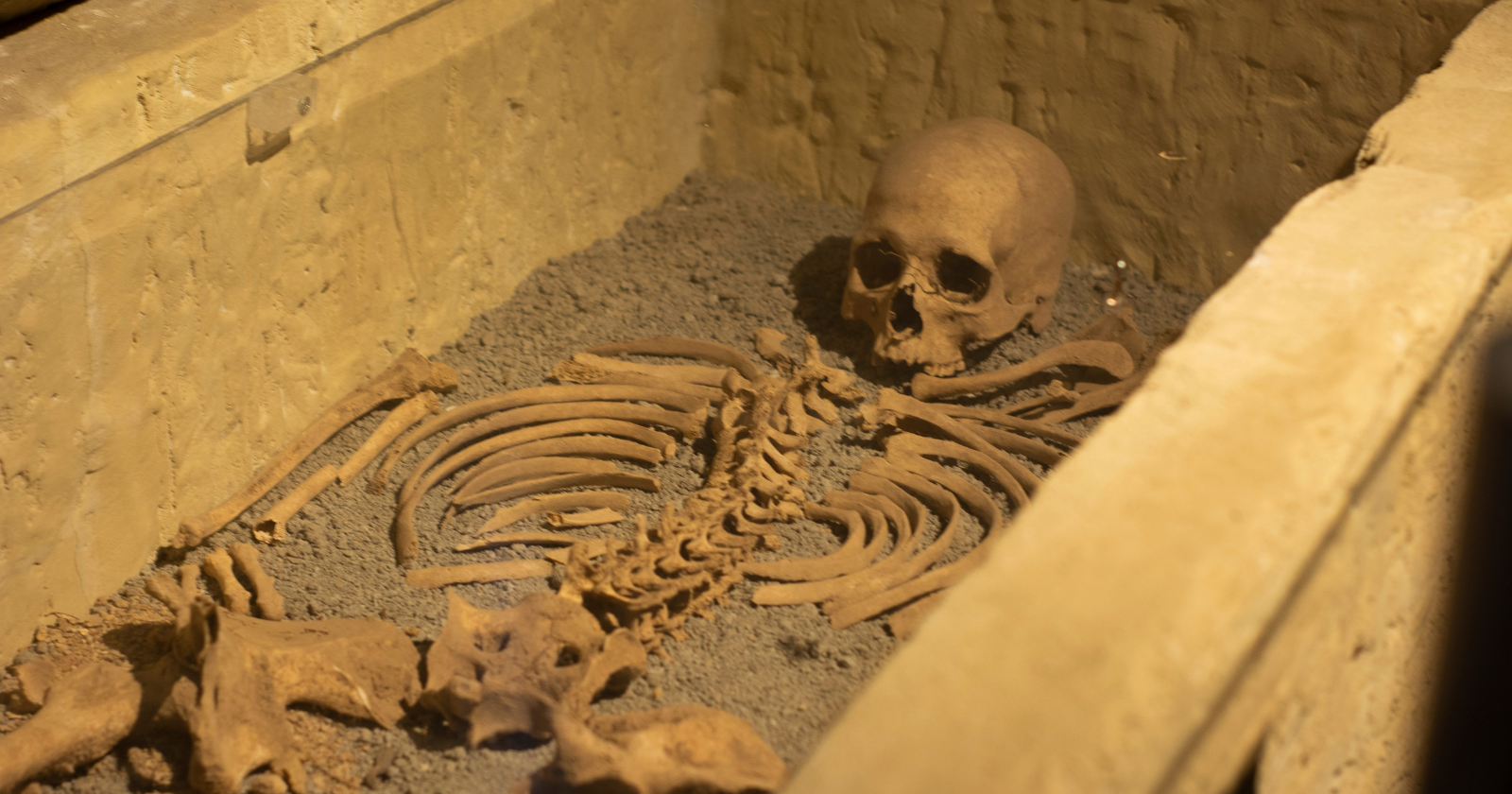
Approximately 4,000 years ago, four sisters, daughters of the pharaoh Amenemhat II from the Middle Kingdom, were interred at Dahshur with bows and additional weaponry placed within their tombs — arrows specifically retrieved from at least one of the sisters, as well as from a nearby fifth royal woman. A recent examination of their skeletal remains suggests that these weapons were not merely ceremonial. The study indicates that distinct muscle attachment sites found on several of the women’s bones are compatible with the high-intensity strain associated with years of drawing a bowstring. Conversely, other bioarchaeologists analyzing similar evidence remain skeptical that the bones can distinguish between an archer and someone who engaged in various other physically demanding, repetitive tasks.
What the skeletal remains reveal
The research, spearheaded by Zeinab Hashesh from Beni-Suef University and published on 17 July 2026 in Frontiers in Environmental Archaeology, investigated the remains of Princess Ita, Princess Khenmet, Princess Itaweret, and a tentatively identified Princess Sathathormeryt, along with a fifth royal woman, Noub-Hotep, and one male internment, King Hor. All of them were laid to rest in the royal necropolis at Dahshur, notably chosen by Amenemhat II for his pyramid complex during a reign typically situated in the nineteenth century BCE, a timeframe Egyptologists view as one of enhanced stability and extensive royal construction. The primary evidence presented by the team revolves around entheseal changes, the roughened, enlarged bone texture created where tendons and ligaments attach, which can thicken over time as a response to extended mechanical loading.
Ita exhibited enlarged attachment sites on her right shoulder, arm, and hand. Noub-Hotep had notably strong forearm and right hand attachments, with arrows specifically recovered from her tomb. Itaweret displayed significant development in her shoulder and chest, coupled with well-healed fractures in her ribs and foot, suggesting she led an active and physically dynamic life rather than a passive one. Hor’s remains showed asymmetry between the left and right sides of his body, a wear pattern indicative of repetitive bow use, typically resulting from drawing predominantly with one arm.
Hashesh presents her argument straightforwardly: “Members of the royal family, particularly the women, were engaged in skilled, physically demanding tasks such as archery and hunting,” she stated in a statement. From her perspective, the weapons found within the tombs were not merely symbolic offerings — they were instruments the women actively utilized.
Why other researchers remain unconvinced
The disagreement centers not on whether the bones exhibit wear but rather on whether entheseal changes are sufficiently distinct to ascertain their cause. Sonia Zakrzewski, a bioarchaeologist from the University of Southampton, articulated the main objection in remarks to Live Science: “The precise reason for that use is unclear. Therefore, we cannot assert that these skeletal changes are necessarily linked to the use of weaponry.” Activities such as grinding grain, weaving, carrying loads, and various other repetitive tasks from the Middle Kingdom can all produce similar markings on bone, and research on entheseal changes has long faced challenges in reliably connecting specific patterns to individual activities as opposed to general physical exertion.
Scott Haddow, a bioarchaeologist from the University of Turin, raised a more specific technical concern: archery is inherently asymmetric, employing one arm differently from the other; however, some of the skeletal changes noted in the study appear more like generalized, bilateral strength than the unilateral pattern that archery would typically create. Factors like age, body size, and genetic differences all affect how pronounced these attachment sites become, independent of the activities that led to their development, complicating attempts to directly associate a particular sport or skill with skeletal features.
Sébastien Villotte from the French National Centre for Scientific Research highlighted a potentially significant issue regarding the study’s method rather than its conclusion: the analysis lacks