**Enhancing the Toolkit for Covalent Pharmaceuticals with Bicyclobutanes**
The arsenal for the creation of covalent pharmaceuticals has experienced significant enhancement with the emergence of a new category of molecular warheads. Taking advantage of the ‘spring-loaded’ reactivity of bicyclobutanes (BCBs), this innovative strategy shows potential for developing safer therapeutics with reduced side effects and may also expand the range of diseases that covalent pharmaceuticals can address.
Covalent pharmaceuticals stand out due to the presence of a functional group, referred to as a warhead, that establishes a covalent bond with an amino acid on a targeted protein. This mechanism is commonly employed to inhibit enzymatic activity. Historically, covalent pharmaceuticals encountered obstacles due to concerns over toxicity. Nevertheless, recent progress has alleviated these problems, with numerous covalent pharmaceuticals receiving clinical approval. Their key benefits include enhanced potency, extended activity, and the capacity to target regions that are typically unreachable by conventional drugs.
Historically, the majority of covalent pharmaceuticals have depended on acrylamide warheads that mainly bond with cysteine, a sulfur-containing amino acid. While effective, this method constrains drugs to a single type of chemistry, limiting clinical variety and sometimes leading to off-target effects and unwanted side effects.
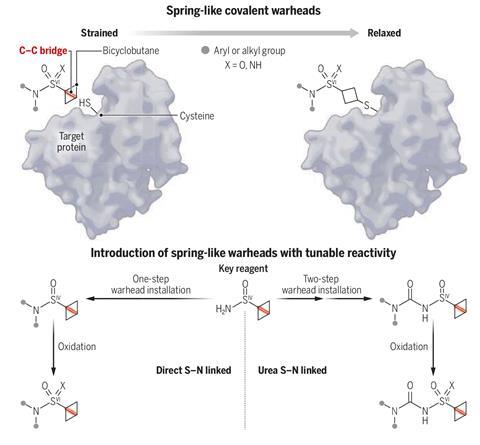
Introducing Justin Lopchuk and his team at the H. Lee Moffitt Cancer Center and Research Institute, who have presented a groundbreaking approach to designing warheads using BCBs—specifically, sulfonamide- and sulfonimidamide-bicyclobutane groups. With BCBs, their reactivity is such that they preferentially interact with cysteine. The allure of BCBs originates from their strained molecular structure, functioning akin to a compressed spring, which releases energy and instigates swift reactions suitable for covalent inhibition. The researchers faced considerable hurdles, as no existing reagents permitted a gentle, late-stage addition of sulfur(VI)-bearing sulfonamide- and sulfonimidamide-BCBs to amines on pharmaceutical compounds, chiefly due to their increased reactivity.
The breakthrough was marked by a transition to utilizing sulfur(IV) reagents, which made BCBs less reactive and appropriate for late-stage functionalization. This method involved initially introducing the sulfur(IV) reagent to the amine, followed by oxidation or oxidative amination to form the reactive sulfur(VI)-based warhead on the pharmaceutical. Experimental outcomes reveal that BCB warheads exhibited superior selectivity and fewer off-target effects compared to traditional acrylamide-based counterparts. A BCB sulfonamide variant of the cancer treatment dacomitinib effectively diminished tumors in mice, demonstrating comparable efficacy.
Commenting on this progress, Elena De Vita from Queen Mary University of London praised the milestone, underscoring the potential for broader application of BCB warheads in covalent drug variants. She foresees a rapid adoption of sulfonyl and sulfonimidoyl BCBs in both academic and industrial research, particularly as the sulfur(IV) reagents utilized in this research become commercially accessible.
To harness this breakthrough, Lopchuk and two colleagues have founded Thyora Therapeutics, a startup dedicated to developing new medicines. According to Lopchuk, their initiative seeks to provide access to a broader spectrum of BCB-containing chemical space, aiding drug discovery efforts. The aim is for the BCB technology to be quickly translated into the development of novel small molecules, offering patients more targeted and safer treatments, especially in oncology and potentially beyond.