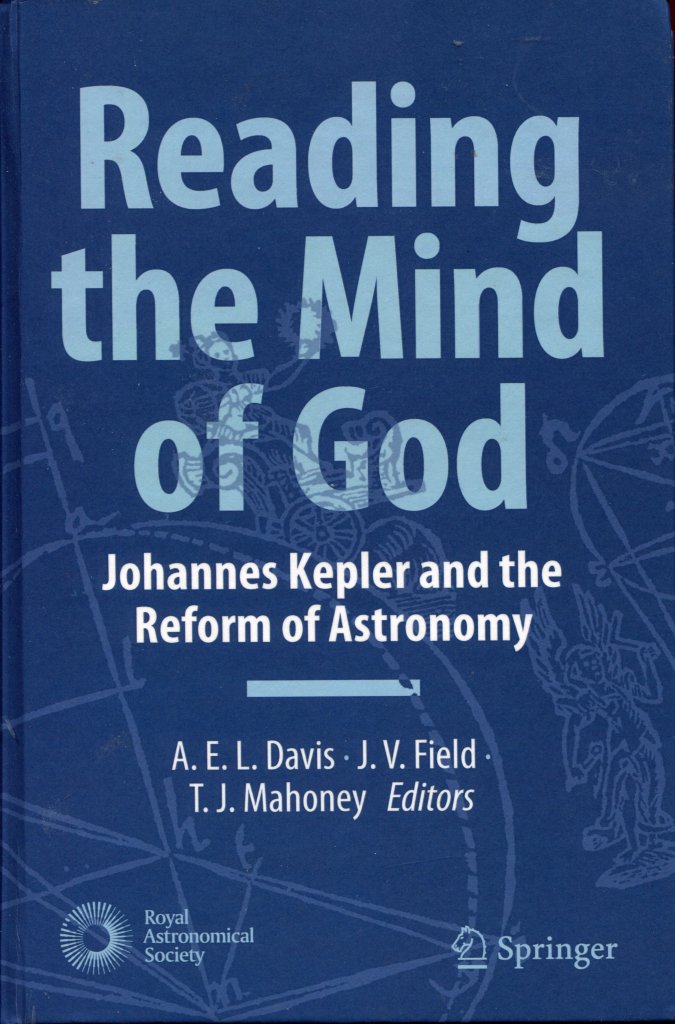
**Interpreting the Divine Intellect: Johannes Kepler and the Transformation of Astronomy**
Johannes Kepler, frequently eclipsed by peers like Galileo Galilei, played a crucial role in the evolution of modern science during the seventeenth century. In spite of his notable contributions, literature focusing on Kepler remains limited when compared to that of Galileo or Newton. The newly released “Interpreting the Divine Intellect: Johannes Kepler and the Transformation of Astronomy,” edited by A. E. L. Davis, J. V. Field, and T. J. Mahoney, aims to rectify this disparity. This volume serves as a thorough overview of research concerning Kepler, designed to enhance the accessibility of his work for both astronomers and students, extending beyond the niche history of science texts.
**Overview and Main Themes**
The book opens with an introduction that places Kepler within the historical context of science, underscoring his contributions to astronomy, optics, mathematics, music, and astrology. It prepares the reader for the chapters that follow by outlining Kepler’s research methods and his perspectives on calendar reform.
**The Theological and Cosmological Basis of Kepler’s Work**
Charlotte Methuen’s article, “Kepler, Religion and Natural Philosophy: A Theological Biography,” investigates the theological foundations of Kepler’s scientific endeavors. Methuen conveys Kepler’s perception of God as a mathematical being, which fueled his mission to uncover the logical framework of creation. Subsequently, J. V. Field’s “Kepler’s Cosmology” examines Kepler’s theological inspirations through his texts “Mysterium Cosmographicum” and “Harmonice Mundi,” which weave together mathematics, music, astrology, and astronomy.
**Tycho Brahe’s Impact and the Discovery of Planetary Orbits**
T. J. Mahoney’s “Measuring the Heavens: How Tycho Brahe Revolutionised Observational Astronomy” presents a succinct account of Tycho Brahe’s life and the essential observational data that facilitated Kepler’s astronomical advancements. A. E. L. Davis’s chapter, “Kepler’s Discovery of the Planetary Orbit: The Goldilocks Solution,” delivers a technical examination of Kepler’s path to formulating his first two laws, which may pose challenges for those unfamiliar with the subject.
**Transitioning from Astronomy to Astrology and Optics**
Andrew Gregory addresses the debate surrounding the translation of Kepler’s “Astronomia nova,” while Sheila J. Rabin investigates Kepler’s contributions to astrology. A vital chapter by W. H. Donahue, “Kepler’s Work on Optics,” emphasizes Kepler’s substantial influence in the domain of optics. J. V. Field’s article, “Kepler and Galileo,” explores their intricate relationship and the debates surrounding comets after 1618, while also questioning the assumed superiority of Galileo’s methodology in this scenario.
**Subsequent Contributions and Legacy**
J. V. Field’s “The Long Life of the Rudolphine Tables” commends Kepler’s efforts in forecasting planetary movements. Jay M. Pasachoff’s chapter relates Kepler’s work to contemporary astronomical observations, including the Kepler Spacecraft mission. Eberhard Knobloch assesses Kepler’s mathematical contributions, acknowledging the practicality behind Kepler’s mathematical endeavors.
**Posthumous Works and Translation Efforts by Kepler**
Jarosław Wloarczyk’s analysis of “Kepler’s Dream and Lunar Astronomical Phenomena” sheds light on Kepler’s aims to depict a heliocentric model. W. H. Donahue’s concluding chapter, “On Translating Kepler,” uncovers the challenges and justifications for the scarcity of translations of Kepler’s works prior to the twentieth century.
**Final Thoughts**
The book wraps up with an exhaustive timeline of Kepler’s life, a glossary, and an index for additional reading, rendering it a crucial addition to Keplerian studies. Although its original cost may be daunting for some, Springer provides a discounted option, making this enlightening work more available. “Interpreting the Divine Intellect” ultimately offers a richly detailed analysis of Kepler’s life and his significant impact on the scientific domain.