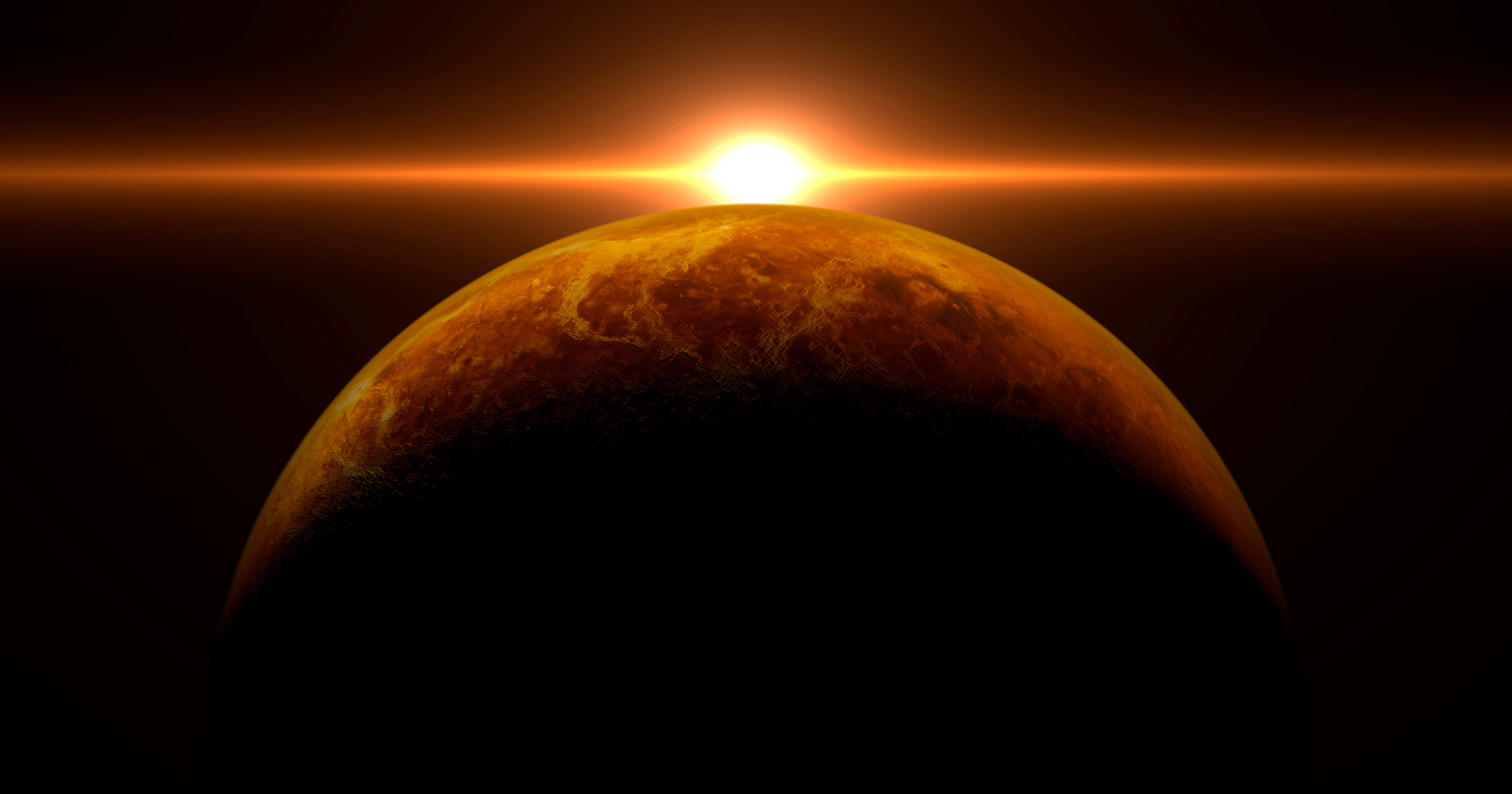
When the Soviet Venera 13 lander arrived on Venus in 1982, it operated for 127 minutes before the planet’s conditions overwhelmed it. The surface environment of Venus is so extreme that it can destroy equipment within hours, with the maximum functioning time for a successful Soviet lander limited to just a few hours.
Venus exhibits a duality, characterized by two contrasting environments. The surface is excruciatingly hot and under immense pressure, whereas fifty kilometers up, the conditions resemble those on Earth.
The Surface: A Scorching Hell
Venus boasts an average surface temperature of roughly 467°C, surpassing that of Mercury, the Sun’s nearest planet. This temperature exceeds the capabilities of a typical kitchen oven by over 200°C, highlighting the overwhelming heat of Venus.
In addition to this extreme heat, the atmospheric pressure is about 93 times that of Earth’s sea level, which is comparable to being over 3,000 feet underwater. Moreover, the atmosphere consists of 96% carbon dioxide, rendering it uninhabitable for humans.
Causes of the Venusian Heat
Even though Venus orbits the Sun closer than Earth does, it is not this proximity that results in its high temperatures. A runaway greenhouse effect is responsible, with the thick carbon dioxide atmosphere trapping vast amounts of heat. This heating process ensures that despite a Venusian day lasting 117 Earth days, surface temperatures remain fairly constant.
Research, including climate modeling from NASA led by Michael Way at the Goddard Institute for Space Studies, indicates that Venus may have once supported a shallow liquid-water ocean and more temperate conditions for up to two billion years. However, findings from the University of Chicago and a subsequent Nature Astronomy study challenge this, leading to ongoing debates regarding Venus’s early climate.
An Earth-like Upper Atmosphere
Ascending 50 kilometers from the surface of Venus shows a dramatic change in conditions. In this layer, temperatures fluctuate between 30 to 70 degrees Celsius, and the atmospheric pressure resembles that at Earth’s surface. NASA’s investigations and findings suggest this could be the most Earth-like environment beyond our planet.
This idea inspired NASA Langley’s HAVOC airship concept, which aims to study Venus by floating in its appealing upper clouds without landing.
The Reality of the Cloud Layer
Despite the Earth-like conditions of temperature and pressure, survival is still problematic. This region is situated within sulfuric acid clouds, positioned 45 to 70 kilometers above the surface. A human without adequate protection would not endure the corrosive, unbreathable atmosphere, although pressure resistance would not be a concern.
This upper-atmospheric layer has ignited speculation about the possibility of microbial life. NASA points out that extremophiles on Earth, which thrive in acidic environments, could potentially survive here. However, this conjecture is yet to be substantiated and remains a subject for further investigation rather than a definitive sign of life.
Venus does not present just one environment but rather a dual one; a blazing furnace is hidden beneath a cloud layer resembling Earth. The daunting surface alongside the intriguing possibility for life in the upper atmosphere makes Venus a planet of considerable interest and enigma.