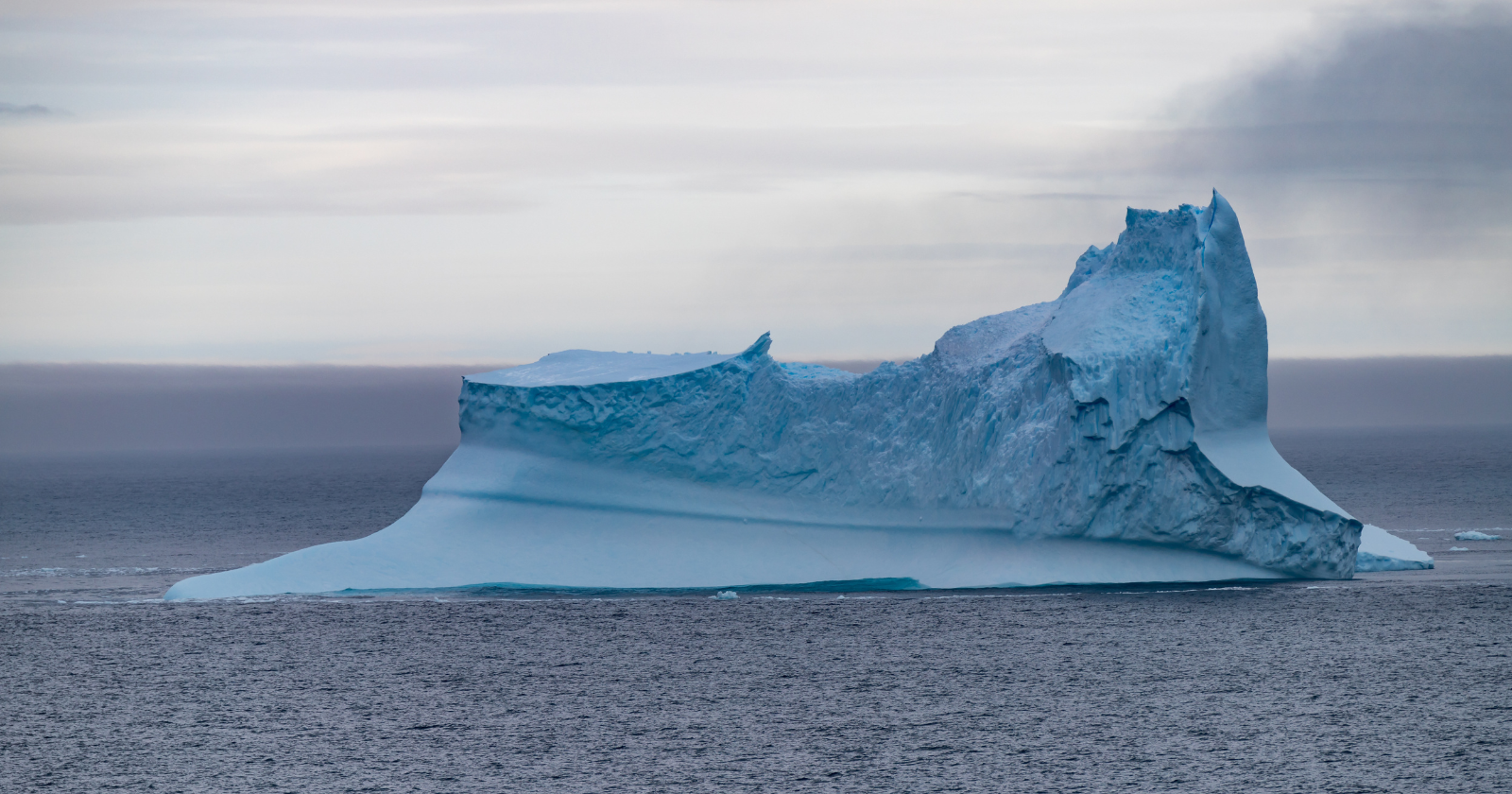
The two-ton block of ice made its way to the Iowa State Memorial Union via a refrigerated truck. It had been sourced from the Portage Glacier near Anchorage a few days prior by a team of US Navy scuba divers, retrieved by helicopter, flown to Anchorage airport, placed on a commercial flight to Minneapolis, and finally transported the last three hundred miles to Ames. The conference’s organizer was a 42-year-old Saudi prince named Mohammed bin Faisal, son of the sitting king and leader of Saudi Arabia’s Saline Water Conversion Corporation.
Delegates arriving in Ames on October 2, 1977, for the First International Conference on Iceberg Utilization were welcomed with chips from the two-ton iceberg chilling their beverages. The drinks served were apricot nectar, honoring the prince’s religious practices. Larger pieces of Portage Glacier ice were somewhat clumsily arranged in punchbowls. The ice was around 4,000 years old.
The prince’s intentions were not purely for amusement. He aimed to make a point.
## Why a prince was importing icebergs to Iowa
Mohammed bin Faisal had spent the last decade overseeing Saudi Arabia’s national desalination initiative. At the time of the Iowa conference, he was arguably the individual who had made the most significant strides globally in industrializing the process of converting seawater into drinking water. Saudi Arabia’s capability to support a contemporary population in a region lacking nearly all natural fresh water was, and continues to be, directly attributable to the desalination infrastructure he established.
He was also acutely aware, from firsthand experience, of the high expenses associated with desalination.
Removing salt from seawater necessitated significant energy expenditures. In Saudi Arabia, this energy was derived from burning oil — oil that the nation was otherwise marketing internationally for hard currency. Each gallon of desalinated water represented, in effect, a gallon of lost oil revenue, in addition to the considerable capital and operating costs tied to the desalination facility. As Saudi Arabia’s population expanded, so did the demand for water and the specific economic burden of operating desalination on a large scale.
Mohammed bin Faisal was seeking alternatives. During the late 1970s, one particular alternative was gaining traction among a select group of engineers globally: capturing the vast amounts of freshwater that were currently draining uselessly into the ocean each year as icebergs broke away from Antarctica and Greenland.
The calculations were compelling. A single large Antarctic iceberg contains more freshwater than many cities consume in a year. If it could be reliably towed to a coastal country dependent on desalination, insulated to minimize melting during transit, and then melted gradually at the destination, the resulting water could, in principle, be more economical than desalination.
The specific initiative that Prince Mohammed was advocating called for an 85-million-ton Antarctic iceberg to be towed approximately 5,000 miles through the Indian Ocean and Red Sea to Saudi Arabia. The estimated cost: around 90 million dollars.
## What actually happened next
The plan did not materialize.
At the conclusion of the Iowa conference, the prince informed the delegates: “We can accomplish this if we invest the effort. Perhaps we will tow an iceberg within three to five years.” A Time magazine article from the same month quoted him forecasting that an iceberg would arrive in Arabia within three years.
Neither scenario unfolded. The specific engineering challenges associated with towing a hundred-million-ton floating block of freshwater 8,000 kilometers across warm equatorial waters proved to be far more complex than initial models suggested. The insulation challenge was particularly daunting. Any covering capable of enduring the journey, preserving enough of the iceberg while it spent weeks in tropical waters, and remaining economically viable on a large scale had yet to be developed. The propulsion issue was also significant — no available tugboat could haul a mass of that magnitude at any reasonable speed against actual ocean currents.
French engineer Georges Mougin, a member of Prince Mohammed’s original team, continued to work on the challenge quietly for the following thirty years. He never quite let it go. In 2011, utilizing 3D modeling software, updated satellite-derived ocean current data, and improved insulation materials that didn’t exist in the 1970s, he conducted new simulations. His findings, presented at various technical conferences, indicated that iceberg transport was more viable than had been demonstrated in the 1977 attempt — but still costly, still risky, and still requiring specific political and financial dedication that no nation had been prepared to commit.
The concept quietly fell into the same category as ocean thermal energy conversion and salt-dome compressed air storage: technically feasible, economically tenuous, and unfashionable enough that no significant investment was made.
## Why the idea is being looked at again
The particular reasons for the resurgence of interest in the idea deserve clarification.
Desalination has not become more affordable as quickly