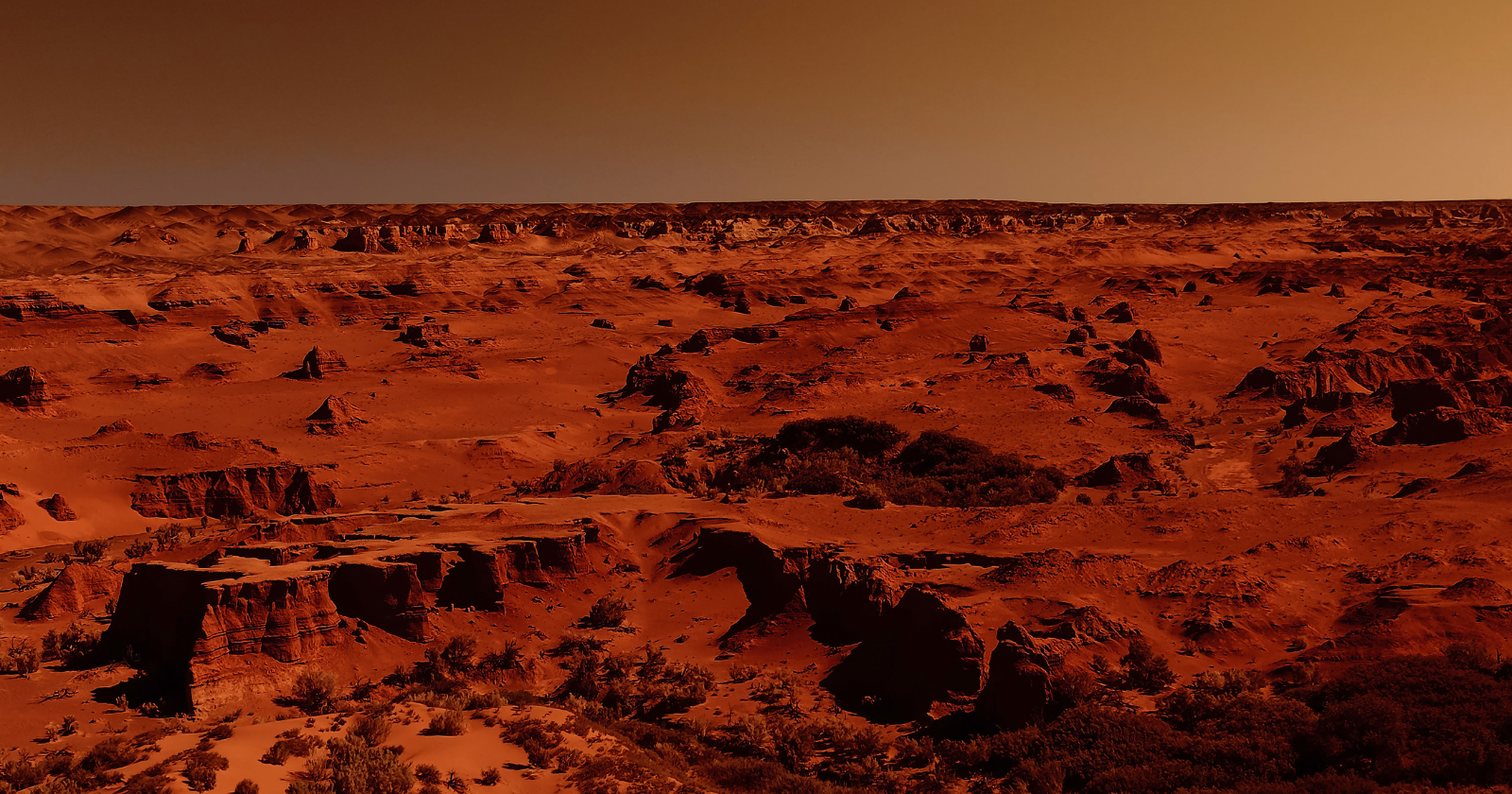
Somewhere within Jezero Crater, on an April evening in 2021, a gold container about the dimensions of a toaster let out a breath.
Not much emerged. Approximately 5.4 grams of oxygen, which NASA’s Jet Propulsion Laboratory estimated could sustain an astronaut for around ten minutes of typical activity. No visible plume, no audible sound, nothing that a camera could have captured. Simply a machine exhaling during the initial hour of its existence, a few hundred million kilometres away from anyone interested.
That container was MOXIE, the Mars Oxygen In-Situ Resource Utilization Experiment, which had made history as the inaugural device to generate a usable resource on another planet’s surface.
## The process of generating oxygen from Martian air
Mars possesses an atmosphere that is thin, frigid, and roughly 95 percent carbon dioxide. That may seem utterly inhospitable until you recall the composition of carbon dioxide. One carbon atom, two oxygen atoms. Break the bond, and the oxygen is readily available.
MOXIE accomplished this separation through solid oxide electrolysis: heating the gas to approximately 800 degrees Celsius, and then using electricity to detach a single oxygen atom from each CO2 molecule. Oxygen was produced on one end, while carbon monoxide was released on the other. A team at MIT’s Haystack Observatory, under the leadership of Michael Hecht, the mission’s principal investigator, dedicated years to compacting this concept into a box capable of enduring a launch, seven months in deep space, and a landing.
Nothing was retained. Each operation was assessed for volume, purity, and efficiency, then immediately expelled back into the atmosphere from which it originated.
## The substantial aspect of returning home is the oxygen
Rockets require fuel, along with an oxidizer, because combustion without oxygen leads to nowhere. As they ascend from Mars, there is no available air to utilize along the way.
Hecht provided the figures to MIT News: lifting four astronauts off Mars’s surface would necessitate approximately seven tonnes of rocket fuel and twenty-five tonnes of oxygen. The breathability contributes minimally in comparison. A crew spending a year on the planet might only consume a single tonne collectively.
Thus, the oxygen dilemma is fundamentally a launch issue. Transporting twenty-five tonnes from Earth entails a colossal, costly, and precarious delivery operation arriving prior to any crew. Generating twenty-five tonnes on-site implies a smaller spacecraft and a reduced catalog of potential catastrophic failures.
## Sixteen operations, every season, every hour of the day
“The atmosphere of Mars varies significantly more than it does on Earth.”
This was deputy principal investigator Jeffrey Hoffman, clarifying why the team consistently manipulated the conditions affecting their own instrument. Mars’ air density can decrease by half throughout the year. Temperature variations can reach a hundred degrees. A device that operates smoothly at noon in summer and fails at midnight in winter is a device that no rational person would trust for a crew’s return journey.
Therefore, MOXIE operated during daylight and darkness, throughout different seasons, and after dust storms. NASA’s two-year progress reports highlight a peak performance of 10.56 grams per hour in November 2022, achieved by adjusting voltage instead of current across the electrolysis cells, a modification made partly for safety at high outputs.
When it finally powered down on 7 August 2023, MOXIE had completed sixteen runs and produced a total of 122 grams of oxygen. According to JPL’s final summary, this is roughly equivalent to what a small dog inhales over ten hours. Its peak output reached 12 grams per hour at a purity of 98 percent or better, double what the agency initially requested.
## One publication, seven runs, one cautious assertion
The peer-reviewed study of MOXIE’s initial performance, published in Science Advances in 2022 by Hoffman, Hecht, Donald Rapp, and a long list of co-authors, only covers the first seven operations through the end of 2021, and characterizes the instrument as the first demonstration of in-situ resource utilization on a different planet.
One paper regarding one instrument. What it confirms is that the chemistry is valid when faced with authentic Martian air rather than a simulation chamber in Massachusetts. This constitutes a more focused and significantly more valuable finding than anything incorporating the term colony.
A larger successor, as outlined in the accompanying MIT article, would need to function continuously at the oxygen generation rate of several hundred trees, land on Mars years before any astronauts arrive, and operate with the closest technician being a planet away. Hecht has informed My News 13 that a practical offspring would be the size of a washing machine, not a toaster.
## Nobody inhaled a molecule of it
Every gram MOXIE produced returned to the Martian atmosphere within hours. Unused, unburned, unstored. As a demonstration, it exceeded its own expectations. As a source of anything usable, it was rendered ineffective by design. That was always the goal.
MOXIE fulfilled every technical