A recent advancement in the domain of metal-organic frameworks (MOFs) offers promising alternatives for energy-saving heating and cooling systems, potentially revolutionizing our approach to managing building temperatures worldwide. Importantly, researchers have created a MOF capable of operating in diverse climates without the need for conventional electrical inputs, opening doors to sustainable thermal technologies.
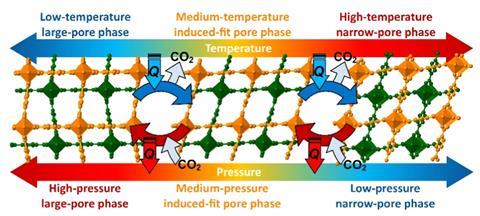
In a pivotal 2022 finding by scientists at the University of A Coruña in Spain, a MOF displayed shape-altering characteristics during carbon dioxide adsorption and desorption, causing temperature fluctuations. This initially happened with changes in pressure, but further investigations have shown that even stable pressure conditions can enable the MOF to autonomously manage heat storage in reaction to external temperature changes. This ‘reverse’ process allows the MOF to release carbon dioxide on hot days, creating a cooling effect, while at night, it reabsorbs the gas, emitting heat to elevate the surroundings’ temperature.
Such revelations are changing the way MOFs are utilized, as stated by Claire Hobday, a solid-state refrigeration specialist from the University of Edinburgh. She notes that the application of a constant gas pressure triggers an endothermic phase transition in the MOF upon heating, resulting in a cooling effect that can be precisely adjusted to satisfy varying thermal requirements by manipulating the static pressure.
This adaptability tackles the issue of versatility across different climates, which existing technologies often face, typically necessitating specific transition temperatures dictated by the energy demands of phase transitions. The pressure responsiveness of these MOFs permits noteworthy modifications to transition temperatures within a spectrum of -30°C to 120°C, significantly surpassing conventional thermal storage technologies.
The potential uses of this technology range from residential climate management to industrial applications. The MOF is capable of collecting heat at lower temperatures, storing it effectively, and subsequently releasing it at elevated temperatures, providing a budget-friendly approach to thermal energy management.
To aid in the identification of new MOFs with analogous properties, the research team has fine-tuned a mathematical model to examine existing literature for suitable candidates. This, along with resources such as the National Institute of Standards and Technology’s MOF adsorption isotherm catalog, allows for comprehensive investigation into the refrigerant capabilities of MOFs.