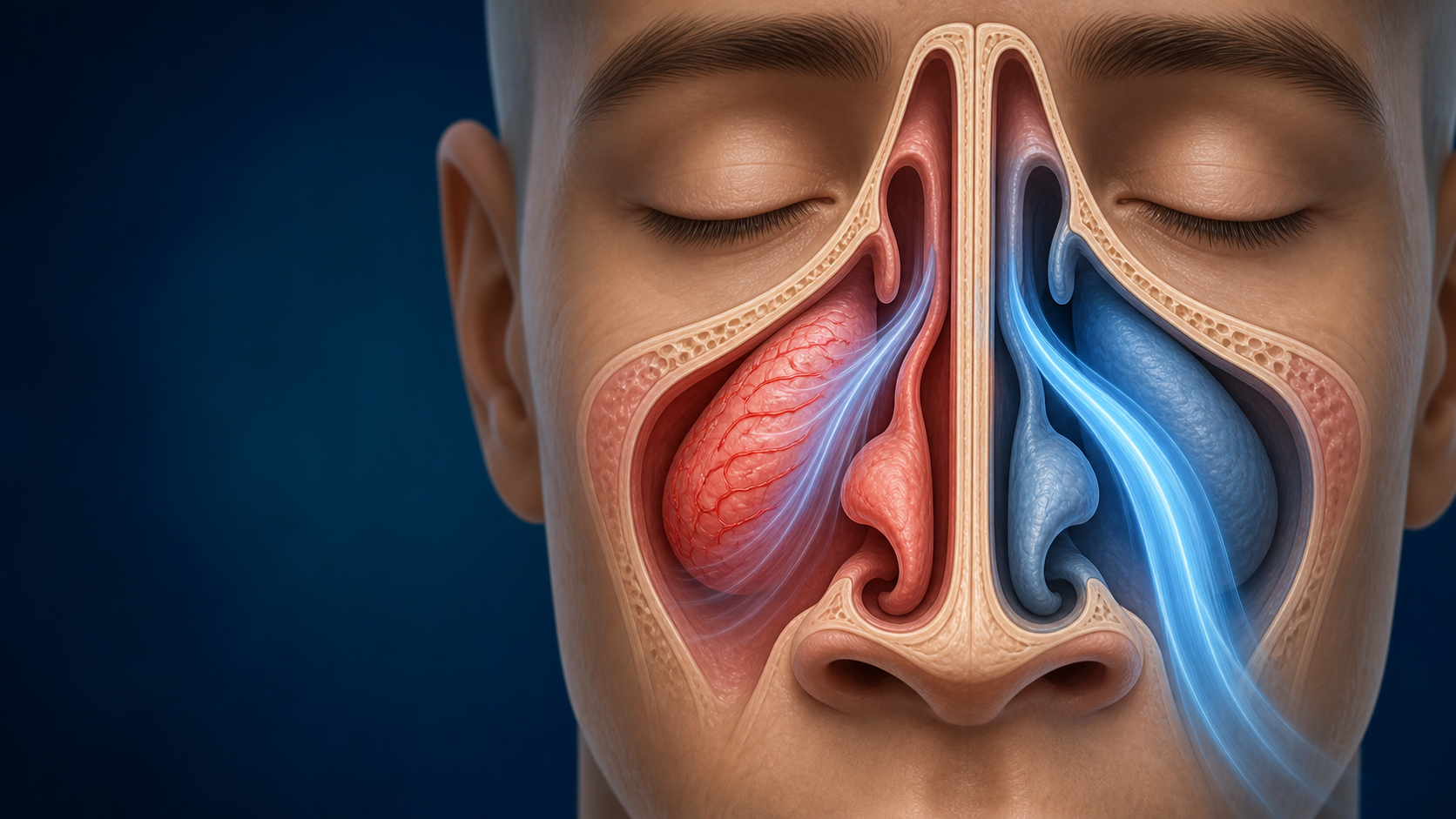
Placing a finger beneath your nostrils while breathing in a typical manner can uncover an intriguing occurrence: the airflow might frequently feel more forceful on one side, even in the absence of external factors such as physical activity or nose clearing. This variation is usually genuine and part of a natural cycle where balance may fluctuate unexpectedly.
The nasal cycle is this common biological process where one nostril becomes comparatively blocked while the other clears. It primarily involves a shift in the blood volume contained in the expandable vascular tissue within the nose, rather than mucus transferring between sides. Normal physiology indicates it is not a medical condition, and its frequency and visibility can differ among people.
The Turbinates Are Not Static Platforms
Curved bony extensions referred to as turbinates or nasal conchae in each nasal pathway enhance the surface area for warming, moistening, and filtering the air that enters. The largest of these, the inferior turbinate, has a robust mucosal covering along with a submucosal layer of erectile tissue. This tissue can expand or contract, affecting the volume of the turbinate and the resistance of the airway.
Here, “erectile” is an anatomical descriptor. When venous spaces on one side fill with additional blood, the lining becomes thicker, decreasing the space for airflow. Conversely, on the opposite side, vessel constriction reduces the tissue volume, allowing for easier passage. It represents a dynamic equilibrium, with asymmetry generally unnoticed unless intentionally examined, during relaxation, or when extra swelling occurs from cold or allergies.
A Cycle Can Span Minutes or Hours
The unpredictable essence of this cycle is encapsulated in the term “hours later.” A review from 2018 suggested that the duration of phases ranges from about 30 minutes to six hours. This cycle is observed in roughly 70 to 80 percent of healthy adults, though not necessarily in perfect alternation. Observations indicate asymmetrical phases, irregular transitions, and simultaneous changes between sides.
A study in 2016 with 33 healthy adults found that, while awake, average dominance durations were 2.63 hours for the left nostril and 2.17 hours for the right, extending to approximately 4.5 hours during sleep. These averages do not represent strict schedules but rather general trends due to the limited sample size.
Autonomic Signals Regulate the Blood Vessels
The sympathetic and parasympathetic divisions of the autonomic nervous system manage nasal blood vessels. Sympathetic signals facilitate decongestion through vessel constriction, while parasympathetic activity encourages vasodilation. These alternating messages contribute to the resistance characteristics.
While the regulation of blood vessels is thoroughly studied, pinpointing the cycle’s pacemaker remains less clear. The cycle’s continuation, even with interrupted nerve pathways, indicates no singular control mechanism. Research has identified left-right variances in biological-clock gene expression in nasal tissues, suggesting local timing may play a role without confirming it as the primary driver.
Changing Position Can Alter the Flow
Body posture affects airflow dominance, with research indicating heightened flow through the upper nostril when lying on one side. This helps clarify the sensation of nasal congestion shifting during position changes in bed.
Numerous elements, including exercise, sleep, temperature variations, hormones, inflammation, and medications, can influence the dimensions of the nasal lining, sometimes overriding the established rhythm. While colds or allergies do not initiate the nasal cycle, they can enhance its visibility.
Its Function Is Plausible, Not Definitive
The turbinates’ function in conditioning air before it reaches the lungs gives rise to theories regarding the cycle’s purpose. One theory suggests that alternating high-flow sides allows time for the congested lining to replenish moisture and facilitate mucociliary clearance. Another theory proposes that varying flow rates influence the deposition of odor molecules, possibly enhancing scent detection.
Both theories have experimental backing but lack conclusive evidence. The 2018 review recognized the ongoing ambiguity about the cycle’s purpose despite extensive academic focus. Therefore, it is prudent to regard this alternation as a modification in air conditioning and odor delivery, without definitively attributing it to evolutionary design.
A Switching Nostril Differs from a Constantly Blocked One
Normal nasal cycling typically does not raise concerns. Continuous blockage, recurrent bleeding, and pain should be clinically assessed, as they indicate issues such as a deviated septum, polyps, or enlarged turbinates, rather than mere nasal cycling. For the majority, unequal airflow reflects the flexible, vascular character of the nasal system.