Sunlight is luminous, plentiful, and notoriously unpredictable. A laser is focused, directional, and coherent, which is why it has traditionally been the benchmark source for generating entangled photons. In a recent experiment, scientists gathered daylight, isolated a slender violet segment, and utilized it to initiate the same nonlinear process. The outcome was a pair state with 93.9% fidelity to the ideal Bell state they aimed for.
The peer-reviewed study published in Optica serves as an impressive proof of principle, but its two main figures necessitate different interpretations. Fidelity refers to the quality of the reconstructed quantum state and does not represent the fraction of sunlight transformed into photon pairs. The stated efficiency becomes comparable to a laser only after considering the distinctly different pump bandwidths.
What the 94% result truly measures
The researchers reconstructed the two-photon state using coincidence counts collected across 16 polarization settings. Its fidelity to the intended Bell state was 0.939, with an uncertainty of 0.027. When rounded to a percentage, this amounts to 94% ± 2.7 percentage points. Additionally, they reported a concurrence of 0.905 ± 0.053 and a purity of 0.919 ± 0.045.
These measurements address related but separate questions. Fidelity assesses how closely the measured state aligns with the desired maximally entangled state. Concurrence measures the level of entanglement on a scale from zero to one. Purity indicates how much the reconstructed output resembles a singular clean quantum state instead of a statistical mixture. Together, they characterize highly entangled, comparatively low-noise photon pairs.
They do not indicate that 94% of incoming solar photons became functional pairs. A significant portion of sunlight never achieved this stage due to collection losses, filtering, polarization, and the strict phase-matching demands of the crystal. The 94% figure pertains to state quality among the detected pairs, not energy conversion or yield.
How the researchers converted daylight into a quantum pump
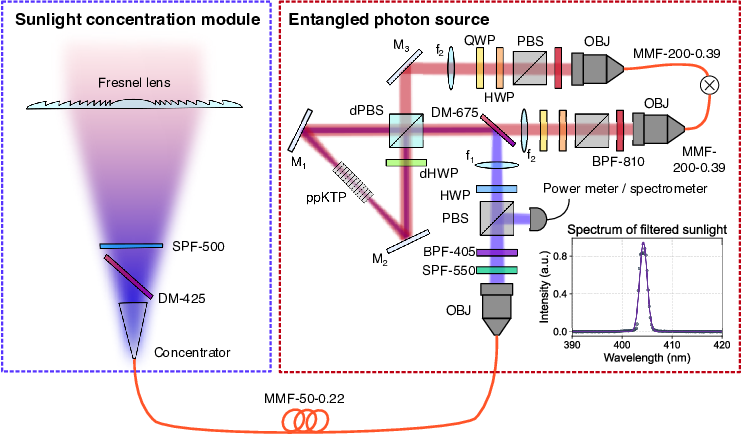
This was not merely a crystal sitting in a sunbeam. The team harnessed direct sunlight with a 1 by 1.4 metre Fresnel lens covered by color films, then used a short-pass filter, a dichroic mirror, and a specialized glass concentrator. A multimode fiber with a 50-micrometer core transported the selected light to the photon source.
There, filters narrowed the spectrum to 405 nanometers with a bandwidth of 1.5 nanometers. Polarization optics prepared equal horizontal and vertical components before the beam entered a periodically poled potassium titanyl phosphate crystal inside a polarization Sagnac interferometer. Through spontaneous parametric down-conversion, some 405-nanometer pump photons generated pairs near 810 nanometers. The comprehensive experimental report details the optics and measurements recorded over three separate days.
The source bypassed an electrically powered pump laser, but this does not equate to an electricity-free quantum device. The crystal still required temperature regulation to uphold phase matching. The avalanche photodiodes, time-tagging electronics, power meter, and solar-tracking apparatus also necessitate support within a functional system. The accomplishment specifically denotes a sunlight-pumped entangled-photon source.
For each polarization projection, the team gathered data for two minutes and searched for paired detections within a one-nanosecond coincidence window. After normalizing for the variable sunlight power, the average was around 10 coincidences per minute for every 100 nanowatts of pump power. Counts significantly outside the expected arrival-time peak were nearly zero, suggesting minimal accidental background.
Why incoherent light can still yield entanglement
Sunlight is spatially and temporally incoherent. At first glance, this seems incompatible with entanglement, but the relevant degree of freedom is crucial. Pump coherence in one degree of freedom constrains the entanglement achievable in that same domain. In this case, the target entanglement was in polarization, while sunlight’s most evident disorder was spatial and spectral-temporal.
The researchers filtered and polarized the light, then arranged two down-conversion pathways such that the detectors could not discern which path produced a pair. Their superposition formed the polarization-entangled state. Previous work had demonstrated that a broadband free-running diode source could generate high-quality polarization-entangled pairs. The conceptual avenue to less coherent pumps was established prior to this experiment; the first claimed here is natural sunlight facilitating polarization-entangled SPDC.
This distinction is significant. The result does not negate the utility of lasers, whose directionality, stability, and tunability remain immensely valuable. It illustrates that laser-like coherence is not a universal requirement for every form of photonic entanglement.
The Bell test provided a secondary verification
State tomography reconstructed the density matrix, but the team also evaluated the correlations employing the Clauser-Horne-Shimony-Holt version of Bell’s inequality. Local classical descriptions are limited by S = 2. The sunlight experiment yielded S = 2.5408 ± 0.2171, surpassing that threshold by 2.49 standard deviations.