Few concepts in physics have experienced a stranger trajectory than the cosmological constant. Albert Einstein introduced it in 1917 to maintain a static universe, abandoned that intention after the acceptance of cosmic expansion, and subsequently watched as the same mathematical term evolved into the simplest explanation for accelerating expansion.
A May 2026 analysis from the Dark Energy Survey adds yet another twist. By integrating various approaches to measure the universe’s expansion and growth, the collaboration detected a slight inclination towards dark energy that varies over time rather than remaining unchanged. The signal achieves 3.0 standard deviations in its most comprehensive data combination. While this is intriguing, it does not meet the five-sigma threshold that physicists require for a definitive discovery.
## Why Einstein introduced lambda in 1917
Einstein’s original field equations permitted a dynamic universe. However, the dominant conception was of an eternal and unchanging cosmos. In his [1917 cosmology paper](https://cds.cern.ch/record/632340), Einstein appended a term symbolized by the Greek letter lambda. Its repulsive effect could counteract the gravitational attraction of matter, creating a finely balanced static model.
This balance was unstable, and observations soon favored an expansionist model. Einstein abandoned the static concept. The popular tale suggests he later deemed the cosmological constant his greatest blunder. While this reflects his eventual dissatisfaction with the added term, the quote originates from physicist George Gamow’s later reminiscence. A [historical inquiry into the statement](https://arxiv.org/abs/1310.1033) uncovered no existing document in which Einstein used those precise words.
Thus, the popular narrative is overly simplistic. Einstein introduced lambda for a universe that does not match ours and subsequently viewed the independent extra term as unattractive. Whether he actually uttered the iconic one-liner as Gamow recalled remains uncertain.
## Acceleration revived the old term
By the late 1920s, measurements of galaxy redshifts and theoretical advancements had confirmed an expanding universe. Most physicists anticipated that gravity would decelerate that expansion. However, two research teams studying distant Type Ia supernovae discovered in 1997 and 1998 that the expansion was accelerating. Saul Perlmutter, Brian Schmidt, and Adam Riess later shared the [2011 Nobel Prize in Physics](https://www.nobelprize.org/prizes/physics/2011/popular-information/) for this breakthrough.
A positive cosmological constant provided the large-scale gravitational behavior that the measurements indicated. In contemporary terms, it can be regarded as a constant energy density of empty space exerting negative pressure. It became lambda in the Lambda Cold Dark Matter model, or ΛCDM, alongside ordinary matter and cold dark matter.
However, this resurgence did not imply that physicists comprehended lambda. Simple quantum-field calculations of vacuum energy disagree significantly with the minuscule value inferred from cosmological observations. Moreover, the term dark energy does not identify a specific substance. It designates whatever causes accelerated expansion, with a cosmological constant serving as the simplest candidate.
## What the 2026 Dark Energy Survey analysis merged
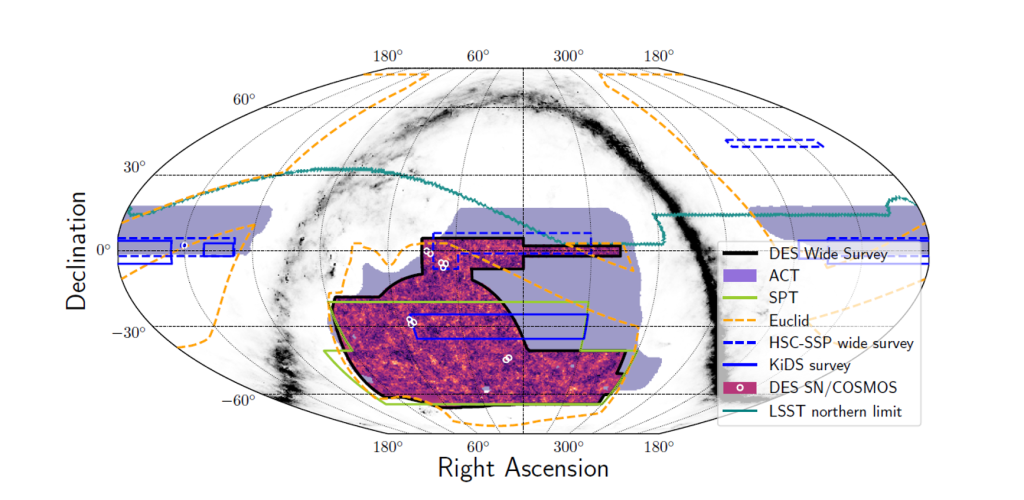
The new finding is from a 2026 analysis, not a sequence of observations first gathered this year. The Dark Energy Survey employed a 570-megapixel camera in Chile over 758 nights from 2013 to 2019, capturing images of 669 million objects across approximately one-eighth of the sky. Its final project amalgamated Type Ia supernova distances, baryon acoustic oscillations, weak gravitational lensing, and galaxy clustering.
The collaboration’s [dynamical-dark-energy paper](https://arxiv.org/abs/2605.27221), submitted in May 2026 and slated for publication in Physical Review Letters, explores whether all those growth and geometry probes favor a time-varying equation of state. The [official Year 6 results page](https://www.darkenergysurvey.org/des-y6-cosmology-results-papers/) outlines the primary fits and links to the supporting analyses.
Each probe reveals a different facet of the same history. Supernovae provide relative distances, whereas baryon acoustic oscillations serve as a standard ruler. Galaxy clustering monitors how matter accumulated, and weak lensing assesses the gravitational distortion of background galaxies. Consistency across these methodologies is significant, as an observational bias affecting one may not influence the others in the same manner.
Scientists quantify dark-energy behavior with w, the ratio of pressure to energy density. A cosmological constant has w = -1 at every moment. The tested extension expresses w(a) = w0 + wa(1-a), where a tracks the universe’s expansion. Lambda corresponds to w0 = -1 and wa = 0. Allowing both parameters to fluctuate provides more flexibility in the data but also heightens the standard for determining whether the added complexity is warranted.
## How distant the result is from a constant
Utilizing only Dark Energy Survey probes, the collaboration derived w0 = -0.84 ± 0.10 and wa = -0.44, with an uncertainty of roughly