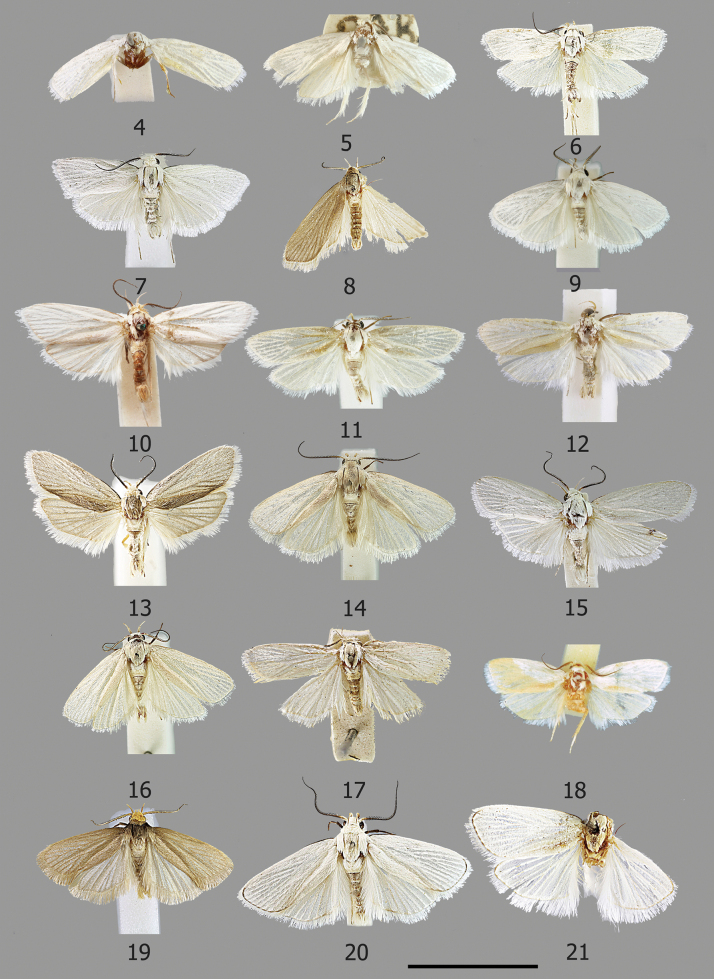
By the time Edward Meyrick investigated a small white moth at London’s Natural History Museum, someone had already attempted to restore it with incorrect wings. The specimen was missing its head and abdomen, and hindwings from another species of moth had been affixed to its existing forewings. Meyrick, an authority in this field, examined it twice in 1927 and expressed a judgment that was eventually published: “better neglected.”
Such a conclusion was reasonable given the tools available at that time. However, it turned out to be significantly temporary. A 2025 update in ZooKeys utilized information hidden in the labels and DNA retrieved from a fragment of one remaining leg to determine the moth’s identity. This damaged specimen was revealed to be part of an Alfred Russel Wallace collection from Sarawak, serving as the historical basis for a genus that now includes 14 species, 11 of which have been newly described.
The ancient moth did not by itself generate 11 species. Researchers Mark Sterling, Ben Price, and David Lees examined numerous specimens, fine anatomical details, and various forms of genetic evidence. What the 1850s specimen provided was the essential link between a name established in 1863 and intact moths gathered over a century later.
## A type specimen that taxonomy could hardly utilize
Francis Walker classified Topiris candidella in 1863 based on a unique specimen. This established it as the holotype by monotypy: the physical reference that permanently corresponds with the species name. As the Natural History Museum clarifies in its guide on the significance of type specimens, subsequent researchers must have the ability to compare other organisms with that name-bearing reference.
This comparison became almost impossible as the moth deteriorated. Today, it comprises the pin, part of the thorax, the forewings, two middle legs, and the base of one hind leg. The initial description included a head, abdomen, and hindwings, indicating those structures were likely present in 1863. Prior to Meyrick’s examination, someone had “repaired” the specimen by attaching hindwings from a Yponomeuta moth. Those incorrect wings were ultimately removed and mounted separately.
In the meantime, the museum held numerous unexamined snow-white moths from Southeast Asia that featured wing veins similar to T. candidella. Externally, some were extremely challenging to differentiate. If the damaged type could not be objectively linked to them, researchers would have had to leave Topiris as an unidentifiable one-species genus and create another genus for the intact specimens.
## Three handwritten letters revived the collecting history
The clue beneath the pin was not the full name of Wallace. It was a small white circular label marked “SAR.” Sterling and Lees recognized the style and abbreviation of the label as typical of Wallace’s collections from Sarawak, likely written by his assistant Charles Allen. The letters indicated the area of Malaysian Borneo where Wallace had been collecting.
This provenance was bolstered by the collection’s history and Wallace’s own travel accounts. The researchers determined that the type, along with three additional specimens found later, had been gathered during his time in Sarawak. The most probable site and duration were the Peninjau bungalow near Kuching between 13 December 1855 and 18 January 1856.
At that time, Wallace was engaged in the eight-year Malay Archipelago expedition that would revolutionize biogeography. The museum’s record of Wallace states that he collected 125,660 specimens during that journey, including over 5,000 species previously unknown to Western science. In 1858, his independently conceived account of natural selection was presented alongside Darwin’s. The rediscovered moth does not serve as evidence for that theory, but it represents a surviving object from the fieldwork that informed Wallace’s understanding of species and geography.
## Genome skimming succeeded where normal barcoding failed
When the moth revision commenced in 2017, the team deemed conventional DNA barcode sequencing impractical for the severely degraded type. Standard primers require a sufficiently intact target region for copying. Over 160 years of storage had shattered the DNA into pieces that were too small and damaged for that method.
In November 2022, the museum submitted a tiny tissue fragment from one of the remaining legs to a pilot study employing genome skimming. This technique reads a large number of short DNA fragments at low coverage throughout the genome. Mitochondrial DNA exists in multiple copies per cell, so even an aged sample can provide enough overlapping fragments to reconstruct a mitochondrial genome.
The sequencing run produced 63.9 million paired-end reads. After filtering, the team utilized 51,230 reads to compile a single 15,651-base mitochondrial genome at an average depth of 112 times. Its standard 658-base COI barcode varied by only one to three bases from two haplotypes located in T. candidella specimens collected in Brunei in the early 1990s.
This close alignment not only updated an ancient fragment with a modern label. It placed the holotype within the same genetic cluster as intact Brunei moths,