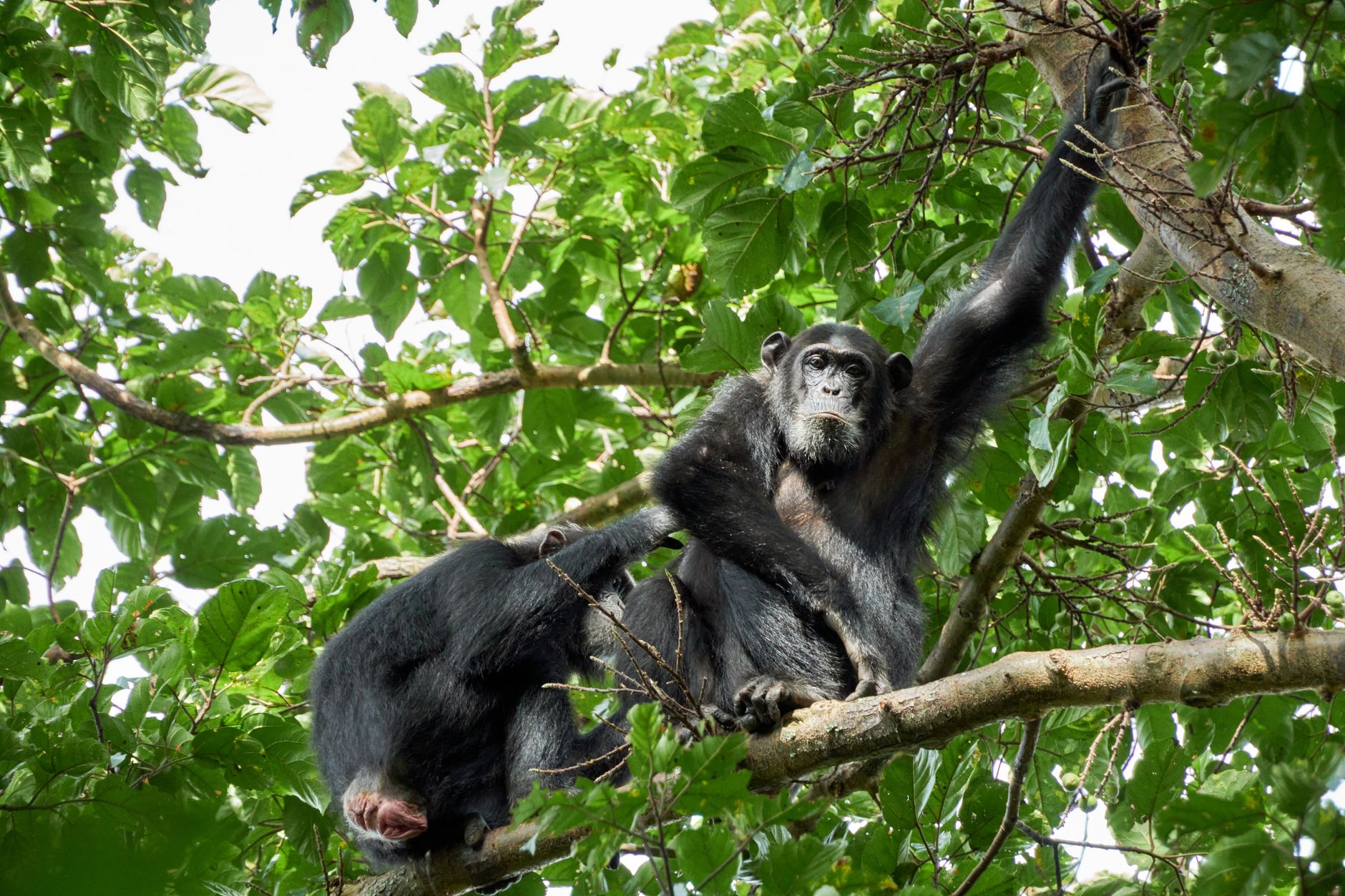
In the thick woods of Taï National Park, a chimpanzee may bark, grunt, pant, scream, or emit a gentle “hoo” amid the trees. What stands out is not just that these creatures possess distinct calls but that they can combine familiar calls, leading to new sequences that may relate to a context neither of the individual components indicates on its own.
A study from 2025 published in Science Advances presented findings on four methods by which wild chimpanzees merge calls: establishing a new association, refining an existing one, maintaining information from both parts, and utilizing order to differentiate otherwise similar pairs. This represents the widest range of combinatorial strategies documented in a nonhuman species to date.
The assertion is significant yet specific. The investigators deduced potential meanings from the instances during which calls were made. They did not demonstrate that a listening chimpanzee deciphered each sequence in a playback experiment or claim to have discovered words, grammar, or human language within the forest.
First emerged a map of the sequences
The latest analysis builds upon work highlighted by ScienceBlog in 2022, where researchers noted that Taï chimpanzees integrate calls into hundreds of structured sequences. That previous study outlined the framework: 12 types of calls were not simply mixed at random, and certain sequences featured numerous distinct vocal units.
The question of meaning remained unanswered. Recognizing that one call generally precedes another does not clarify whether the pair conveys more information than either call on its own. A sound may follow another due to respiratory, emotional, or physical constraints, without constituting a meaningful combination.
Thus, the structural study from 2022 provided the outline, while the 2025 paper examined how that outline correlates with chimpanzees’ actions. This distinction is crucial: sequence structure is essential for a combinatorial communication system, yet structure alone does not convey a message.
What 53 chimpanzees contributed
The research team observed 53 chimpanzees aged over 10 across the East, North, and South communities of the Taï Chimpanzee Project in Ivory Coast. Data were gathered during two field sessions in 2019 and 2020, with researchers tracking identified individuals and documenting their calls along with the surrounding circumstances. The study was observational and non-invasive, relying on long-term habituation instead of experimental disruption in the forest.
The complete dataset contained 5,399 vocalizations. After applying the necessary criteria for event analysis, the researchers focused on 4,323: 3,589 individual calls and 734 two-call sequences, or bigrams. The repertoire included 12 categories, such as barks, grunts, hoos, screams, whimpers, and panted variations of several calls. One specific type, the panted roar, never appeared alone in the assessed data.
For the main comparison, the team chose 16 common bigrams. Each pair was produced by at least 10 different chimpanzees, which helped to ensure that no singularly vocal individual skewed the findings. The researchers then analyzed each pair against its individual calls when those components were noted alone.
“Meaning” here is a probability, not a translation
The researchers documented 22 events representing typical activities: feeding, resting, traveling, grooming, playing, approaching another chimpanzee, aggression, copulation, nest building, hunting, intergroup encounters, and more. For every call and bigram, they estimated the likelihood of its occurrence within each event.
If a sequence was found in a different array of events than its individual components, the team considered that as evidence suggesting the combination likely conveyed distinct information. This production-based approach to defining potential meaning is more stringent than merely assigning an anecdotal English label to a sound, yet it stops short of demonstrating what another chimpanzee perceives.
Even a single label can obscure variation. An earlier ScienceBlog piece illustrated how nuanced versions of the chimpanzee “hoo” varied across alert, travel, and rest contexts. In the present analysis, acoustic variations within a call category were pooled for increased statistical power. This was essential for testing numerous pairs, though it may have also obscured distinctions that future studies could clarify.
Four pathways from two calls to deeper understanding
The most evident candidate for a newly established association was a hoo followed by a pant. This bigram was predominantly noted during nest-related instances, while the individual components used on their own were not connected to nesting. In linguistic terms, this resembles an idiom, whose usage can’t be predicted merely by summing the general associations of its parts. It serves as an analogy, not proof that chimpanzees have idioms in the human sense.
Other pairs demonstrated a more compositional nature. In one instance, the addition of a second call specified the contexts related to the first, rendering the combination more precise. In another case, a sequence retained event associations from both components, as if the information carried by the two calls had been combined.