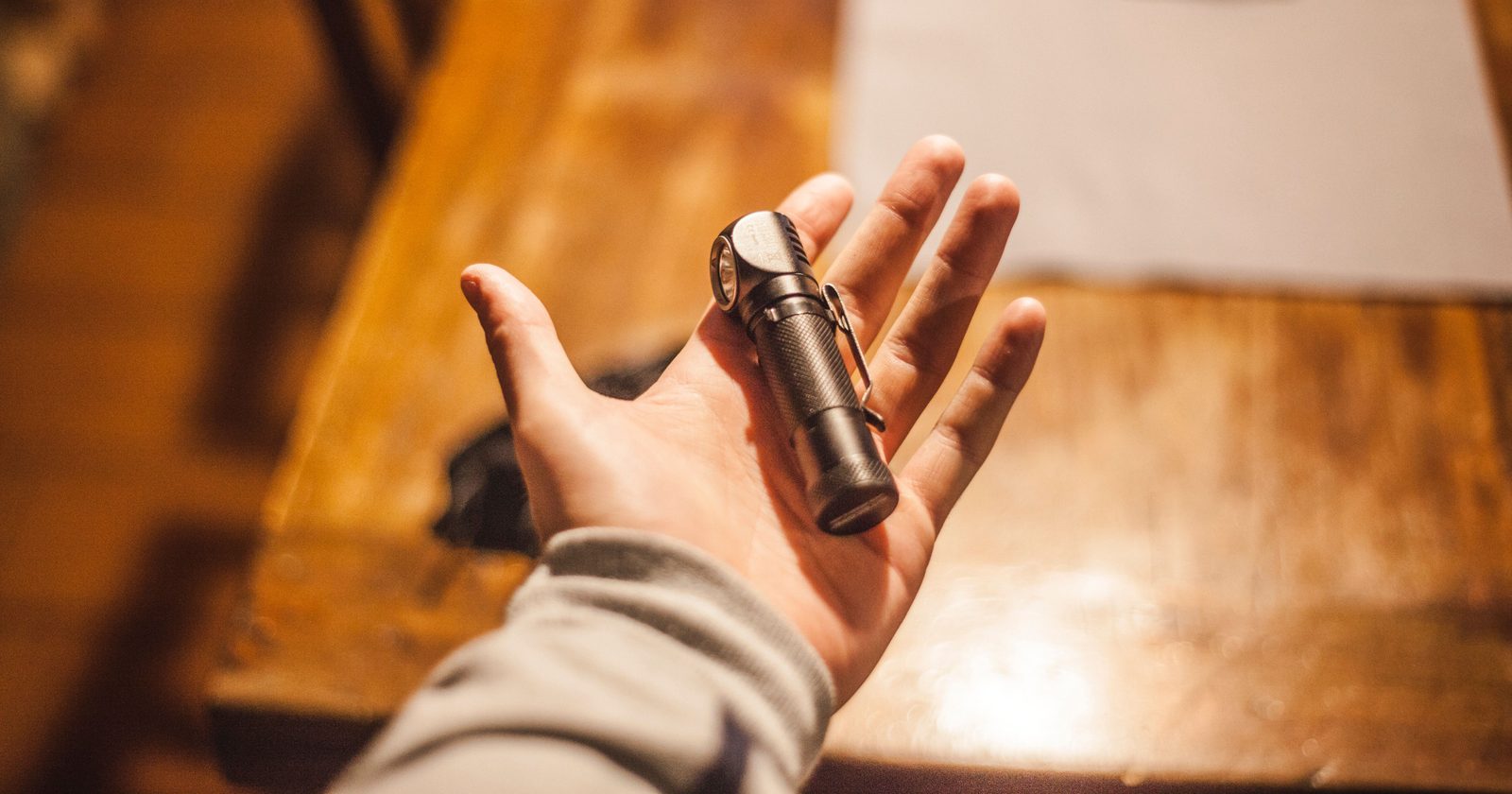
Can a heated hand activate a flashlight? Not by cranking, nor by shaking a magnet back and forth, but merely by grasping it, just as you would hold a lantern on a dim path. In 2013, a 15-year-old confirmed this and accomplished it with components costing less than a cinema ticket.
Her name is Ann Makosinski, and she was a 10th-grade student at St. Michaels University School in Victoria, British Columbia. Her “Hollow Flashlight” operates without a battery, solar panel, or winding. It harnesses the small temperature difference between the skin of your hand and the surrounding cooler air. Four Peltier tiles facilitate the conversion, and the light remains illuminated as long as you continue to grip it.
## How does body heat convert to light?
The secret lies in a physics principle known as the Seebeck effect. When two dissimilar metals are combined, and one side is kept warmer than the other, a small voltage emerges between them. No moving components, no combusting fuel, only a temperature differential driving the mechanism. This encapsulates the essence of the Seebeck effect: a temperature disparity translates directly into voltage, albeit not efficiently.
A Peltier tile is the common apparatus that performs this function. You may have encountered one inside a compact wine cooler or a portable refrigerator, where it typically operates in reverse, utilizing electricity to transfer heat. Reversing this process, with a hot side and a cold side, transforms it into a miniature generator. Your palm serves as the hot side. While the heat isn’t substantial, it suffices for a low-powered LED.
## What Ann Makosinski actually constructed
The concept is straightforward enough to visualize. Four of these tiles are positioned around the circumference of a hollow aluminum tube. When you enclose the tube with your hand, your palm warms the outer surface of each tile. Air circulating through the open center of the tube keeps the inner surface cool. The contrast between the two surfaces is what produces the current.
She created two models, one of which encased the aluminum tube within a length of PVC pipe, with each costing around $26 in materials. Both maintained a consistent LED beam for over 20 minutes. This project earned her top honors in her age group at the 2013 Google Science Fair.
Her fascination with the concept stemmed less from the flashlight itself and more from its energy source. “I’m really interested in harvesting surplus energy, energy that surrounds us but we rarely utilize,” she shared with CBC. The human body continuously radiates heat, with most of it simply dissipating into the room. Her flashlight captures a fraction of it as it escapes.
## Why the hollow tube is crucial
The aspect we continually revisit is what enables the entire mechanism to function. A Peltier tile generates power only when its two sides have differing temperatures. If both surfaces equalize to the same temperature, the voltage ceases, and the light extinguishes. Therefore, the genuine engineering challenge is not producing heat; your hand accomplishes that effortlessly. The real issue lies in preserving the cold side’s temperature.
The hollow interior provides the solution. By keeping the center of the tube open, air can flow past the inner surfaces of the tiles and dissipate the heat that seeps in from your palm. This maintains the temperature difference between the two sides. It also accounts for an interesting characteristic of the device: it glows brighter on colder days. The flashlights shone more brightly at 5°C than at 10°C, as a colder environment means a greater gap between hand and air, resulting in increased power.
## Is a hand-warm flashlight genuinely practical?
As a household torch, it likely won’t replace the one stored in your drawer. The output is modest, the beam is gentle, and it goes dark the instant you set it down. On a warm evening, the temperature differential diminishes, resulting in less light. These are legitimate limitations, not trivial observations.
Evaluating it solely as a consumer flashlight overlooks the essential point. What she demonstrated is that a warm palm and a cool space possess sufficient usable energy to power a genuine electronic device, inexpensively, without any unconventional components. As proof that design can revolve around a small, continuously available energy source rather than a stored one, it remains valid. The flashlight serves as the exterior, while the underlying concept is that the energy has always been present, seeping away unused.
## The larger concept: waste heat as an energy source
That notion extends beyond just a science-fair curiosity. It powers some of the most extended missions humanity has undertaken. NASA’s radioisotope thermoelectric generators operate on the same principle, converting heat into electricity without moving parts. While the heat source differs—coming from the decay of plutonium rather than a warm hand—the conversion step relies on the same physics that Makosinski employed. The twin Voyager probes, launched in 1977, continue using this technology, and the Perseverance rover on Mars draws