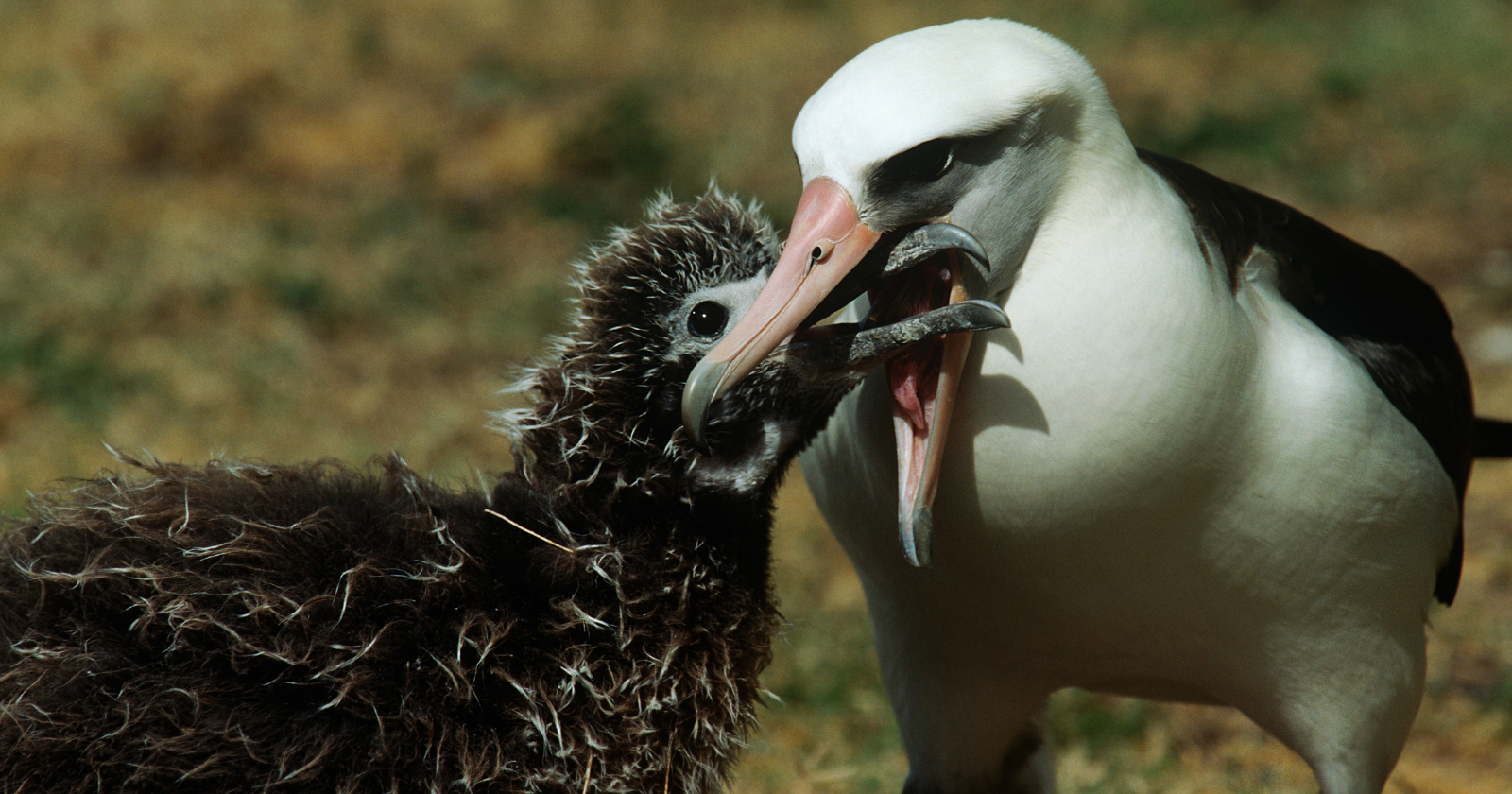
On December 10, 1956, biologist Chandler Robbins became part of the albatross colony on Midway Atoll—a distant coral haven in the Pacific—to place small metal rings on nesting seabirds. Among the many birds he observed, one was an unremarkable female Laysan albatross sitting on an egg. Robbins recorded her band number during a time when Dwight D. Eisenhower was president and transistor radios symbolized progress in technology.
Jump to November 2025: this albatross came back to Midway for the 2026 nesting season, where she rejoined her mate.
**The Arithmetic of an Impossible Age**
The albatross currently recognized as Wisdom, identified by band number Z333, holds the title of the oldest wild bird known on the planet. Her verified age, based solely on breeding behaviors, is at least 74 years, rendering her “approximately 75” according to the U.S. Fish and Wildlife Service, with a possibility of being older. The Laysan albatrosses typically do not breed before five years, and Wisdom was already on an egg during her initial banding in 1956.
Maintaining her recognition over decades demanded effort, as the metal bands deteriorated due to coral sand and seawater over time. Robbins himself updated her band in 2002, closing a historical circle in ornithology by encountering his own legendary data point 46 years later.
**What One Band Bought**
The simple band has proven more enlightening than any electronic transmitter, exceeding early anticipations. Wisdom has challenged previously held beliefs about lifespans for her species and seabirds in general. Of the over 250,000 albatrosses banded on Midway since 1956, the next-oldest known bird is 52, illustrating a 23-year gap. Wisdom consistently resets the standard with every yearly return.
Her remarkable breeding defies assumptions about age-related declines in reproduction. It’s estimated she has produced 50 to 60 eggs, successfully fledging up to 30 chicks. In the 2024 nesting season, she coped with the loss of her long-time mate by forming a new bond with a male, EX25, laying an egg and successfully hatching a chick at age 74—the oldest wild bird to accomplish this milestone. This year, she has arrived early, once more reuniting with EX25 amidst a crowded albatross community.
Her journey also reflects unintentional history: she has endured the loss of mates, survived the tsunami in 2011 that ravaged Midway’s chicks, and traveled millions of miles across the Pacific—circling the globe multiple times—all tracked by a stamped metal ring.
**The Instrument Nobody Upgrades**
Wisdom’s narrative highlights the elegance of simplicity in technology—her band needs no battery, signal, or moving parts. Its effectiveness is due to her species’ remarkable fidelity to breeding sites. The data naturally accumulates every November, sustained by patient, careful observation. The ongoing banding project at Midway spans seven decades, continuing even after Robbins’ death in 2017, demonstrating the persistence of scientific undertakings beyond their initiators. Wisdom’s story exemplifies a 70-year-long scientific inquiry with no ending.
**Seventy Novembers**
Wisdom’s notable fame—underscored by headlines such as “The queen returns!”—masks the remarkable elements in her annual routine. Every year, she traverses vast ocean distances to arrive precisely at a familiar atoll, choose a specific nesting location, and wait among 1.5 million of her kind. The predictable pattern of egg-laying, chick-rearing, and trans-oceanic travels shapes her enduring narrative.
Her routine began before the establishment of the interstate highway system and continues amid the next generation residing in her colony. Wisdom’s enduring tracking device—a humble, timeworn band—gracefully conveys the same message year after year: she is still here, still returning, and still nurturing new life.