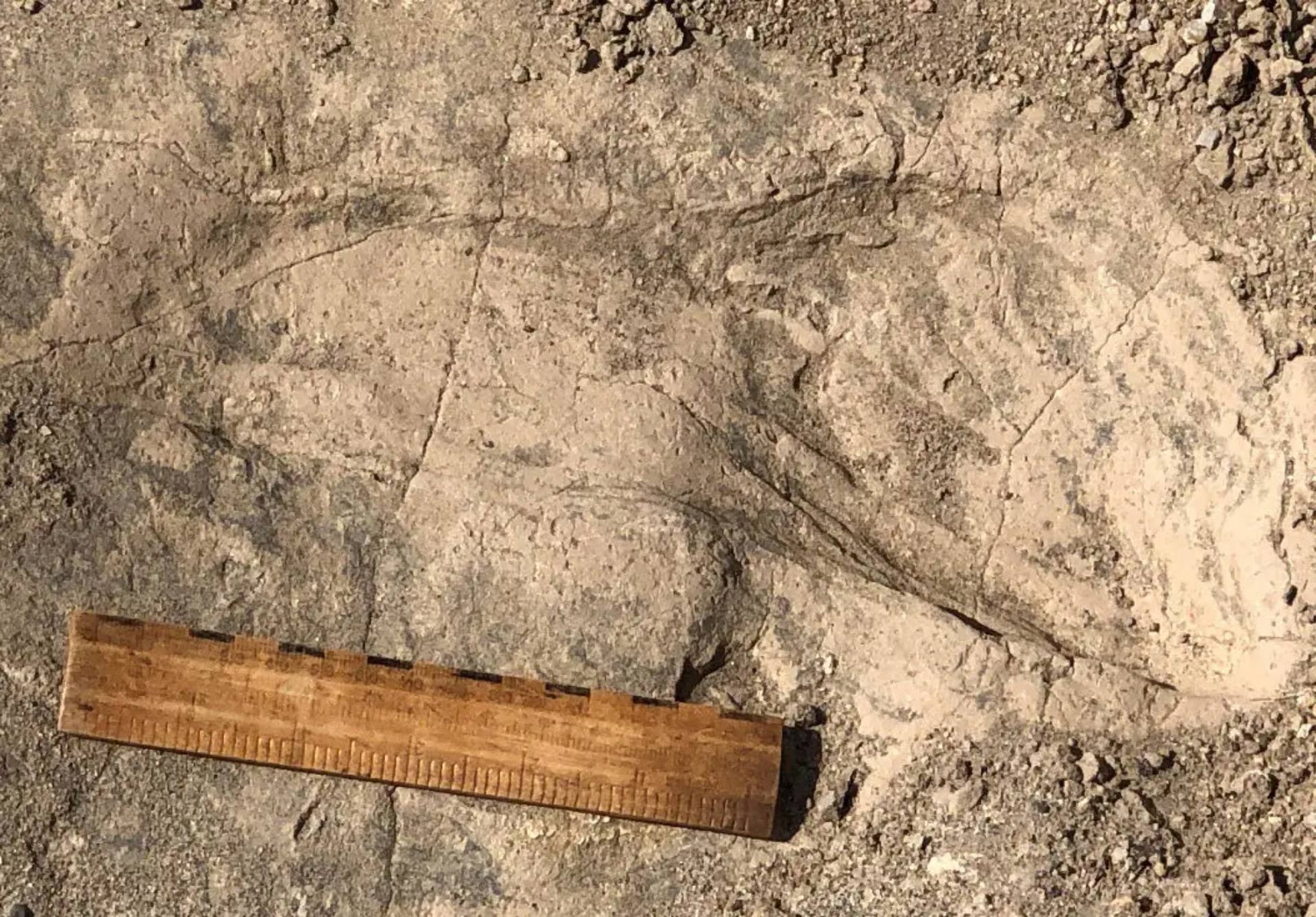
Twenty-one hominin footprints have been uncovered on a single bedding plane at GaJi10, situated on the eastern coastline of Kenya’s Lake Turkana. Kevin Hatala from Chatham University and the Max Planck Institute for Evolutionary Anthropology, in collaboration with colleagues from the United States and Kenya, have disclosed this discovery in the Proceedings of the National Academy of Sciences (volume 123, issue 31). These prints are attributed to eight individuals who walked along the muddy shoreline approximately 1.43 million years ago. The research indicates they likely belonged to Paranthropus boisei, with the tallest reaching around 1.8 meters, weighing roughly 75 kilograms.
In contrast to skeletal remains, footprints provide a distinct glimpse into “fossil behavior” at a precise moment in history, which skeletons cannot capture. GaJi10 is positioned in Area 103 of the Koobi Fora Formation, located within the Okote Member. The track surface lies approximately 40 centimeters beneath a tuff associated with the Akait Tuff, dated to near 1.43 million years ago. First identified by Kay Behrensmeyer and Léo Laporte in 1978, the site was revisited during excavations in 2016 and 2023.
This 2023 surveying uncovered 21 hominin footprints, 14 of which had not been recorded in the 1978–79 findings. The team provisionally associates these prints with eight individuals, with one moving eastward while the others moved westward. The surface additionally contains tracks from 146 other animals, illustrating a diverse and dynamic ecosystem. The sediment exhibited no indications of desiccation or roots, suggesting a short exposure period before burial, which helped conserve these footprints as a unique moment in time.
Kevin Hatala’s team utilized kinematic techniques to study the footprint morphology, comparing them to previously found East Turkana tracks and older Laetoli prints. The GaJi10 prints show similarities to those linked with P. boisei and Australopithecus afarensis, but differ from contemporary human footprints. They are notably distinct from Homo erectus, revealing flatter arches and more abducted big toes.
The estimated dimensions of the individuals who created these tracks challenge established skeletal records for P. boisei, suggesting that some were larger than identified specimens. If these footprints belong to P. boisei, it suggests a broader size variability within the species. Conversely, if they are linked to H. erectus, it indicates considerable variation in foot shape within that species. There is also a chance of an undiscovered species, though this remains unlikely as P. boisei and H. erectus are the only identified hominins from the Okote Member so far.
Media coverage implies that the footprints offer valuable insights into human evolution, hinting at complex social behavior if interpreted as movements predominantly by male adults in groups. Nevertheless, the researchers advise against making definitive assumptions about social structure based solely on these prints. The trackways displayed slow walking paces, with the study underscoring that the observed speed may not represent normal movement behavior.
In essence, Purity Kiura from the National Museums of Kenya underscores the significance of these findings in enhancing our understanding of human evolution and emphasizes the necessity to safeguard such invaluable heritage. The 21 footprints, representing eight individuals, encapsulate a unique moment preserved on a muddy shore at GaJi10, highlighting the rich behavioral insights that footprints can provide, insights that skeletal remains cannot.