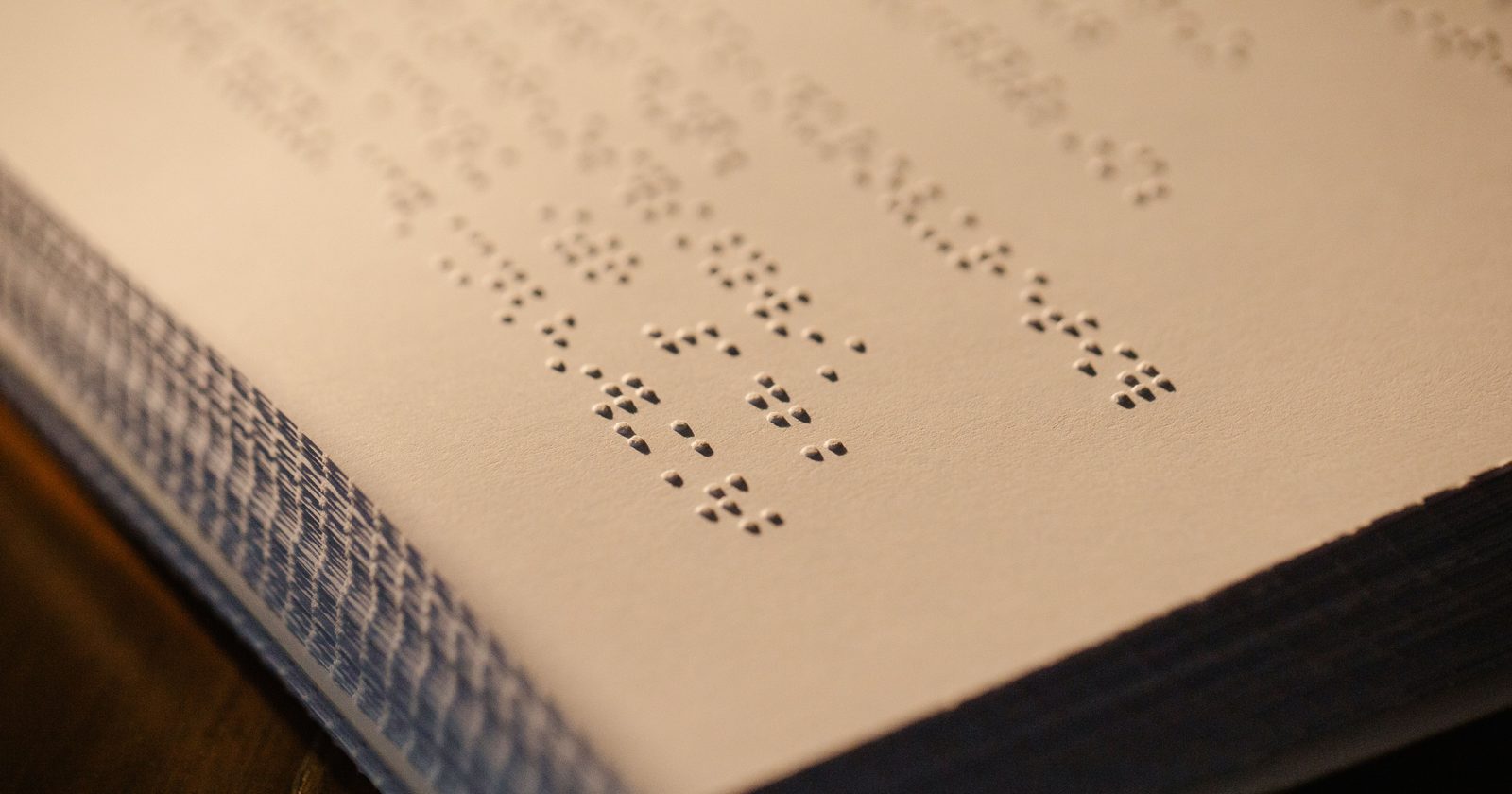
**Groundbreaking Braille Printer Transforms Accessibility for the Visually Impaired**
A device that imprints raised dots on paper for blind individuals to read starts at a minimum of $2,000. A prototype created by a seventh-grader for a school science project ran approximately $350. This discrepancy was identified by someone without any financial interest in the sector that commanded the higher cost.
The seventh-grader was Shubham Banerjee, who at the time was 12 years old and lived in Santa Clara, California. He constructed it using a $349 Lego Mindstorms EV3 robotics kit along with about five dollars’ worth of hardware-store materials.
**The Price Discrepancy That Sparked Change**
It all began with a simple question regarding a sheet of paper. When Banerjee inquired of his parents how blind individuals are able to read, they advised him to research it. He did and discovered that machines designed to create Braille, known as embossers, come with a hefty price tag. For the majority of blind readers, particularly in lower-income nations, these devices are frequently beyond their financial reach.
Banerjee’s response was straightforward. “I just thought that price should not be there,” he remarked. “I know that there is a simpler way to do this.” The latter statement is particularly intriguing. Many people can observe that something is costly; however, fewer presume, often without much basis, that it doesn’t have to be that way.
**What He Created**
The invention was named Braigo, an amalgamation of Braille and Lego. It functions by creating raised dots on paper to compose Braille letters. He arrived at the solution through trial and error, assembling and disassembling seven prototypes before achieving success, enduring many late nights at the kitchen table in the process.
Size was also a crucial factor. Commercial embossers can exceed 20 pounds, whereas the desktop model he envisioned would be considerably lighter. No new laws of physics needed to be developed for this to happen. It involved analyzing an existing product, concluding that it was unnecessarily complex and costly, and experimenting with whether more affordable components could fulfill the same role.
**The Importance of Affordable Braille Access**
The significance of the price gap is noteworthy because reading Braille is not merely a specialized luxury.
Banerjee has referenced a World Health Organization statistic indicating that there are 285 million individuals with visual impairments globally, the majority of whom reside in developing areas. When the starting cost for a Braille printing tool is several thousand dollars, the challenge is not solely the expense of individual purchases. Schools, libraries, and community initiatives often find they cannot budget for the equipment at all.
This is why praise came from those involved with blind readers, beyond just the tech media. Lisamaria Martinez, a community services director at the San Francisco Lighthouse for the Blind who is herself visually impaired, articulated it succinctly: “I love the fact that a young person is considering a community that is often overlooked.” Henry Wedler, a blind chemistry doctoral candidate at UC Davis and advisor to the company Banerjee later established, viewed the affordable machine as a means for individuals with limited resources to “learn Braille and to utilize it practically.” Although Wedler is involved and not an impartial observer, at that stage Braigo remained a prototype, hence the benefits were aspirational rather than guaranteed. Nonetheless, the potential direction was critical to the individuals he described.
**From a Science Fair to Braigo Labs**
The endeavor evolved from a mere science fair submission. In 2014, Banerjee founded Braigo Labs, appointing his mother as CEO due to his minor status, with an initial investment of $35,000 from his father. Subsequently, Intel Capital contributed an undisclosed sum, which by Intel’s account positioned him among the youngest entrepreneurs to secure venture funding.
Edward Ross, an Intel director, expressed the appeal concisely: “He’s addressing a genuine issue, and he aims to disrupt an established market. And that’s fundamentally what it’s all about.” Ross supported the company, so perceive the market-impact language as intent rather than outcome. A subsequent version, Braigo 2.0, incorporated a new Intel chip to translate digital text into Braille, advancing the project beyond the Lego kit initial concept.
Banerjee’s ultimate ambition was characterized by modest wording yet grand aspirations. He articulated that his end vision “would probably be having most of the blind people … utilizing my Braille printer.”
**What We Gain from This**
The central inquiry, does this truly need to be priced at $2,000, was evident for anyone within the industry to consider. His mother, Malini Banerjee, emphasized the point in a manner that resonates due to its obviousness: “What he has conceived, I believe most adults should have contemplated as well.” That perspective reflects a proud mother’s view, but she raises a valid point regarding its peculiarity.
Individuals who operate within a market often take its prices to be unquestionable realities, akin to the way