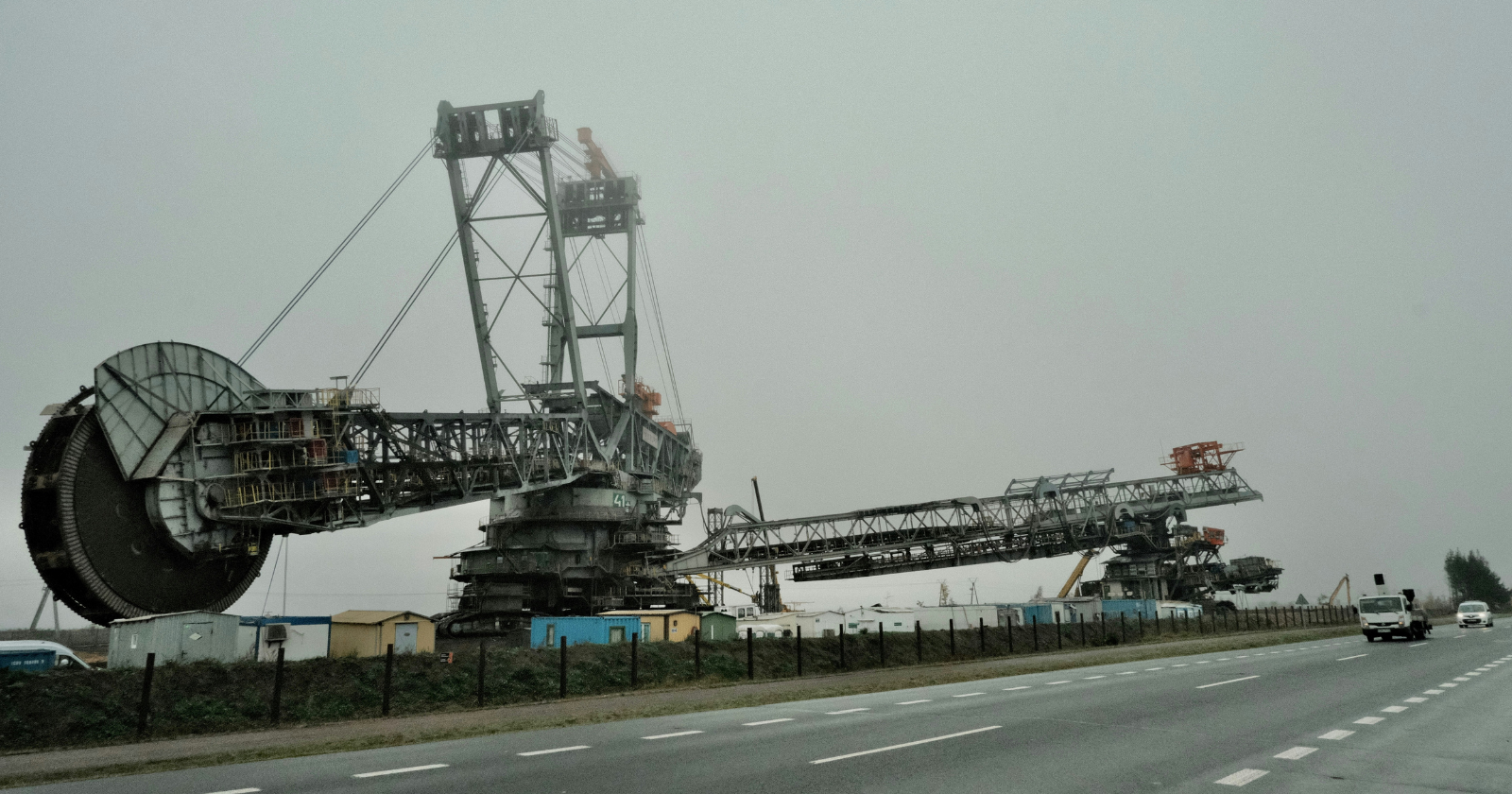
**Bagger 288: The Titan of Open-Pit Mining and Its Voyage**
Envision a colossal machine spanning the length of two football fields, looming over structures, and traversing autonomously across the German terrain. This was the sight that transpired near Cologne in 2001 when the Bagger 288 transitioned from the Hambach mine to the Garzweiler mine, covering a distance of 22 kilometers that took three weeks. In spite of its enormous size—standing at 96 meters high and weighing 12,840 tons—the Bagger 288 progressed slowly, at merely ten meters per minute.
The Bagger 288 is a bucket-wheel excavator, an essential instrument in mining operations intended to remove topsoil, revealing the precious lignite coal underneath. Unlike other machinery that can be taken apart and shipped in sections, the Bagger 288 traveled to its new destination whole, as disassembling and reassembling it would result in considerable loss of both time and efficiency.
This sluggish yet essential journey underscores the careful pace necessary for the secure relocation of such a gigantic machine. It serves as a tribute to patience and engineering accuracy, where rushing could result in chaos or delays. This careful method of relocation also conveys a larger life lesson regarding progress, where significant transformation frequently requires gradual efforts over time.
In terms of sheer dimensions, Bagger 288 maintained its status as one of the largest terrestrial vehicles until it was outdone by its successor, Bagger 293. Nevertheless, Bagger 288’s engineering achievement and effect on mining activities continue to be noteworthy.
Aside from its relocation, Bagger 288’s future and that of its industry are now confronted with new obstacles. The operator, RWE, has pledged to cease lignite mining by 2030 due to environmental factors and energy supply issues. This initiative will convert mines like Garzweiler and Hambach into lakes, signifying a major transformation in land usage and utility.
As Bagger 288 nears retirement, set to cease operation when there are no more resources to excavate, its legacy will persist as a testament to human effort in industrial excavation—a symbol of how engineering addresses monumental tasks, advancing steadily toward an unavoidable conclusion in a swiftly evolving energy environment.