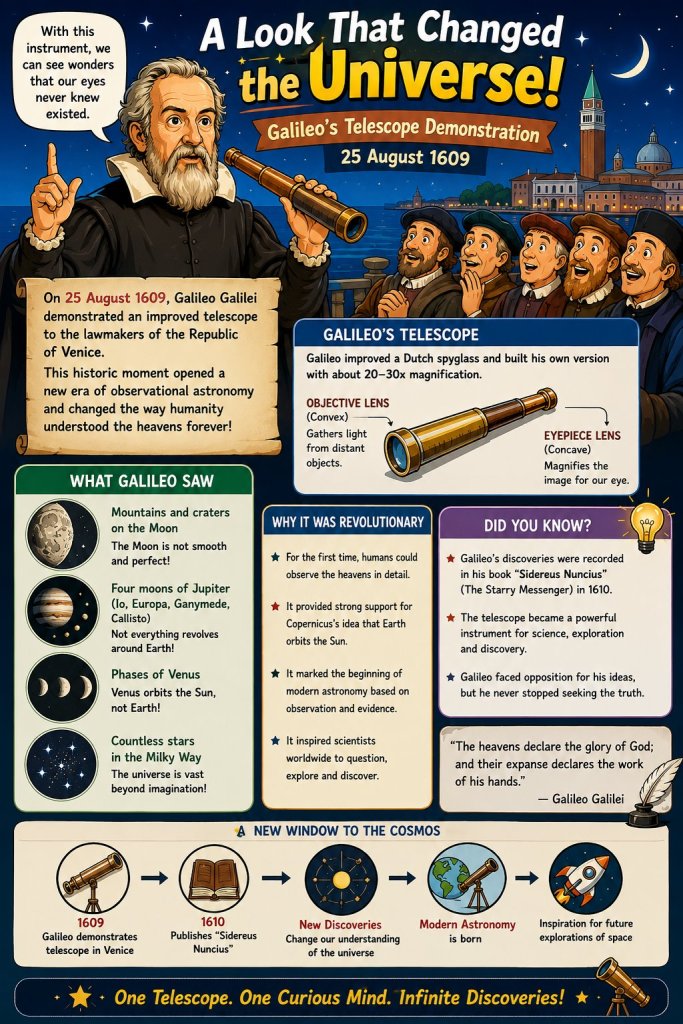
Every August, the anniversary of Galileo’s demonstration of the telescope to the Venetian Senate is celebrated, though it is often misdated. A 2009 article highlights the accurate timeline of events: On 21st August 1609, Galileo privately showcased his telescope to the aristocrats of Venice. By 24th August, the Doge and Senate experienced their demonstration, and the following day, Galileo obtained a permanent mathematics professorship at the University of Padua for a fixed salary of 1000 Florins. The Senate later lamented the privileges granted to Galileo upon realizing that telescopes could be acquired from other sources.
Misleading accounts frequently elevate Galileo as the sole pioneer of the telescope, overshadowing contemporaries such as Thomas Harriot in England, Simon Marius in Germany, and others who were independently conducting celestial observations. Additionally, Jesuit astronomers at the Collegio Romano validated Galileo’s discoveries. Contrary to conventional representations, Galileo did not fundamentally innovate the telescope from the early Dutch models but merely enhanced its lens magnification.
Galileo’s Senate demonstration in 1609 is often mistakenly regarded as the beginning of telescopic astronomy. However, Hans Lipperhey’s invention in 1608 set the stage, attracting interest after showcases to figures like Prince Maurits. Harriot had analyzed the moon’s surface prior to Galileo, whose subsequent writings perhaps echoed theories more aligned with Plutarch instead of challenging Aristotle, as is commonly oversimplified.
The depiction of Jupiter’s moons and the detailed phases of Venus are recognized contributions for contesting geocentric models, even while they fit within existing geo-heliocentric frameworks. The initial effect of the telescope was to slightly enhance visible celestial data; its transformation in observational astronomy evolved over the following decades.
Assertions that Galileo solely sparked modern observational techniques, inspired worldwide scientific exploration, or introduced early holistic cosmic insights are overly reductive. Scientific inquiry existed prior to him, flourishing through empirical observation long before the telescope emerged. The focus on Galileo alone skews the narrative, crafting a misleading heroic image rather than granting rightful accolades across varied geographic and intellectual contributions in early modern astronomy.