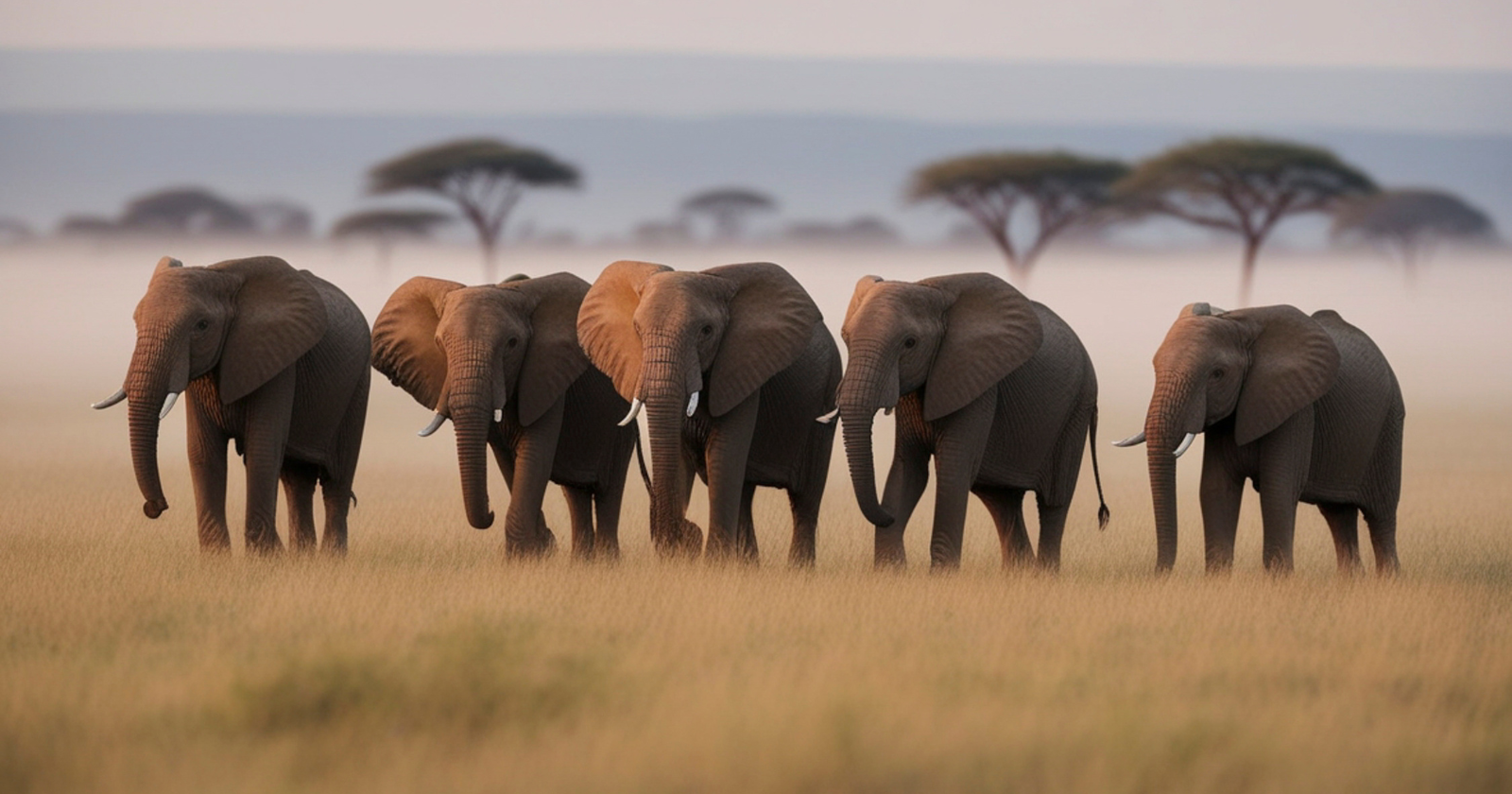
The phone call in 1999 was the sort that concludes with an apology. A conservation organization was in need of a place for a herd of elephants — seven creatures with a history. They were known for escaping and breaking through fences, branded as rogues, and had exhausted all their chances. If Lawrence Anthony didn’t step in, their fate would be death.
Anthony managed Thula Thula, a 5,000-acre former hunting area in Zululand, KwaZulu-Natal, which he was attempting to transform into a game reserve. He had no prior experience with elephants.
He agreed nonetheless, believing that a death sentence warranted a second look.
The man who integrated with the herd
The elephants arrived in a state of trauma — the matriarch and a calf had been shot during their capture — and they acted exactly as expected. Within days, they had knocked down the fence of their holding boma and attempted to return to their previous home, only to be gathered up again just before facing execution.
Anthony determined that the issue was not with the fence but rather with trust — the herd had none left and no incentive to regain any. Thus, he did what made him famous: he moved into the boma, living alongside the herd, sleeping in his Land Rover, communicating with the new matriarch, Nana, through the wire for hours — day after day, night after night, remaining steadily present until the elephants’ rage was spent.
It worked, gradually. Nana ceased charging the fence. Then, one day, she extended her trunk through it toward him. The gates opened, the herd stayed put, and escape attempts ceased — a recovery he detailed in his bestseller The Elephant Whisperer. The herd expanded, nurtured calves, and reverted to a semblance of wild normalcy on the reserve. Anthony proceeded to take on other unlikely rescues, most notably the animals from the Baghdad Zoo during the 2003 invasion.
March 2012
Lawrence Anthony passed away from a heart attack on March 2, 2012, at the age of 61, away from the reserve while on a business trip to Johannesburg.
What occurred next is why his name persists. In the days following his death, Thula Thula’s elephants — by then two separate herds — emerged at the family residence. According to his son Dylan, as reported in news articles at the time, the herds had not approached the house in a year and a half, and the trek from their grazing area would have taken them around twelve hours. The first herd showed up on a Sunday; the second, the following day. They lingered around the house for roughly two days, the family recounted, before returning to the bush. A family photo capturing the line of elephants moving toward the house circulated globally.
Reserve staff members have mentioned that the elephants returned around the anniversary in subsequent years. The story became a staple in conversations about animals.
What can and can’t be asserted
It is crucial to be precise, as this story is often exaggerated beyond its origins.
The vigil itself is attested by family members and was reported at the time — the herds did come to the house after a long absence, shortly after Anthony’s passing, and stayed. That much has witnesses. The twelve hours is Dylan’s estimate of the trek, not a verified journey. And the part everyone is eager for — that the elephants were aware — is exactly the aspect no one can prove. No one knows what led them. Skeptics highlight that unusual vehicle activity, gatherings, and noise at a compound are precisely the signals keen-sensed animals pick up on, and that an extraordinary coincidence, recounted affectionately, solidifies into telepathy.
However, the sober scientific context does not render the behavior mundane. Elephant grief is one of the most well-documented emotional responses seen in any non-human animal: elephants linger over their deceased, touch and manipulate the bones of family members, and revisit sites of death for years. They communicate over vast distances in infrasound beneath human hearing, and they are, without a doubt, creatures that maintain relationships with individuals over decades. A herd that once endeavored to kill every human in proximity had devoted thirteen years to learning that a particular human signified safety. Whatever signal led them to the residence that week, what they did upon arrival — gather, remain, depart — fits well within what elephants are known to do for their own.
The debt, as the herd perceived it
Anthony often remarked that he hadn’t saved the elephants so much as engaged with them, and that the herd had imparted more knowledge to him than he to them.
The version of the story that persists beyond him is neater than the reality and does not necessarily require alteration. Remove every unverifiable assertion and what remains is still extraordinary: seven condemned elephants gained an additional thirteen years and two generations of calves because one man was ready to stay beside their fury until it dissipated — and when he passed, the animals that had previously broken every fence on the property walked to