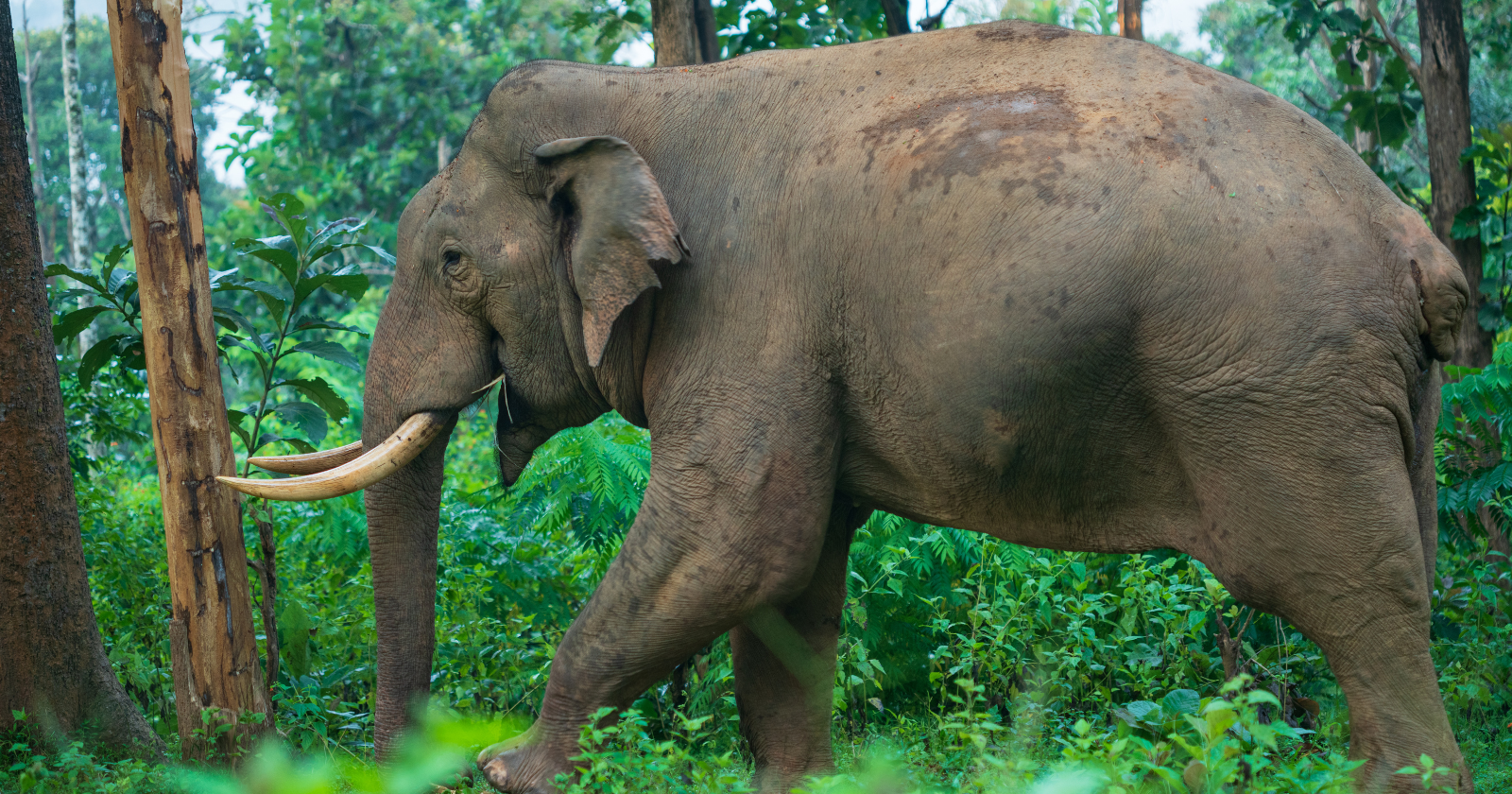
A sugar cane plantation, to a famished elephant, resembles a vending machine with its glass already shattered.
Free nutrition, no waiting, nothing obstructing access. Bananas are even more enticing, and pineapples even better. For numerous years, smallholder farmers along Thailand’s forest boundaries have cultivated precisely the crops that a three-ton herbivore would select from a menu, then spent their evenings attempting to dissuade the animal from consuming them. Fireworks, slingshots, shouting, spotlights. These tactics work until they no longer do, as elephants are quick learners.
Several farming communities in Kanchanaburi province have taken a different approach and begun cultivating crops that are unappealing to the herds.
## Coffee instead of cane
Since 2023, the [Zoological Society of London](https://www.zsl.org/news-and-events/news/new-initiative-sees-coffee-farming-help-save-thailands-elephants) has partnered with the Thai NGO Eco-exist Society to assist smallholders on the western forest periphery in replacing bananas and sugar cane with coffee. ZSL’s logic is simple: coffee is significantly less enticing to an elephant than something sugary, soft, and rich in sugar. Additionally, coffee thrives in shaded conditions, allowing plots to be placed under existing native trees instead of clearing them, with the shrubs positioned alongside marigolds, chili bushes, and beehives, which large herbivores tend to avoid.
Robusta was chosen for practical reasons. The [Darwin Initiative](https://www.darwininitiative.org.uk/news/2025/05/16/reducing-wildlife-conflict-with-coffee/), which partially funds this initiative, reports that soil assessments, farm mapping, and focus groups across seventeen conflict-affected communities, encompassing 375 households, identified robusta agroforestry as the model most likely to outperform existing cash crops in a stable domestic market. The same surveys estimated crop damage in these villages at over one million baht, approximately £30,000, within five years.
## Why the herds emerge at all
Elephant population figures explain only a portion of the situation. ZSL estimates the national wild population to be between 3,500 and 4,000. A paper in [Scientific Reports](https://www.nature.com/articles/s41598-023-40070-3) traced crop raiding in the Eastern Economic Corridor back to land use changes, as industrial estates and farmland have taken over the low, flat areas that elephants prefer, leaving a mosaic of forest fragments and plantations that serve as a substitute habitat. In certain eastern regions, the study indicates that the wild population has been increasing by about eight percent annually within this mosaic. Water shortages in the forest also drive animals outward. An elephant entering a banana field is more of a commuter on an established route than a raider.
## The cooperative managing sales
Cultivating the crops is the easier part. ZSL and Eco-exist have established a farmer-led cooperative named Chiang Yim, which translates to “smiling elephant,” to oversee processing, marketing, and long-term purchase agreements with buyers, currently enlisting over forty farmers with a goal of acquiring 1,000 hectares of elephant-friendly farmland by 2030. In [project updates from Kanchanaburi](https://www.zsl.org/news-and-events/feature/scaling-nature-positive-agroforestry-thailand), the team outlines a first model farm at Huai Kayeng, now featuring over twenty species ranging from coffee and coconut to mangosteen, avocado, pepper, and rosewood, with two additional sites co-designed with farmers at Tha Manao and Chalae.
The diversity of crops serves as a form of insurance. If coffee prices decline, the pepper will still sell.
## Why the stakes extend beyond crop damage
Crop damage represents the milder side of the issue. Investigations by the [Heinrich Böll Foundation](https://th.boell.org/en/2023/12/12/human-elephant-conflict-thailand) estimated around 150 people killed and over 133 injured in encounters with wild elephants over a six-year period, alongside more than ninety elephants perishing, some due to electrocution from wires farmers set up around orchards to protect their trees. A [decade-long survey published in Animals](https://pmc.ncbi.nlm.nih.gov/articles/PMC12071072/) documented 341 conflict incidents across 34 of Thailand’s 77 provinces between 2014 and 2023, primarily clustered in the east and during the rains from July to October, occurring mostly on farmlands where elephants sought food. This represents one dataset from one research team, not a comprehensive academic consensus, though the overall trends are difficult to overlook.
## Elephants also enjoy coffee
That title is derived from a research paper, and the findings serve as a warning. Researchers