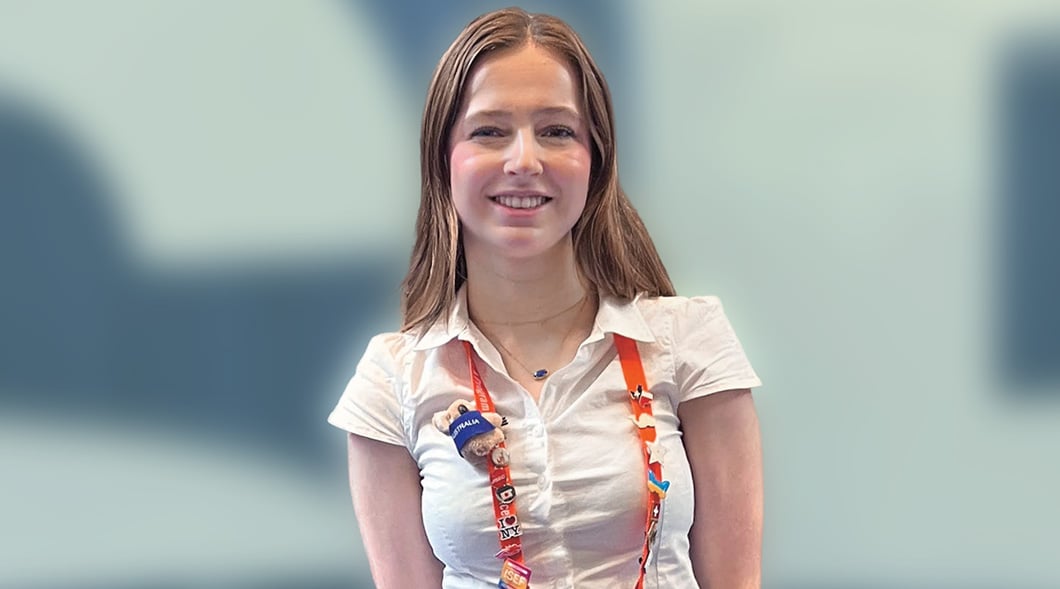
The initial spark was a newspaper article. Not a laboratory, not a funding grant, nor a professor with an available bench — it was a local publication in Fauquier County sharing a story that families read during breakfast and then privately fret about for the remainder of the week: tap water was found to contain PFAS and microplastics, with no public funding available to eliminate them. Households had to fend for themselves. In one such household, an 18-year-old at Kettle Run High School interpreted “on your own” as a call to action rather than a sign of neglect and began to innovate.
Mia Heller’s parents did what many concerned parents would do — they invested in a state-of-the-art home water filtration system. Then, they encountered the hidden issues of modern water treatment: membranes can clog. They become dirty, slow down, require replacement, and each new component represents an extra expense and more plastic waste headed to the landfill. Observing this cycle of buying and discarding, Heller posed the transformative question that separates consumers from inventors: what if the filter didn’t use any membrane?
The solution she developed in the spring of 2024 resides in a garage in Warrenton, Virginia, and weighs approximately the same as a bag of flour. It lacks mesh. It has no cartridge. Instead, it utilizes magnetic oil.
### The magic of plastic and oil
Ferrofluid is one of those materials that appears to have been crafted by someone keen on making physics resemble a sorcery. This liquid is infused with nanoscale magnetic particles suspended in oil, and when a magnet is introduced, it forms spiky black crowns and behaves almost as if it has intention. It has applications in loudspeakers, spacecraft seals, and the kind of desk toys that people gift to engineers during the holidays.
Its practical use in this instance stems from chemistry rather than theatrics. Microplastics repel water — they prefer to cling to oil. Introducing ferrofluid into a contaminated sample allows the plastic particles to adhere to it. Then, when a magnetic field is applied, the oil moves according to the field’s direction, dragging the associated polymers along. The water remains untouched. Nothing is filtered through; nothing is confined in a matrix that will ultimately degrade. There is no solid membrane to replace since none exists.
Heller did not initially create the polished version. The first prototype, as outlined in [Smithsonian magazine’s coverage of the project](https://www.smithsonianmag.com/innovation/this-high-school-student-invented-a-filter-that-eliminates-96-percent-of-microplastics-from-drinking-water-180988363/), was a rotating magnified vial — a method to observe the binding process. It took about five revisions, developed in a garage and a kitchen while she also attended the half-day program at Mountain Vista Governor’s School, to reach the closed-loop system: one where the ferrofluid is both utilized and reused, cleared of its plastic load and cycled back for another round.
This cycle embodies the core design philosophy in miniature. The membrane filter eventually consumes itself. This design, in theory, preserves its operational fluid.
### Three modules, one litre, one statistic
The present prototype is composed of three sections. One module contains roughly a litre of contaminated water. A separate section holds the ferrofluid. Lastly, there is a smaller core separation module where the magnetic interaction occurs. It processes approximately one litre per cycle, representing a deliberately modest goal — Heller envisions it functioning like a Brita pitcher or an under-sink system, not a city-wide water treatment facility.
To verify whether her design was effective, she needed to assess cloudiness, so she constructed a turbidity sensor as well. Her testing yielded a significant figure that has been associated with the project ever since: **95.52% of microplastics eliminated**, assessed by weight. Accompanying this is a second, perhaps more crucial statistic — **87.15% of the ferrofluid recovered** and recycled back into operation.
The 95.52% has often been rounded up to “96%” in media reports, reflecting the kind of simplification that headlines often employ; however, the tested figure is the more accurate one and is worth noting. It gains context through comparison: standard drinking-water treatment facilities, already serving urban populations, achieve roughly between 70% and upwards of 90% in microplastic removal. A garage prototype the size of a bag of flour, in its creator’s tests, achieved results at the higher end of that scale.
Her efforts led her to the Regeneron International Science and Engineering Fair in 2025 as a finalist, where she was awarded $500 from the Patent and Trademark Office Society.
### What a promising concept still needs to demonstrate
Matthew J. Camp