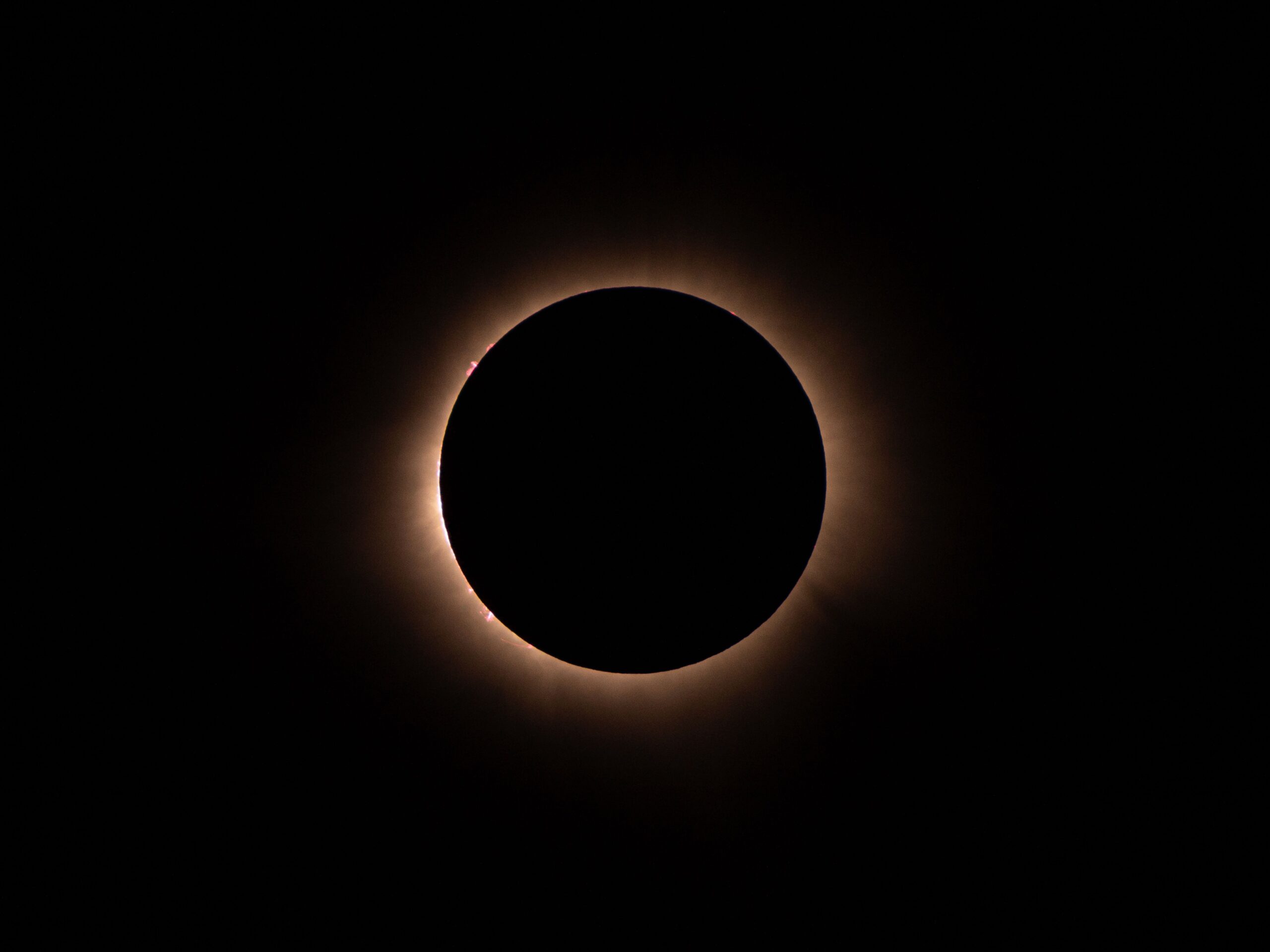
The occurrence of a solar eclipse showcases a celestial event where, for a short period, the most radiant entity in Earth’s atmosphere morphs into a dark circle, obscuring the Sun. This striking moment permits the Sun’s corona, a delicately arranged atmosphere normally hidden by the Sun’s brightness, to be revealed. Notably, this phenomenon is made possible by a remarkable coincidence: the Sun is around 400 times wider than the Moon and roughly 400 times more distant, causing the two celestial bodies to seem nearly the same size in Earth’s sky. This resemblance in perceived size allows the tiny Moon to sometimes obscure a Sun spanning over a million kilometers, unveiling the otherwise concealed corona.
Nevertheless, these ratios are not fixed or precise, since the Moon’s orbit around Earth is elliptical, leading to a fluctuating near-match rather than a stable 400-to-one ratio. The apparent dimensions of celestial objects are essential for comprehending this event. According to NASA, both the Sun and the Moon cover about half a degree in the sky, despite their vastly different actual sizes and distances. One might observe that a thumb positioned close to the eye can obscure a building, illustrating a similar perspective utilized by the Moon to cover the Sun on a cosmic scale.
Eclipses are unpredictable events as the alignment between the Sun and the Moon varies. The Moon’s elliptical trajectory leads to changes in its distance from Earth, influencing its apparent size. When a new Moon aligns perfectly and appears larger, it entirely blocks the Sun, producing totality—the phenomenon of daytime darkness. In contrast, when the Moon seems smaller, an annular eclipse occurs, showcasing a “ring of fire” around the Moon.
For total solar eclipses to take place, multiple conditions must be satisfied: the lunar phase needs to be a new Moon, the alignment must occur near a node (the point where the Moon’s orbit intersects Earth’s orbital plane), and the observer’s location within the shadow has to be precise. Although new Moons occur frequently, these conditions are rare, leading to infrequent total solar eclipses.
During totality, the Sun’s photosphere, from which the majority of visible sunlight escapes, is obscured, allowing the corona to be seen. The corona is never absent; it is merely dim compared to the photosphere, making it an intriguing scientific focal point during an eclipse. Artificial coronagraphs replicate this process by using an occulting disk to study the corona on a regular basis, yet total solar eclipses present unique chances to observe parts of the corona that typical coronagraphs cannot reveal.
Eclipses take place in other regions of the Solar System, though few are akin to those experienced on Earth. For instance, Mars’ moons Phobos and Deimos are only capable of creating partial eclipses. Larger moons of the giant planets can create complete shadows, but none achieve the ideal apparent size correlation observed from Earth.
The accuracy of the Earth-Moon-Sun alignment is temporary. The Moon is slowly drifting away from Earth, at a rate of about 3.8 centimeters annually, suggesting a future where the Moon will be too small to fully cover the Sun. This shifting distance indicates that we are in a transient period where eclipses adequately unveil the corona.
Eclipses continue to hold scientific significance, providing a rare glimpse of the solar corona and insights into solar physics mysteries, such as the reason behind the corona’s temperature being significantly higher than that of the Sun’s surface. Guidelines for safe viewing impose strict limitations on when it is possible to observe the Sun with the naked eye during an eclipse—a fleeting moment during totality and exclusively from within the path of totality.
In summary, the nearly perfect eclipse is distinctive precisely because the fit is not precise. Earth serves as an exceptional platform for witnessing total solar eclipses, uncovering the corona while protecting the surrounding atmosphere, thanks to the extraordinary celestial alignment that is both evolving and transient.