The method originated on Earth. A 2017 study employed tidal tomography, which involves analyzing a planet’s internal structure based on the deformation of its exterior under tidal forces, to determine the buoyancy of Earth’s deep mantle. In 2025, the same technique was applied to the Moon, deducing a thermal asymmetry within the lunar mantle based on its monthly tidal reactions.
Mars was the next logical target, albeit a challenging one. The significant force acting there is the Sun’s, and the aspect this technique can effectively assess is the seasonal component, influenced by Mars’s 0.0934 orbital eccentricity and its axial tilt of 25.2 degrees, which changes throughout the Martian year of 687 Earth days.
Alexander Berne, alongside colleagues from the Lunar and Planetary Laboratory at the University of Arizona, now reports in Nature that Mars exhibits asymmetric flexing under this seasonal force. A significant part of the stiffness difference indicated by this flexing can be attributed to mantle temperatures that are approximately 200 to 400 degrees Celsius warmer beneath the southern highlands compared to the northern lowlands. The paper was submitted in December 2025 and accepted in July 2026.
Sixteen years of radio fluctuations
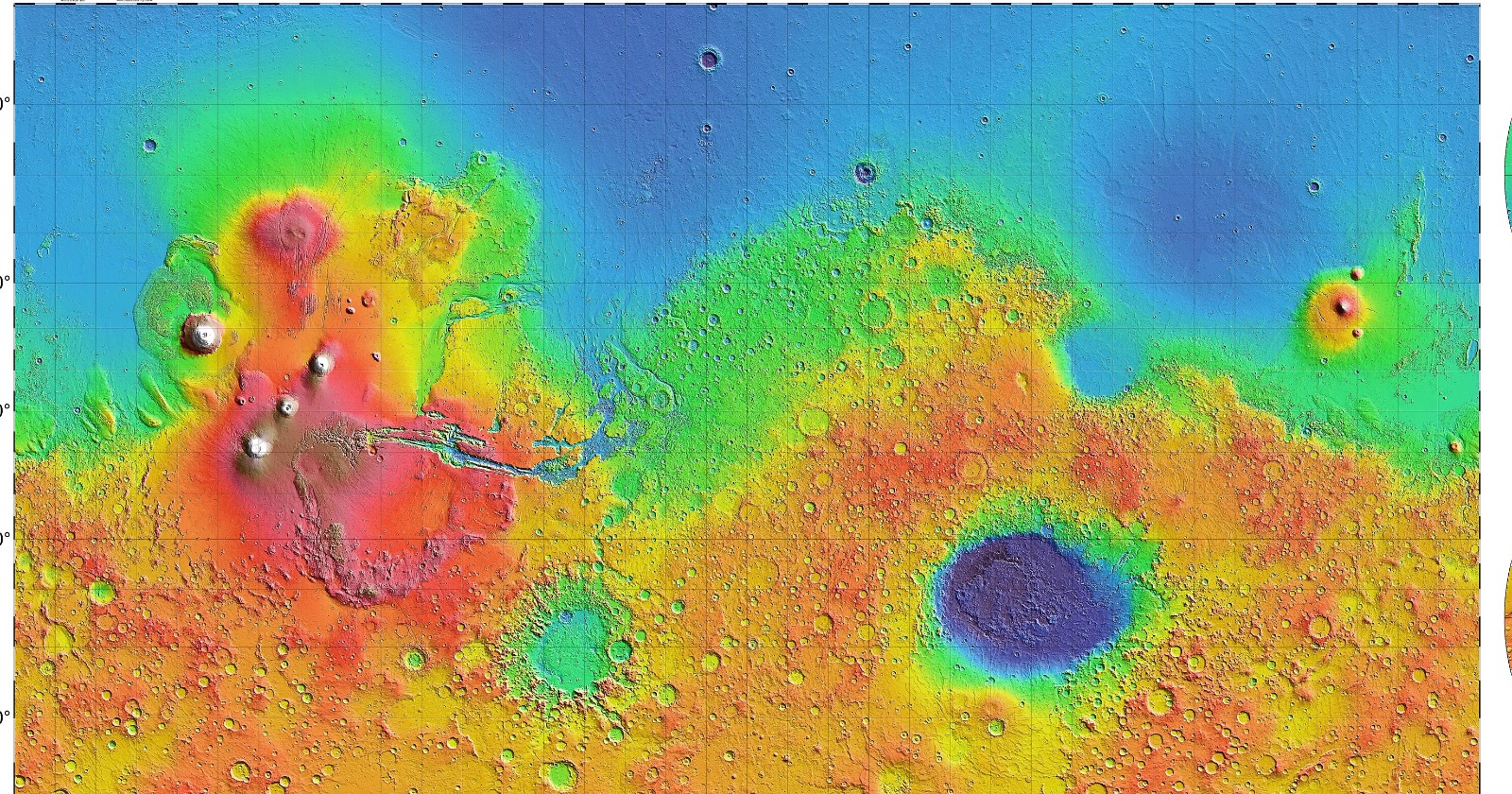
The reason behind Mars’s dual character remains one of the longstanding unresolved issues in planetary science, and the paper discusses the origins of this phenomenon as widely contested. The northern hemisphere features a low, smooth plain; conversely, the southern hemisphere is elevated, rougher, and more densely cratered. The paper attributes an average difference of about 25 kilometers in crustal thickness to this, or alternatively a disparity of around 200 kilograms per cubic meter in crustal density, treating both as potential explanations rather than definitive figures.
The interior was never directly imaged here. It was inferred from spacecraft movement. Berne and colleagues analyzed X-band Doppler data gathered by NASA’s Deep Space Network from three orbiters, Mars Global Surveyor, Mars Odyssey, and Mars Reconnaissance Orbiter, over a period of approximately 16 years, utilizing the minute variations in the velocities of these spacecraft to deduce how Mars’s gravitational field fluctuates throughout the Martian year.
The reasoning hinges on a principle of symmetry. A perfectly spherical planet, compressed by tidal forces, deforms only according to the nature of that compression, which for solar tides is predominantly what geophysicists refer to as degree two. Such a planet would generate virtually no degree-three signal. Mars, however, generates a considerable one: a particular coefficient deviates from the spherical symmetry expectation by about 300 percent, with confidence exceeding 99.99 percent.
This figure is a remainder. It persists only after accounting for the mass reorganized by the Martian atmosphere, and the authors candidly acknowledge that their error margins do not encompass extreme atmospheric scenarios. When they recalibrate the correction for a cold, dusty, low-solar-flux Mars, the north-south pattern broadly correlates with the dichotomy, but for the two components they mention in that scenario, one achieves three sigma and the other is at two. They also point out that solar tidal forces are theoretically stronger at daily frequencies than at seasonal ones, and they do not attempt to recover daily signals, as the empirical accelerations they estimate to absorb unmodeled non-gravitational effects largely account for them.
The stiffness map outlines a pre-existing surface feature
Something within Mars varies across its composition. To investigate this, the team conducted a Bayesian inversion over models in which the mantle’s effective shear modulus, its resistance to deformation, differs across regions.
The successful model is hemispheric. The mantle beneath the northern lowlands is more rigid, centered around 45 degrees north and 138 degrees west over Vastitas Borealis; in contrast, the mantle beneath the southern highlands is less rigid, centered near 45 degrees south and 42 degrees east, in proximity to the Hellas basin. The overall variability is determined to be 81 percent, plus or minus 60 at three sigma, which informs the paper’s more cautious assertion of exceeding 20 percent.
This centering is noteworthy, as the announcement from Caltech, where Berne completed his doctorate before transitioning to Arizona, was titled <a href="https://www.caltech.edu/about/news/