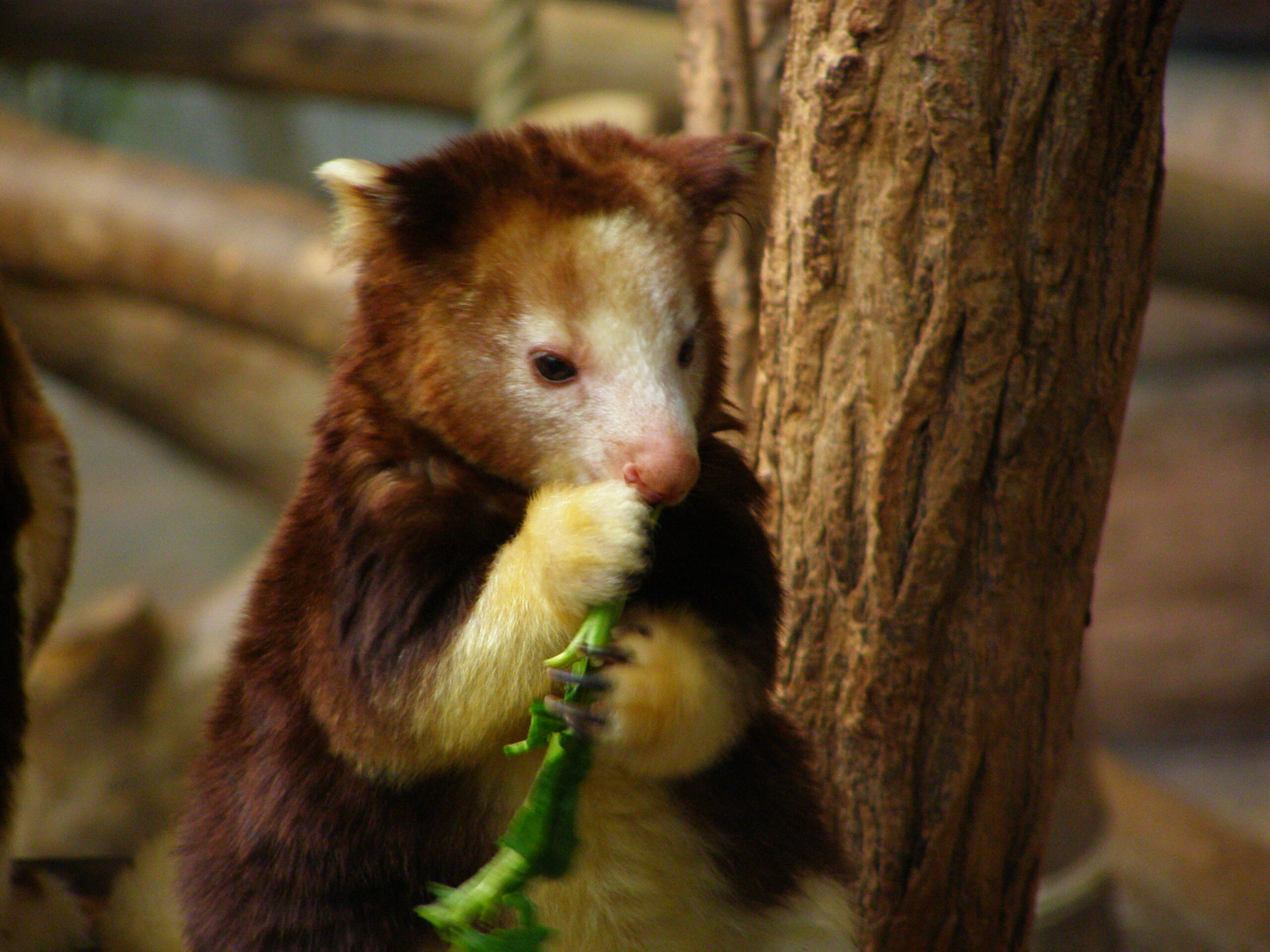
One year post his arrival, a young Huon tree kangaroo named Nane is increasingly spending his daylight away from his mother — navigating branch to branch solo in the Australasia habitat at Denver Zoo Conservation Alliance, where he came in late July 2025 as the first joey of his kind ever born at this establishment. This newfound independence is a minor, seemingly everyday milestone for a marsupial adapted for life in the trees, set against a considerably more challenging backdrop: Dendrolagus matschiei, the Huon or Matschie’s tree kangaroo, is categorized as Endangered on the IUCN Red List, with its habitat restricted to the mountainous rainforests of the Huon Peninsula in northeastern Papua New Guinea.
Tree kangaroos, from an anatomical perspective, are kangaroos that reverted a previous adaptation. Their ancestors descended from trees and adapted for terrestrial life; tree kangaroos ascended once more. In Nane’s case, this manifests as a yearling figuring out how much weight a branch can sustain, and how far he can venture before seeking Pearl again.
From pouch to “at foot”: Pearl and Tristan’s inaugural joey
Nane’s parents, Pearl and Tristan, arrived at the Denver facility in 2023 following a breeding suggestion from the Association of Zoos and Aquariums’ Species Survival Plan, a collaborative program aimed at overseeing genetic diversity and the demographic health of accredited North American zoos. Both were experiencing parenthood for the first time. Their joey, born in late July 2025, marked the inaugural Huon tree kangaroo birth in the zoo’s history.
Marsupial infancy operates on a different timeline compared to typical zoo births, which often leads to an unusual announcement schedule from an external viewpoint. A tree kangaroo joey is born after a very brief gestation period, climbs unaided into the pouch, and does most of its development while attached and mostly hidden for several months. Keepers conduct monitoring through pouch inspections and by observing the alterations in the mother’s abdomen. In the zoo’s February 2026 Baby Bulletin, Animal Care Specialist for Australasia, Thea McCormack, noted the joey at about six months old, peeking out from the pouch, and remarked that he would continue to spend time inside before exploring on his own.
This transition followed the anticipated pattern. By around nine months, per subsequent zoo reports, the joey was “at foot” — a term used for young marsupials that are permanently out of the pouch yet still following their mother — consuming solid foods and exploring the outdoor habitat. By the time he turned one in late July 2026, he was climbing more independently while still closely connected to Pearl. Each of these stages is not assured. First-time marsupial parents and extended pouch-dependency durations make each transition noteworthy in its own right.
What the body is achieving up there, and the status of wild counterparts
A Huon tree kangaroo is approximately the size of a mid-sized dog, covered in thick, russet-and-gold fur, with a face resembling that of a bear more than a kangaroo. This physique tells the tale of its habitat. Unlike terrestrial kangaroos, which possess relatively slender forelimbs, tree kangaroos have robust, muscular forelimbs and powerful curved claws for gripping bark. Their hind limbs are shorter and broader in comparison to a wallaby’s, and critically, the hind legs can move independently, allowing for a walking motion along branches rather than the simultaneous hop characteristic of terrestrial kangaroos. Rough footpads assist on damp moss. The long tail, while not prehensile, serves as a counterbalance and stabilizing pole, and is among the first elements to observe when a yearling such as Nane is exploring a new pathway.
These adaptations are specifically suited for a limited environment. Per the IUCN evaluation (Ziembicki & Porolak, 2016), the species is confined to the Huon Peninsula, inhabiting montane and upper-montane rainforests, with the Red List classifying it as Endangered and noting a continuous population decline. The assessment articulates the species in terms of an exceedingly restricted range and minimal population — figures below 2,500 mature individuals have been referenced from that analysis, and that number is best