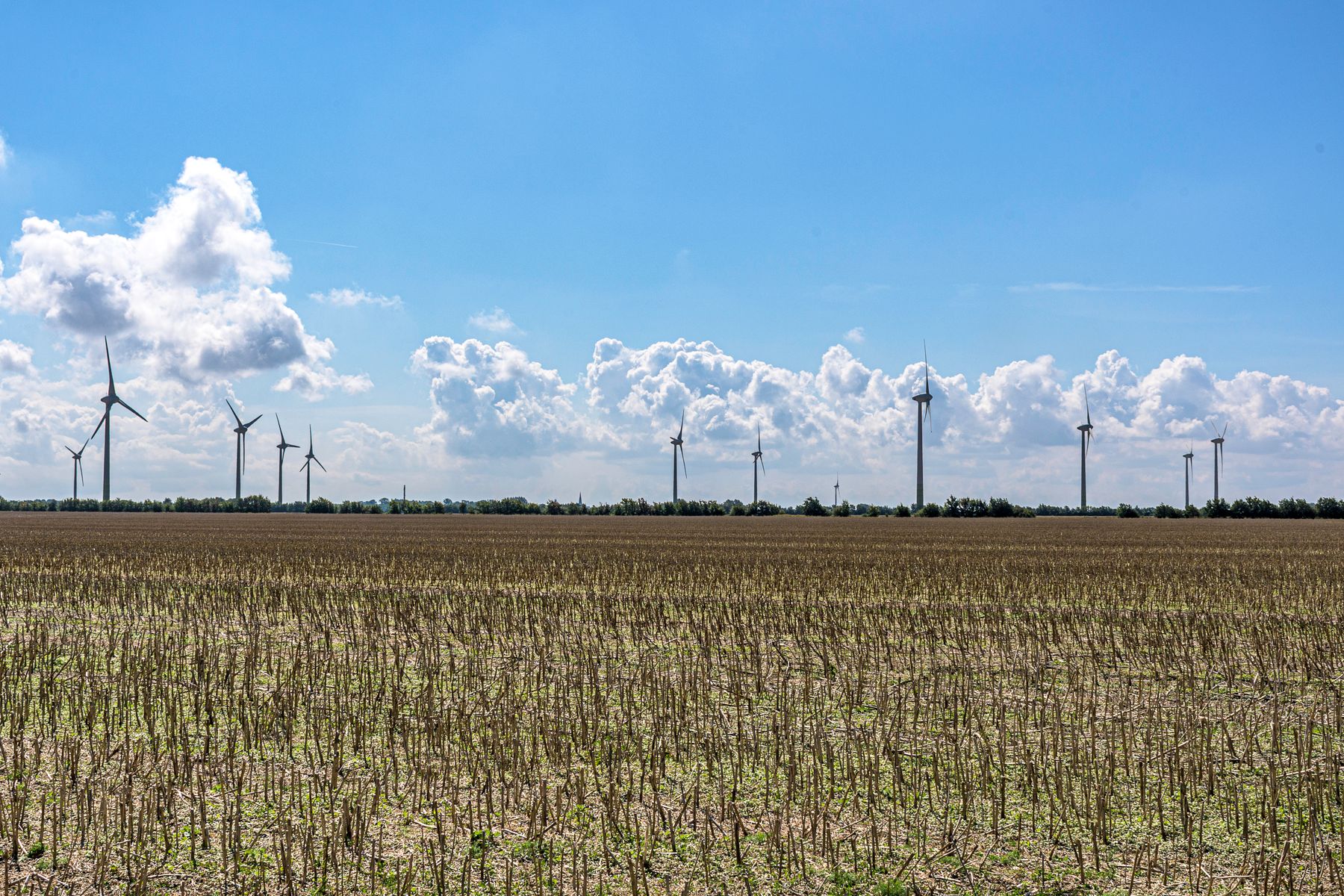
A wind turbine occupies a noticeable section of agricultural land. Its installation can also disrupt a less apparent system: the buried pipes that facilitate the drainage of nearby fields. A severed or damaged drainage line might not immediately reveal itself when equipment departs. The initial visible sign may emerge later, when precipitation surpasses the impaired system’s capacity to expel water.
This is a recognized construction issue, although existing reports do not clarify how many farms in the Midwest currently have unresolved damage. A case study by the Center for Rural Affairs updated in July 2025 discusses Iowa farmers who faced tile damage and subsequently received compensation. Engineering reports illustrate why other system failures can remain hard to detect for years.
The field relies on connections beneath the surface
Contrary to its name, contemporary drainage tile frequently comprises plastic piping. Older systems may contain sections made of clay. Water flows into the underground network and proceeds toward an outlet, lowering a seasonally elevated water table in soils that would otherwise drain more slowly.
North Dakota State University Extension’s drainage guide, authored by agricultural engineer Tom Scherer and agronomist Hans Kandel, clarifies that the system eliminates excess gravitational water. It does not merely deplete the soil of all moisture that plants can utilize.
The agricultural repercussions of insufficient drainage extend beyond mere puddling. Saturated ground can postpone planting, hinder machinery operation, and deny roots essential oxygen. Driving machinery over damp soil can create compaction, adding yet another barrier to crop development. The resultant yield impact varies based on the soil type, crop, and rainfall patterns; there is no universal percentage loss applicable to every compromised field.
Cables and construction paths intersect existing drains
Wind energy development necessitates access for heavy machinery and electrical connections between turbines. These routes may cross drainage systems put in place long before any project was conceived. The visible surface of a farm offers only limited insight into what exists below ground.
In a December 2011 construction article in Wind Systems, engineer Ron Krizan noted drainage mapping as a recurring challenge. Landowners and tenant farmers could frequently identify the general direction and quantity of lines, even when precise surveyed maps were lacking.
Krizan differentiated between the routes taken by underground collection cables versus haul roads and crane paths. Excavation can sever a pipe; construction traffic can compact it. When feasible, routing a cable parallel to drainage laterals can minimize the number of crossings compared to running across them.
He also pointed out that cable plowing could leave an operator unaware of a compromised drain until surface symptoms emerged. Consequently, repair would involve pinpointing the break near installed electrical infrastructure, complicating efforts that would have been easier prior to burial.
A dry season can obscure a compromised pipe
Krizan’s January 2012 follow-up on recognizing damaged tile mentioned two distinct surface indicators. Some breaks create sinkholes as soil shifts into the drainage line. Other compromised pipes lead to water blockage, ultimately shown as standing water or stressed crops.
A partially crushed pipe may still channel sufficient water to appear operational. Sediment can gradually restrict the remaining flow, and a dry year may never exert enough demand on the line to unveil the issue. Krizan recounted instances where symptoms surfaced three to five years post-initial damage.
The wettest area is not necessarily directly above the break.
This makes a soaked strip a reason for investigation, rather than conclusive proof that a specific construction activity caused it. A contractor needs to determine the pipe’s condition and the obstruction’s location. The physical connection between the drain and the construction path is more critical than the appearance of a particular section of land.
Farmers have recounted both damage and compensation
The Center for Rural Affairs’ Adair County case study draws on discussions with three farmers who host turbines. It notes that Ralph Lents and Sara Shepherd experienced damage to their field tiling and crops during construction and were later compensated by the developer.
Lents also negotiated the positioning of an access road to minimize disruption to his farming activities. The interviews depict lease income as beneficial supplemental revenue, alongside practical issues regarding how the project utilized the land.
These are isolated accounts from a small case study, not a comprehensive survey of wind leases throughout the Midwest. They illustrate that drainage damage and financial gains from accommodating turbines can exist simultaneously. However, they do not confirm that compensation consistently restores a field’s drainage functionality or that every construction project leaves unaddressed issues.
Restoration necessitates documentation and follow-up
The Illinois Department of Agriculture’s agricultural impact mitigation initiative explicitly addresses restoration following wind, pipeline, and transmission construction. Its publicly available resources include both a wind-farm agreement and drain-tile repair diagrams. The stated objective is to restore impacted farmland to its pre-construction capabilities.
University of Wisconsin Extension’s drainage guidance elaborates on why follow-up is contingent on the season. It identifies snowmelt and periods following heavy rainfall as advantageous times for inspection. It also observes that older drainage records often lack completeness, making maps, visible outlets, and field observations essential pieces of evidence.
A restoration record can document a repair prior to trench closure.
Observations during subsequent wet conditions aid in determining whether the interconnected system is genuinely draining the field.