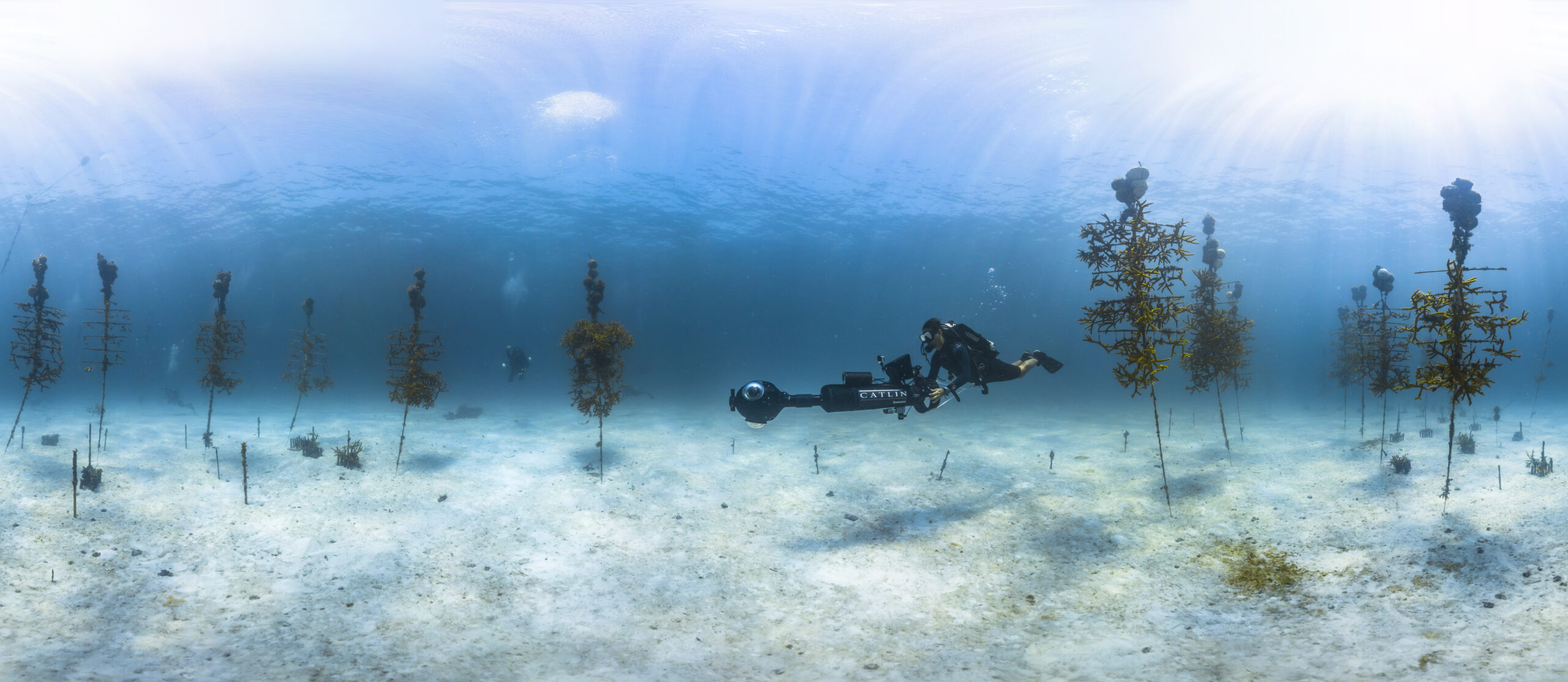
In 2001, Florida Keys tropical-fish collector and live-rock aquaculturist Ken Nedimyer, together with his daughter Kelly as part of her 4-H project, initiated an ocean-based coral farm, as stated in a profile by Divers Alert Network. Six years later, Nedimyer established the Coral Restoration Foundation. Presently, its Coral Tree nurseries extend throughout the Florida Keys, with the design being embraced by restoration organizations globally.
The timeline is crucial because the well-known image of pale PVC trees in azure waters, adorned with coral fragments suspended from monofilament, pertains to a subsequent phase. The 2001 farm had not yet incorporated Coral Trees; CRF attributes that design to 2011. Nedimyer’s initial efforts commenced with staghorn corals that naturally colonized his live rock as early as 1996, and he reattached fragments when they detached.
The initiative that opted not to sell
Nedimyer’s primary occupation kept him in the water consistently, fostering a unique relationship with coral growth. Live-rock aquaculture consists of placing rock on a permitted seafloor lease and enabling marine life to inhabit it. According to the DAN account, Nedimyer observed staghorn coral developing naturally on some of that rock in 1996.
The core objective of the father-and-daughter venture was commercial rather than restorative. Aquarium enthusiasts sought branching corals, and legally cultivated coral seemed to present a viable alternative to wild harvesting. In a 2009 interview with CORAL Magazine, Nedimyer mentioned that the idea emerged from Kelly’s 4-H project and that their original intention was to cultivate coral for the aquarium market.
The corals were never commercialized. Instead, Nedimyer stated that the project transitioned towards outreach, education, and ultimately restoration. This shift became increasingly important as staghorn and elkhorn coral populations dwindled, culminating in NOAA Fisheries listing both species as threatened in 2006.
A nursery aimed at supplying aquariums and one focused on restoring reefs may appear alike underwater, but their end goals differ. One distributes its corals to private aquariums, while the other reintroduces them to damaged reefs. Nedimyer’s increasing inventory of healthy branching corals became more prized as restoration materials than as commercial stock.
2007, followed by the tree
Nedimyer established the Coral Restoration Foundation in 2007, formalizing work that had evolved from the family initiative. A popular narrative encapsulates the early years into a single arc. The key distinction is that CRF was founded in 2007, while the specific Coral Tree design emerged four years later.
In a 2011 paper published in AACL Bioflux, Nedimyer, Kevin Gaines, and Stephanie Roach characterized the Coral Tree Nursery as a novel method for cultivating corals in an ocean-based nursery. The paper recognizes Nedimyer as the design originator and differentiates it from previous suspended-line, floating-net, and seafloor-rack techniques. This primary publication substantiates the historical attribution more directly than later organizational summaries.
The design is intentionally straightforward. A vertical PVC trunk with horizontal arms is anchored to the seafloor and maintained upright by a subsurface float, allowing the structure to move with waves and currents. Coral fragments dangle from its branches on wire or monofilament without resting on the bottom.
Suspending the corals minimizes the surface area available for nuisance algae and restricts access for benthic predators like snails and worms. The 2011 paper also connects improved growth to increased water flow and the lack of a substrate holdfast requirement. Its lightweight, cost-effective components render each tree relatively easy to install, modify, and replicate.
CRF’s current nursery page indicates that branching corals cultivated in this manner can become ready for reef restoration in six to nine months. It describes the Tavernier nursery near Islamorada as spanning approximately 1.5 acres and housing over 500 Coral Trees. Significantly, CRF designates the capacity to cultivate more than 50,000 corals annually across its nurseries collectively, rather than limiting this to the Tavernier site alone.
What the nurseries contain now
CRF refers to Tavernier as the largest in-situ coral nursery worldwide and asserts that it belongs to a network that stretches along the Florida Keys. The organization currently reports around 600 genotypes from more than 20 coral species within its Florida nurseries. The Coral Tree design has also been modified for other coral species and adopted outside Florida.
Genetic tracking represents a less conspicuous aspect of the operation. Producing a vast quantity of a single clone would also replicate the same vulnerabilities, while sustaining diverse genotypes aids in preserving variation within depleted coral populations. Consequently, CRF characterizes its nurseries not only as production sites but also as living archives of genetic diversity.
The trees are functional structures, constructed using lightweight materials and crafted to keep corals in the water column during their growth. The corals carry a deeper history: they are descendants of colonies nurtured through a father-and-daughter initiative, redirected from aquarium sales towards reef restoration.