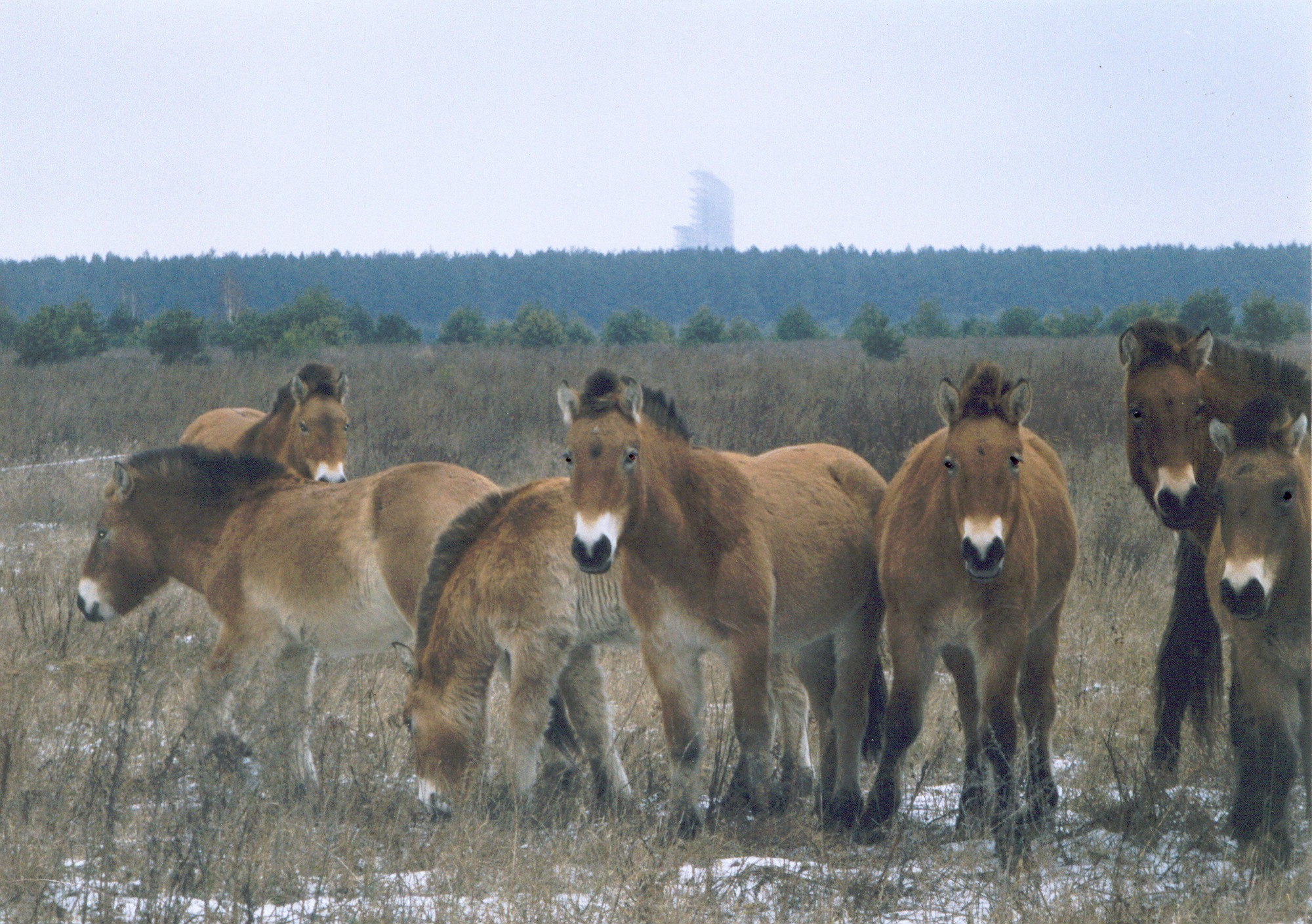
The narrative of Chernobyl’s Przewalski’s horses commenced in 1998, encompassing more intricacies than commonly stated. Various groups were brought in between 1998 and 1999: 28 horses from Ukraine’s Askania Nova Biosphere Reserve and three from a nearby zoo. Despite challenges during transit, and with only two stallions and 15 mares managing to reproduce, the goal was to establish a free-ranging population to boost biodiversity in the deserted Chernobyl landscapes.
Przewalski’s horses, previously extinct in the wild, persisted through captive breeding, although their historical domestication status remains contentious, with some suggesting they resulted from extensive harvesting rather than true domestication. This uncertainty adds to the fascination surrounding their reintroduction.
Following their introduction, initial population increases experienced fluctuations, despite challenges. By 2008, the population reached 64 horses, with illegal hunting identified as a significant factor for decline, though not all losses were accurately recorded.
In 2018, a survey confirmed 137 horses residing in Chernobyl, Ukraine, along with a small group in Belarus. Social structures were established, including harem herds and stallions organized within the exclusion zones, reflecting adaptation beyond typical open steppe environments.
While growing populations do not negate the dangers of radiation, they emphasize the horses’ resilience in an evolving landscape with minimal human presence. This introduction aimed at practical objectives: enriching biodiversity and restoring equilibrium in disrupted ecosystems.
The 2018 assessment is no longer the conclusion. A 2025 study noted further population growth, estimating up to 200 horses in Ukraine and 50 in Belarus, demonstrating stable reproduction. The historical trajectory now spans from the late 1990s introduction, through the 2018 survey, and into a flourishing population, over 25 years later, dispersing throughout a recuperating ecosystem.