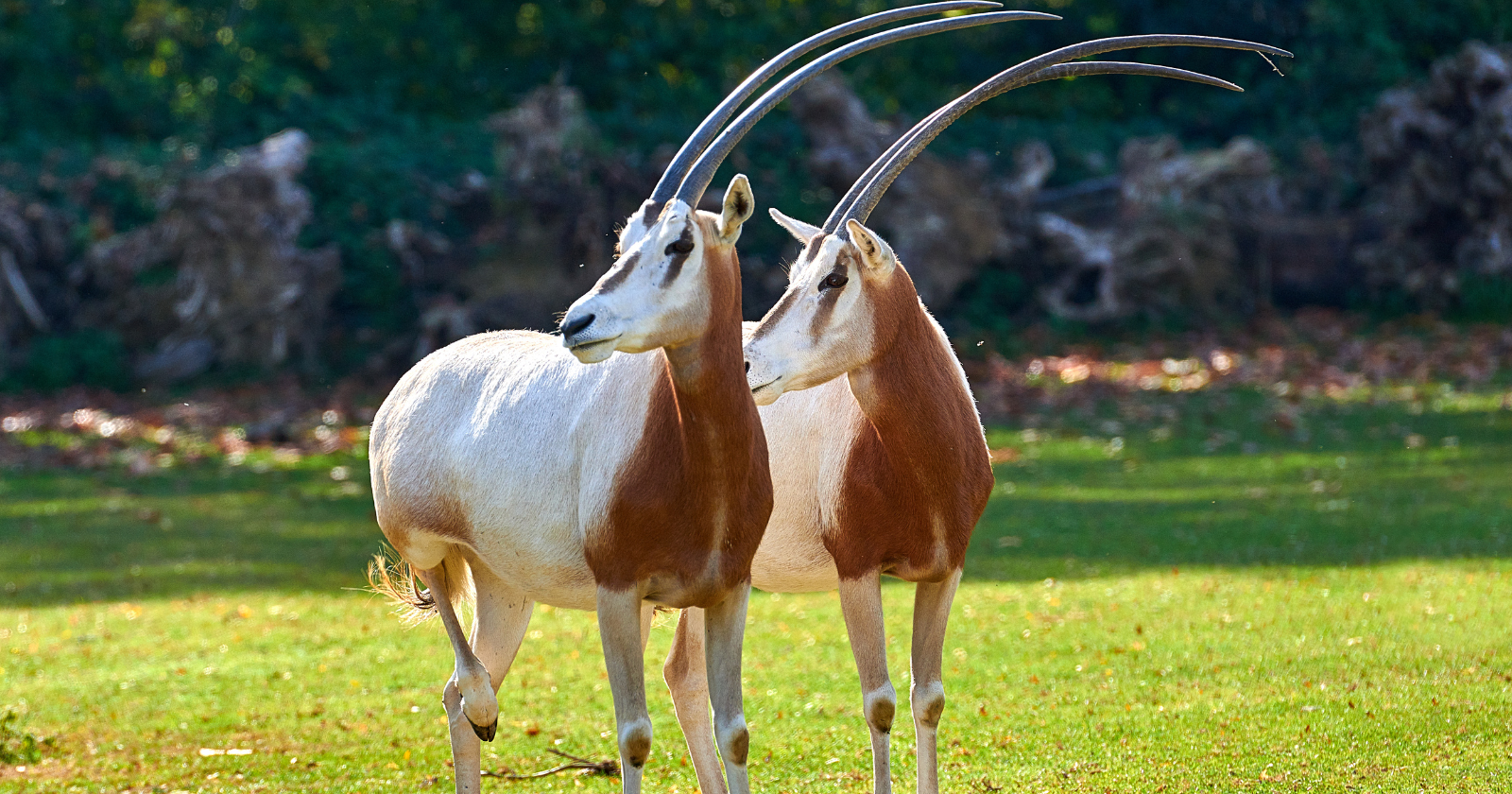
For roughly 25 years, the scimitar-horned oryx was found everywhere except for the one place it was native to.
A remarkable desert antelope — light-colored, with elongated curved horns that sweep back like the sabers for which it was named — it used to inhabit North Africa’s grasslands in large herds. However, hunting and drought wiped it out in the wild, and in 2000 the IUCN officially declared it: Extinct in the Wild. There remained thousands alive, but none were free.
The species that thrived only in captivity
“Extinct in the Wild” represents one of the most peculiar classifications in conservation — it indicates a species survives exclusively in zoos, ranches, and breeding facilities, with no wild population. For the oryx, this safeguard turned out to be vast.
While the last wild individuals disappeared, the animal prospered within enclosures. More than 220 zoos and breeding centers worldwide hosted scimitar-horned oryx, a dispersed global population descended from animals captured decades earlier. The species wasn’t eradicated; it was stored — grazing fields in Texas, Europe, and the Gulf while its natural habitat lay vacant. The challenge was no longer survival. It was reassembly: how to transform a fragmented captive population back into a wild herd.
Rebuilding a herd for repatriation
The solution took form in Abu Dhabi. Motivated by the conservation legacy of the UAE’s founding leader, the Environment Agency – Abu Dhabi created what conservationists call the “World Herd” — a genetically varied breeding population sourced from those 220-plus institutions, mixed purposefully to prevent inbreeding in the future wild herd.
The Royal Zoological Society of Scotland conducted genetic analyses to select the appropriate founders; the Smithsonian, the Zoological Society of London, Saint Louis Zoo, and the nonprofit Sahara Conservation collaborated with the government of Chad. Chad provided the site: the Ouadi Rimé-Ouadi Achim Faunal Reserve, a protected expanse exceeding 78,000 square kilometers — one of the largest globally — in the Sahelian grasslands where the oryx had last been observed.
Then, in 2016, the airlift commenced. An initial group of 25 oryx was packed, flown from Abu Dhabi to central Chad, fitted with GPS satellite collars, and — after a period in holding pens to adjust — released into the open Sahel, marking the return of the first wild scimitar-horned oryx in approximately 25 years.
From 25 to 600
The desert welcomed them back swiftly. The first calf born in the wild appeared in December 2016, just months after their release — evidence that the animals could not only survive but also reproduce on their ancestral terrain.
It multiplied from there. Over the ensuing years, the program transported and released a total of about 285 oryx, and the wild-born offspring took over: over 500 calves born in the reserve, leading to a wild population that has now exceeded 600 self-sustaining individuals. In 2023, the IUCN undertook something it has seldom done for a large mammal — it elevated the scimitar-horned oryx on the Red List, from Extinct in the Wild to Endangered.
“Endangered” still carries a heavy connotation, and rightly so. Yet, it signifies a promotion. It means the species now possesses a sufficient and self-sustaining wild population to be evaluated independently — distinguishing between a museum specimen and a living wild animal. Transitioning from Extinct in the Wild to merely Endangered is one of the rarest advancements in conservation history.
What the revival actually demonstrates
It’s important to be realistic about the events that unfolded here, as it runs counter to the typical extinction narrative.
The oryx’s recovery was not a fortunate twist of nature recovering on its own. It was orchestrated, purposefully and at significant expense, over many years — a captive gene pool curated across three continents, genetic assessments to prevent a bottleneck, an airlift, satellite collars, holding pens, and years of field monitoring in a remote reserve, primarily financed by a Gulf state. Remove any component of that operation, and the oryx remains merely a zoo inhabitant. The existence of the wild herd is the result of human effort to create the conditions necessary for it to thrive.
That’s both the encouraging aspect and the sobering reality simultaneously. Extinction in the wild was reversed — the category isn’t always irrevocable, and a species can be reconstructed from captive stock and returned to its native land if sufficient organizations collaborate for an extended period. However, it required a coalition of zoos, agencies, and a national government nearly two decades to restore a single antelope in a single reserve. The scimitar-horned oryx now grazing the Sahel serves as a testament that “extinct in the wild” need not signify an end — and a standard.