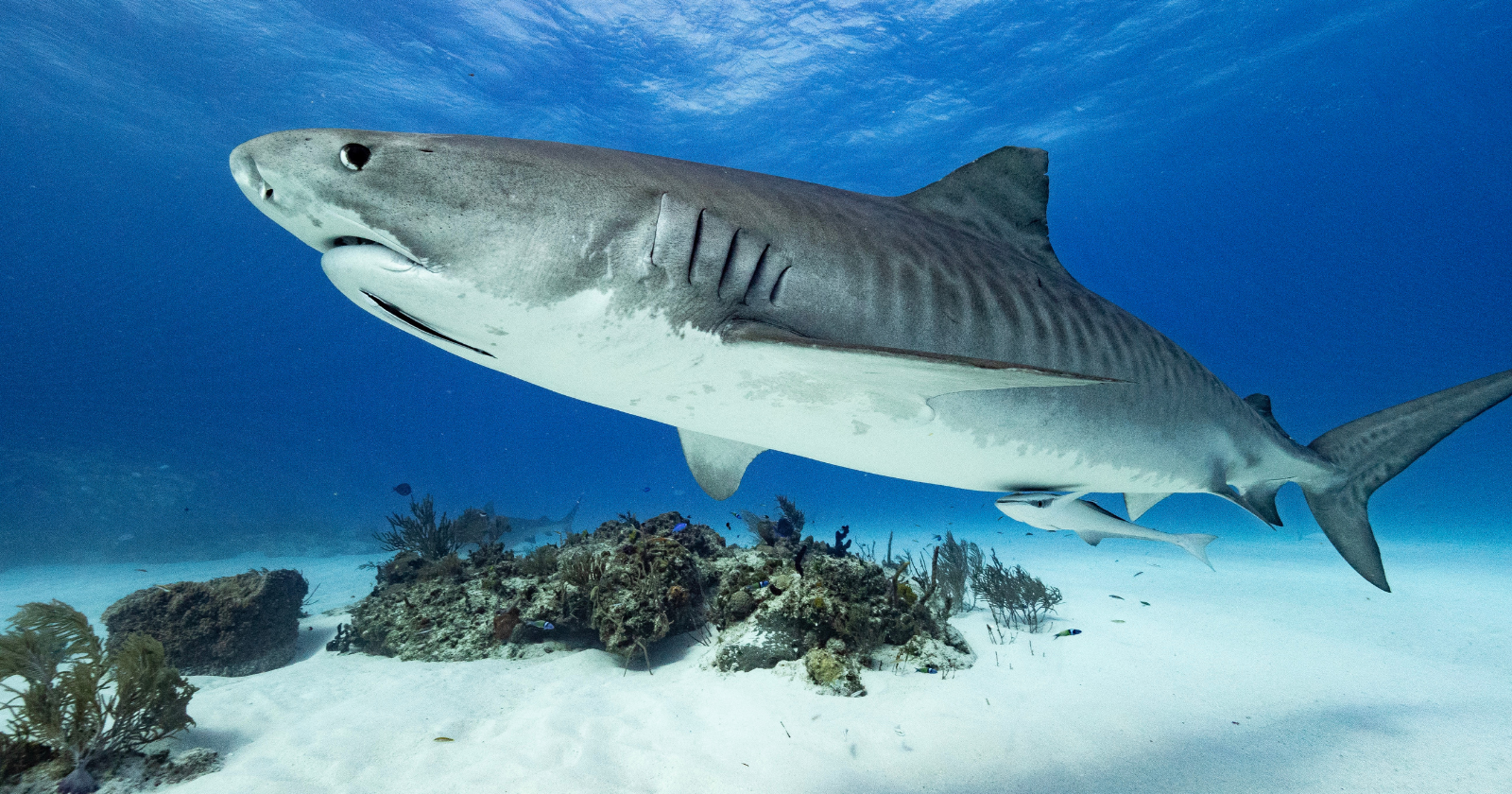
The most efficient survey team to operate in the Bahamas in years consisted of no clipboards, no salaries, and a mouthful of serrated teeth each.
Between 2016 and 2020, scientists equipped camera packages to seven tiger sharks on the Great and Little Bahama Banks, then allowed them to continue their usual activities. In total, they recorded 20.6 kilometers of seafloor, one of which utilized a 360-degree camera that the team claims is a first for any marine creature. That footage contributed to a 2022 paper in Nature Communications led by Austin Gallagher from the research organization Beneath The Waves.
The key figure was 66,000 to 92,000 square kilometers of seagrass across the banks, the largest such system known on Earth. National Geographic compared the upper figure to Portugal. The study states that this discovery adds 41 percent to the world’s documented seagrass.
Previously, the record was held by about 40,000 square kilometers behind the Great Barrier Reef, which came to light in a 2009 survey using towed cameras, even though it lies within one of the planet’s most comprehensively studied reef systems.
How such a vast meadow remained undetected
How could something the size of a small country remain concealed in some of the clearest waters of the ocean? Primarily by being sparse. Much of the Bahamian seagrass is thin and low, its blades rising only a few centimeters above the sand and often partially buried in it, which from space appears as bare seafloor.
Earlier estimates for the banks varied approximately 30-fold, and the underwater inspections that verified them covered less than 5 percent of the area. Those checks are referred to as ground-truthing, which Beneath The Waves researcher Oliver Shipley described to the Naked Scientists as confirming that what the satellite data indicates is indeed present.
Divers performing that role cover several hundred meters each day. The sharks managed an estimated 51.6 kilometers daily, at three times the usual depth of human surveys.
Attaching a camera to a tiger shark
“Almost like a NASCAR pit crew.” That’s Shipley’s description of the tagging process. A shark is captured on a baited line and restrained beside the boat, and a package containing the camera, a satellite tag, and a radio tag is affixed through its dorsal fin using biodegradable cable ties. These ties connect at a link that dissolves in seawater, so after a specific duration, the rig detaches, surfaces, and signals where to retrieve it.
Each deployment recorded approximately one to two hours of video, with around 72 percent of that time spent over seagrass. More significantly, there were two release sites where none of the satellite maps indicated seagrass, yet the sharks swam over it more than 70 percent of the time. The authors regarded this as evidence that existing satellite-based estimates had underestimated the banks.
Still, the footage represents only a fraction of the banks. It functioned as an independent validation of an estimate derived from multiple satellite maps and 2,542 diver surveys. This constitutes one study, and 92,000 square kilometers is its maximum estimate; the more cautious figure is closer to 67,000.
The carbon storage of that grass
Seagrass absorbs carbon from the water and sequesters it into the sediment beneath, a part of what scientists term blue carbon, meaning carbon retained by marine and coastal ecosystems. An initial estimate in the 2022 paper indicated that the Bahamian meadows might contain a fifth to a quarter of all carbon buried in seagrass sediments globally, with further research required.
A 2023 follow-up in Communications Earth & Environment sampled ten meadows around the Exumas and estimated the stock at 420 to 590 million tonnes of organic carbon in the upper meter of sediment. According to its findings, annual burial equals or exceeds the country’s total greenhouse gas emissions. On a square meter basis, Bahamian beds store less than the global average, thus their significance lies in their size.
Those samples also contained a cautionary note: seagrass-derived carbon in the sediment has been declining since around 1980, which the authors attribute to tourism and boat traffic.
The importance of sharks to seagrass
It all began with a shark biologist observing the environment. Gallagher had been filming tiger sharks to learn about their daily behaviors, and when the footage repeatedly showed meadows, he reached out to Carlos Duarte, a prominent seagrass scientist at King Abdullah University of Science and Technology (KAUST). Gallagher later informed National Geographic that the meadows function like a savanna, with tiger sharks serving as the top predator.
That role is significant. Regulating grazers can prevent meadows from being over-grazed, and both papers suggest that the longstanding protection of tiger sharks in the Bahamas, established for over a decade according to a KAUST press release, has likely helped maintain that equilibrium.
The Nature Communications team also asserts that camera-equipped sharks continue