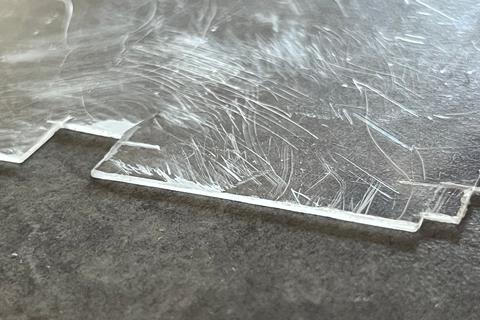
A novel method that operates at lower temperatures to depolymerise acrylic glass back into its monomer could provide a more effective and environmentally sustainable means of recycling the material. This technique, which does not require solvents, was created by Swiss researchers who showed that it could yield high amounts of pure monomers suitable for creating new acrylic.
Acrylic sheets are produced from polymethyl methacrylate (PMMA), resulting in lightweight and shatter-resistant substitutes for glass such as plexiglass and Perspex. However, converting the polymer back to monomers has traditionally necessitated pyrolysis at temperatures exceeding 400°C. Current methods also employ solvents that may contaminate the final product and lead to unwanted discolouration.
Recently, Athina Anastasaki and her associates at ETH Zurich, Switzerland, have introduced what they assert is the first low-temperature chemical recycling process for acrylic, which occurs at temperatures lower than 200°C. Significantly, it does not require solvents or light irradiation, which enhances the potential for commercial scalability.
Earlier investigations into lower temperature techniques for chemically recycling PMMA primarily concentrated on non-commercial, PMMA model materials. These were engineered with chain-end functionalised polymers that serve as weak links, making them easier to depolymerise.
“While these model materials improved our kinetic and thermodynamic insights, they could not substantially address the plastic crisis and the urgent need for recycling, as commercial polymers usually lack these precisely defined chain ends,” shares Anastasaki. “We aimed to explore whether we could create a much simpler process applicable to commercially relevant PMMA without re-engineering the polymer and ideally without the use of a solvent.”
To achieve this, the team focused on the hydrogen atom transfer (Hat) reaction. The researchers delved into whether the removal of a hydrogen atom from the polymer’s backbone could cleave the polymer mid-chain without depending on chain ends under mild conditions.
While screening for potential Hat agents, including several established systems, the researchers discovered that they did not function adequately at their desired temperatures. Nevertheless, control tests with an N-hydroxyimide reagent, previously reported by other groups to efficiently trigger depolymerisation when used as co-monomers, led to an unexpected finding. The N-hydroxyimide spontaneously instigated the Hat reaction, resulting in the division of the polymer chain into two pieces, with one fragment quickly unraveling into monomers.
By optimizing the system with N-hydroxytetrachlorophthalimide, the researchers demonstrated effective depolymerisation at temperatures ranging from 180 to 230°C. The maximum yield achieved was 96%. However, processing the remaining 4% through a subsequent cycle reclaimed 99% of the acrylic.
“Utilizing N-hydroxyphthalimides as an external radical source, rather than incorporating them into the polymer backbone, represents a significant advancement for practical PMMA recycling,” states Jon Husband at the University of Bath. In January, Husband published findings on a recycling technique that utilizes UV light to degrade PMMA.
“This paper makes critical strides towards a scalable method by eliminating the necessity for light irradiation,” remarks Husband. He elaborates that photochemical processes often have scalability issues since light is absorbed and diffused as it travels through reaction mixtures.
“Additionally, the new approach can be executed in bulk, potentially offering benefits over solvent-based methods,” Husband notes. “However, this is at the expense of higher temperatures compared to earlier solution-phase techniques.” He also mentions that the cost of tetrachloro-N-hydroxyphthalimide may pose a considerable challenge.
Anastasaki emphasizes that the transition from laboratory to industrial application is still a ‘considerable distance’, but the team has submitted a patent. “We are exploring the feasibility of scaling up our method and investigating even more affordable N-hydroxyimide alternatives to enhance the practicality of our approach,” says Anastasaki.
“In light of the impressive advancements being achieved by Athina’s team, along with our ongoing efforts at Bath, a commercially viable solution for acrylic recycling may be on the horizon,” adds Husband.