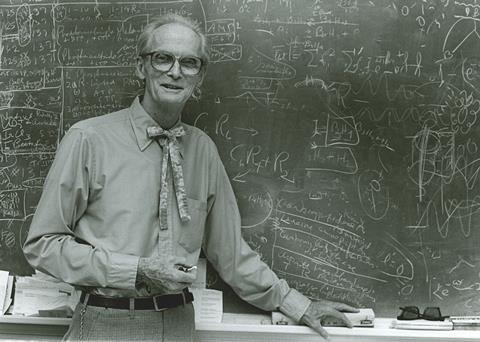
Boranes represented some of the most distinctive compounds recognized by chemists during the early to mid-20th century. The contributions of William Lipscomb in clarifying their structures and bonding led to his receipt of the Nobel prize in chemistry in 1976 and significantly advanced the scientific community’s comprehension of the chemical bond.
Initially known as boron hydrides, boranes follow the general formula BxHyRz. Long before Lipscomb showed any interest, Alfred Stock had created the volatile compounds B2H6, B4H20, B5H9, among others.
During the 1950s, Lipscomb, along with his colleagues Bryce Crawford and Wolfgang Eberhardt, unraveled the structures of various boranes through low-temperature x-ray crystallography, a methodology that was quite rare at that time. Lipscomb found that these compounds shared two electrons across three atoms – a phenomenon now recognized as three-centre two-electron bonds.
This concept explained the peculiar geometry of boranes, their surprising dipole moments, and their apparent electron deficiency. It also reinforced the validity of the bridged diborane structure proposed by Christopher Longuet-Higgins a decade prior.
He demonstrated that one could logically interpret the structures
Douglas Rees, a past member of the Lipscomb group, later characterized Lipscomb’s contributions as ushering in a ‘new era in the comprehension of the chemical bond’. Indeed, his research continues to influence contemporary boron chemistry, serving as a foundation for developments in materials science, supramolecular chemistry, and medicine.
2D borane
Borophene can be viewed as boron’s equivalent to graphene, a two-dimensional material that propagates the electron-deficient bonding discovered in boranes across a surface. Unlike its carbon counterpart, borophene does not form a uniform hexagonal lattice. Rather, its monoatomic sheets present a more diverse configuration of triangles and hexagons. ‘Lipscomb would have thoroughly enjoyed these [2D sheets] and would have swiftly formulated a theory regarding the bonding in them and the fascinating electron counts associated with them,’ remarks chemistry Nobel laureate Roald Hoffmann, who spent a year in the Lipscomb group at Harvard and contributed to a book that Lipscomb authored about boron hydrides.
Borophene is thrilling from a practical standpoint, asserts Mark Hersam, a materials chemist at Northwestern University in the US, adding that