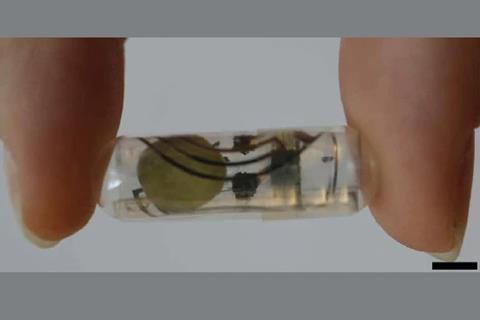
A novel class of edible batteries can function within the body for a set duration before being completely decomposed in the digestive tract, presenting a means to energize temporary internal medical apparatus. Ingestible and implantable electronics are applicable for monitoring the gut, verifying whether patients have adhered to their medication regimens, or administering electrical stimulation, increasingly regarded as a less invasive option compared to surgical interventions. However, these devices require a power supply, and traditional batteries frequently contain hazardous materials. Alkaline and lithium-ion batteries can potentially leak damaging electrolytes or produce gas if their enclosure fails, and their non-degradable parts must either be retrieved or left to accumulate as electronic waste in the gastrointestinal system.
Bioresorbable batteries – engineered to safely disintegrate in the body after usage – provide a solution to this issue. Nevertheless, past efforts have struggled to achieve the necessary power and reliability for effective functionality within the body.
Currently, Giovanni Traverso and his team at the Massachusetts Institute of Technology, US, have created a paper battery utilizing materials deemed safe for human ingestion in limited quantities. ‘We incorporated magnesium for the anode and molybdenum trioxide for the cathode,’ details Mehmet Girayhan Say, a materials scientist at Chalmers University of Technology, Sweden, who spearheaded the research. They employed plant-derived cellulose fibers to bind the two metal layers together. This produced thinner, more durable electrodes with improved electrical contact while still permitting the material to disintegrate naturally once inside the body. Ultimately, they replaced the conventional water-based electrolyte with a biodegradable liquid formed by melting together two food-safe components, choline chloride and lactic acid. This resulted in a more consistent voltage output compared to the urea-based saltwater solutions employed earlier. ‘This performance is satisfactory [as it’s] directly providing adequate voltage and fairly reasonable energy density to power basic integrated circuits,’ remarks Kourosh Kalantar-Zadeh at the University of Sydney, Australia, who did not participate in the study.
The battery is encased in natural waxes – beeswax for short-term safeguarding and a plant wax for prolonged retention – available in two formats: a small circular cell that fits within a standard capsule and a larger variant for devices requiring more power. Both progressively degrade over a span of weeks to months when evaluated in simulated stomach acid. ‘The electrode thicknesses and cathode loading were selected to ensure that even during complete dissolution, the amounts of magnesium and molybdenum released remain below established daily tolerable intake thresholds,’ states Say.
The researchers evaluated two devices powered by this battery in pigs. The first was a tracking tag that utilizes a wireless signal to indicate when a capsule has been ingested. Fueled by the new battery, the tag was capable of transmitting over significantly greater distances than typical passive tags, and its signal diminished as soon as it transitioned from open air into body tissue – a definitive indication of being swallowed. The second device was an ingestible hormone stimulator that provided several days of continuous electrical stimulation to the stomach lining. This elevated levels of the hunger hormone ghrelin without harming the surrounding tissue. The batteries could remain in the stomach for at least three days, after which they degraded over a few weeks. ‘The significance lies not just in the battery itself but in what it facilitates: a completely bioresorbable, retrieval-free electronics platform for the gastrointestinal tract,’ points out Say. ‘It is encouraging to demonstrate it powering a functional electroceutical device within a living stomach.’
Say envisions the genuine potential of the technology as complete device integration. ‘Combining ingestible electronics powered by a bioresorbable power source would yield a fully self-sufficient, dissolving biomedicine capsule,’ he states. ‘That is the trajectory I find most intriguing from both a scientific and clinical perspective.’