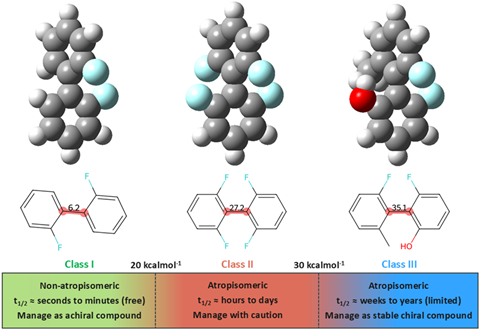
Researchers at AstraZeneca in the UK have created a computational workflow to forecast whether a compound will display atropisomerism, an unusual type of chirality that can complicate the drug development process. The company has already integrated this tool into its internal operations.
Atropisomerism is a form of axial chirality that arises when bulky groups hinder rotation around a single bond.
Around 30% of drugs recently approved by the FDA possess a potentially atropisomeric axis. Not every atropisomeric axis presents an obstacle for drug development; it is contingent on their energy barrier to rotation. Typically, either a low or high barrier is satisfactory. A high barrier indicates that rotation is sluggish and consequently improbable within a relevant timescale; a low barrier suggests the molecule will quickly interconvert, leading to a racemic mixture.
The genuine issue emerges when the rotation barrier allows for isomers to interconvert over durations ranging from minutes to months, implying that a molecule’s stereochemistry could vary during storage or within the body, possibly influencing its potency, selectivity, and safety profile. Such atropisomers have been characterized as a ‘lurking menace’ since they can remain concealed until late-stage development, when companies might discover they have expended considerable resources on drug candidates that they subsequently need to modify or forsake. ‘The misstep of landing on one of these unfortunate atropisomers may result in significant financial loss for a pharmaceutical company,’ remarks Art Bochevarov, a product manager at software firm Schrödinger.
Guided by Elliot Farrar, the AstraZeneca team’s tool employs cheminformatics and quantum mechanics in a modular approach to evaluate molecules’ conformations and transition states under realistic solvent and temperature settings, to pre-screen them for potentially problematic atropisomeric axes. ‘There are already numerous internal initiatives at AstraZeneca where we’ve applied rotational barriers computed with our workflow,’ states Farrar. For instance, the tool was recently utilized in the development of a lung cancer drug candidate.
Earlier this year, Bochevarov and associates at Schrödinger unveiled their own computational tool for forecasting atropisomerism in drug-like molecules. Both techniques achieve comparable accuracy levels, yet they differ in their methodologies.
AstraZeneca’s method utilizes Smiles arbitrary target specification (Smarts) strings-based pattern matching to identify restricted bonds, even within complex systems. In contrast, the Schrödinger tool examines each rotatable bond sequentially and can thus discover restricted bonds that might otherwise go unnoticed.
The tools also vary in terms of accessibility. Schrödinger’s software features a user-friendly interface that facilitates use by non-experts, but requires a subscription for access. AstraZeneca’s tool, on the other hand, is publicly available but necessitates some computational proficiency for effective use.
‘The primary limitation that both our tool and the Bochevarov tool share is addressing larger fused ring systems, specifically macrocycles,’ notes Farrar. Indeed, macrocycles are becoming increasingly significant in drug development, yet they present a more intricate conformation landscape, complicating the prediction of atropisomerism. ‘You cannot pinpoint which bond [in a macrocycle] is responsible for atropisomerism … virtually all of them are implicated,’ observes Bochevarov. Both teams are currently focused on resolving this challenge.
References
1. E H E Farrar et al., Digital Discovery, 2026, DOI: 10.1039/d6dd00210b
2. J Clayden et al., Angew. Chem., Int. Ed., 2009, 48, 6398 (DOI: 10.1002/anie.200901719)
3. Ty Balduf et al., J. Chem. Inf. Model., 2026, 66, 1675 (DOI: 10.1021/acs.jcim.5c02720)
4. J J Douglas et al., J. Org. Chem., 2022, 87, 2075 (DOI: 10.1021/acs.joc.1c01736)