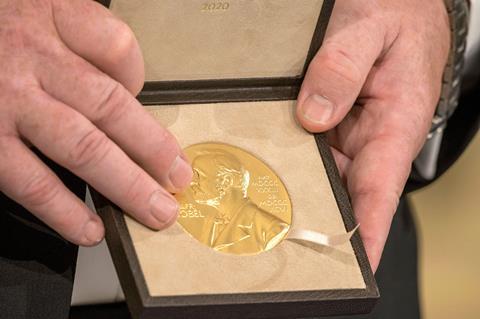
It’s that season when the Nobel prize committees reveal this year’s Nobel laureates. Each laureate will be awarded 12 million Swedish kronor (£900,000), a framed piece of art, and a medal, presented during the Nobel prize ceremony in December. However, the method of selecting a Nobel laureate is cloaked in secrecy. So, how is one of science’s most esteemed awards conferred?
Firstly, what are the Nobel prizes?
Every October, a set of prizes honors individuals in the fields of science, literature, and peace whose contributions or actions have significantly influenced society. The prizes pay tribute to Alfred Nobel – a Swedish chemist, inventor, and engineer, renowned for his invention of dynamite. His final will – signed in November 1895, approximately a year before his passing – specified that his 31 million Swedish kronor estate, roughly £190 million in current currency, should be allocated across five distinct categories – physics, chemistry, physiology or medicine, literature, and peace. In 1969, the Sveriges Riksbank Prize in Economic Sciences was added to the roster of awards in celebration of the 300th anniversary of Sweden’s central bank.
A maximum of three individuals can be awarded the prize. Bengt Nordén, the former chair of the Nobel committee for chemistry, mentioned to Chemistry World in 2015 that ‘having one individual is preferable because it creates an icon that embodies something’.
What is the procedure for selecting a Nobel laureate and what is the duration?
The entire procedure spans roughly 16 months. The Nobel committees initiate the process by distributing confidential nomination requests in September of the year preceding the upcoming awards. Nominators are then given until 31 January to present their candidates for the prize. Upon receiving all nominations, the Nobel committees spend the ensuing months narrowing down the list and scrutinizing the nominated researchers. ‘Evaluating and confirming that this was indeed a groundbreaking discovery and that the nominated individual is the correct one takes time,’ Nordén explained. For instance, a group leader might be linked to a discovery, yet it may have actually been the initiative or concept of a postdoc or PhD student within the group.
After reaching a consensus, the prizes are announced starting from the first Monday in October at 11.45 am Swedish time each day, in this sequence: physiology or medicine, physics, chemistry, literature, and peace. The award for economic sciences is declared the following week.
The newly honored Nobel science and literature laureates then participate in an awards ceremony at the Stockholm Concert Hall in Sweden on December 10 – the anniversary of Nobel’s death. There, the King of Sweden presents them with an 18-carat gold medal and a diploma. The ceremony for the Nobel peace prize occurs on the same day but takes place in Oslo.
Can anyone obtain a Nobel prize?
There are no specific formal criteria delineating who is eligible or ineligible to receive a Nobel prize, other than that nominators cannot nominate themselves.
Nordén noted that many individuals believe that scientists receive the prize as a recognition of lifetime achievement, which is incorrect. He stated that during his involvement in the process, the committee had several criteria of their own to aid their decision-making. ‘The achievement should somehow unlock a door or provide a new perspective; we should see things differently,’ he said. ‘There should [also] be a significant impact in the field of chemistry,’ Nordén added, stating that the consequences of a laureate’s work should possess a ‘richness of implications’ and withstand the test of time.
Contrary to Nobel’s will, prizes are no longer awarded solely for discoveries made in the preceding year. Nordén explained that this adjustment is due to time: the time needed for discoveries to yield consequences and the time required for the committee to assess a nominee.
Who can nominate researchers for a Nobel prize?
Only individuals who receive a confidential invitation from a Nobel committee are permitted to nominate candidates for the forthcoming year’s prize. Nordén mentioned that the committee historically sent out approximately 3000 invitations and received around 300 responses each year. He further added that they attempted to distribute invitations globally, especially to those earlier in their careers ‘who are generally more observant and conscious of current happenings’. Nominators are allowed to submit multiple suggestions for individuals or topics they believe deserve recognition.
The Nobel chemistry committee specifies that those eligible to nominate include: members of the Royal Swedish Academy of Sciences; past Nobel laureates in chemistry or physics; chemistry professors from Nordic countries; individuals who have served as chairs at a minimum of six universities or university colleges recognized by the Academy of Sciences globally; or any other individuals whom the academy considers appropriate. Nordén indicated that the list of invitees is revised annually: ‘If you are inactive, you are removed from the list.’
The committee then maintains the confidentiality of nominations for 50 years. While the committee may