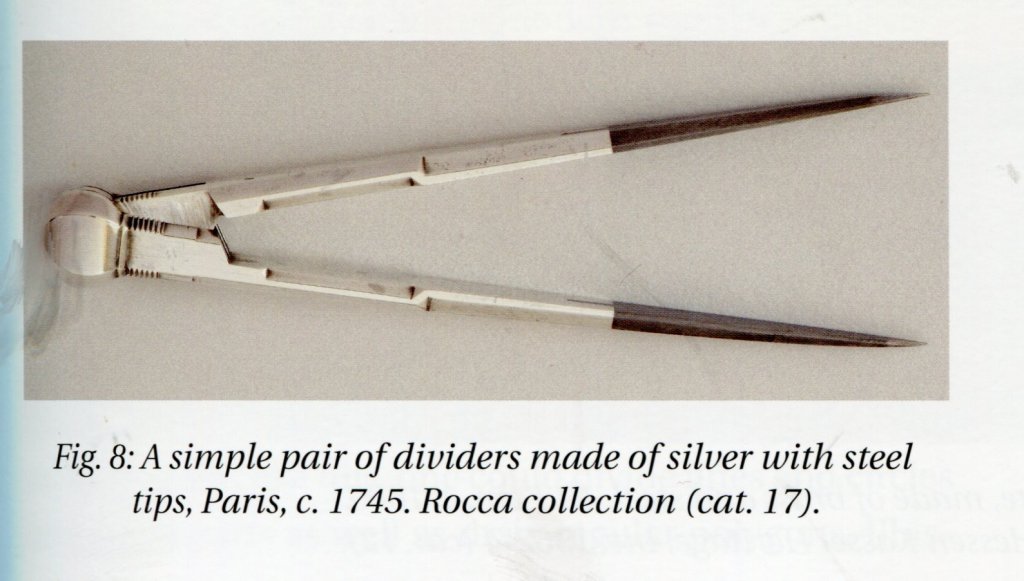
Before the advent of the proportional compass, proportional dividers, often referred to as the reduction compass, were utilized. These were more straightforward instruments rooted in Euclidean theory, applying principles of isosceles triangles. A reduction compass is distinct from a standard pair of dividers due to its hinge being positioned centrally, allowing for proportional measurements on both sides. These ratios could be 2:1, 3:1, or 4:1, facilitating the scaling of representations like maps and architectural designs.
While no medieval reduction compasses remain, one artifact—a 2:1 ratio compass—was unearthed in the ruins of Pompeii, having been buried since 79 CE. Modern comprehension of these instruments progressed during the Renaissance, with both fixed and adjustable hinge models created. Leonardo da Vinci prominently examined proportional dividers in his manuscripts, the Codex Atlanticus and Codex Forster, though none of his designs came to fruition in his lifetime; present-day replicas exist.
Antonio da Sangallo the Younger recorded guidelines for a flat-legged proportional compass that could be fine-tuned to determine any proportion. Swiss clockmaker Jost Bürgi produced an engraved proportional compass featuring adjustable hinges, advancing towards what would turn into the proportional compass. Levinius Huslsius published a manual on Bürgi’s compass, and Erasmus Habermel made additional progress with variations not directly associated with Mordente’s inventions.
Italian mathematician Fabrizio Mordente first unveiled his compass in 1567, designed for intricate mathematical operations. This sparked a considerable debate with philosopher Giordano Bruno regarding the compass’s relevance in atomic theory, leading to considerable controversy and Bruno’s ultimate exit from Paris.
The progression of the reduction and proportional compasses reflects a transformation of geometric devices from basic dividers to sophisticated tools capable of addressing advanced mathematical challenges. These advancements established the foundation for contemporary technical drawing instruments, showcasing a legacy of ongoing technological enhancement and adaptability.