**Reaction Times: A Glimpse into Cognitive Evolution**
The examination of reaction times (RT) has continued to be a crucial aspect of cognitive psychology for ages. From its inception before psychology was established as a formal field to its ongoing significance in studies investigating cognitive functions, RTs provide important understanding of how the brain operates under diverse circumstances.
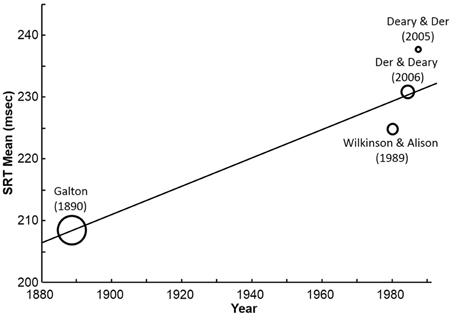
In the late 1800s, Francis Galton, a prominent statistician and eugenicist, amassed a substantial dataset of simple reaction times involving 3,410 subjects. Galton, who was fascinated by individual cognitive variances, hypothesized that RTs could reflect intelligence, implying that quicker processing speeds might associate with elevated intelligence levels. Presently, Galton’s dataset offers a compelling question: are modern individuals faster or slower in their reaction times compared to his Victorian subjects? This inquiry could not only showcase shifts in cognitive processing across generations but also contribute to discussions relating to the Flynn Effect, which tracks the gradual rise in IQ scores over generations.
In contrast to the belief that contemporary individuals are more intelligent, some evaluations of RT data suggest that Victorian subjects exhibited swifter reactions. Research attempting to duplicate Galton’s techniques with recent cohorts consistently shows prolonged reaction times in modern participants. For example, studies conducted by Silverman (2010) and Woodley et al. (2015) demonstrate that, despite a slight average difference of 20 milliseconds, this signifies a notable 10% increase in RTs—a considerable alteration in cognitive terms.
Numerous theories strive to elucidate this occurrence. Some suggest it indicates a decrease in cognitive capability, while others theorize possible changes in motivation, experimental techniques, or even alterations in cognitive load distribution. Nevertheless, reaching a conclusive answer remains challenging due to the lack of comparative data from previous decades. The captivating trend poses vital questions concerning the evolution of cognitive processing and exemplifies a complex interaction of environmental, technological, and cognitive elements that deserve further investigation.
**References:**
– Irwin, W. S. (2010). Simple reaction time: it is not what it used to be. *American Journal of Psychology*, 123(1), 39-50.
– Woodley, M. A., Te Nijenhuis, J., & Murphy, R. (2013). Were the Victorians cleverer than us? The decline in general intelligence estimated from a meta-analysis of the slowing of simple reaction time. *Intelligence*, 41(6), 843-850.
– Woodley, M. A, te Nijenhuis, J., & Murphy, R. (2015). The Victorians were still faster than us. Commentary: Factors influencing the latency of simple reaction time. *Frontiers in Human Neuroscience*, 9, 452.