**Gravity Anomalies: Comprehending Antarctica’s Gravity Void and Its Geological Significance**
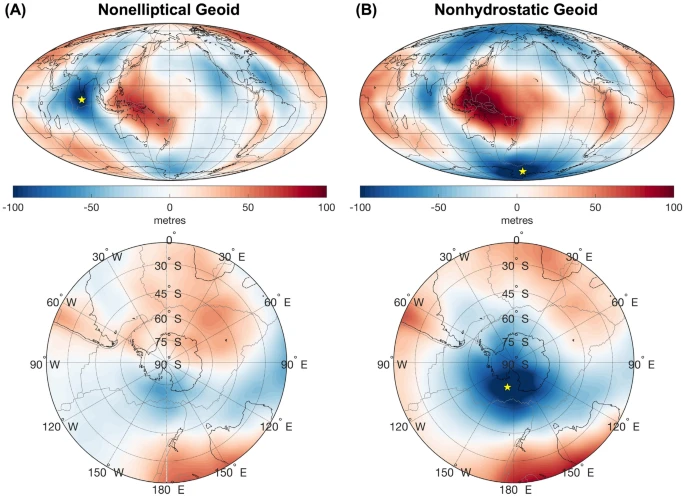
Gravity, the force that we commonly regard as steady and consistent, is not as uniform across the Earth’s surface as one might think. While the majority of the Earth’s surface experiences a relatively stable gravitational force, Antarctica showcases a distinct anomaly referred to as a “gravity void,” where the gravitational pull is considerably weaker. This occurrence is shaped by the planet’s geoid depression—the most intense of its kind.
In areas where gravity is diminished, such as above the Antarctic gravity void, the ocean surface descends in relation to the Earth’s core. This detectable depression signifies gravity’s complex connection with geological structures and climate variations. Even though there has been awareness regarding this anomaly for years, the root causes remained enigmatic until recent research provided insights into its historical background and evolution.
Scientists Petar Glišović and Alessandro Forte employed earthquake data to model Earth’s interior, akin to a CT scan but utilizing seismic waves instead of X-rays. Their research, published in Scientific Reports, combines seismic observations with physics-based modeling, producing detailed three-dimensional seismic diagrams of the Earth’s interior. These diagrams closely match satellite gravity data, confirming the reliability of their models.
Their investigation traces the gravity void’s history back 70 million years, aligning with the era when dinosaurs inhabited Earth and prior to Antarctica evolving into a frozen wasteland. The evaluation indicates that the anomaly experienced considerable strengthening between 50 to 30 million years ago, a timeframe that correlates with the onset of Antarctica’s glaciation.
A noteworthy hypothesis suggests that alterations in Earth’s gravitational mechanics, corresponding with these climatic shifts, might affect ice sheet formation and stability. Further studies intend to examine whether such gravitational changes could actively foster ice growth.
The research underscores how mantle dynamics play a role in the gravity anomaly. Dense rock formations in the mantle’s lower sections offer stability, but a more extensive narrative unfolds within the mantle’s upper layers. Here, heat and buoyant materials ascending from deep within the Earth enhance the surface gravitational depression. This upwelling interacts with ancient oceanic slabs descending along Antarctica’s perimeter. The intricate interaction between these movements results in the gravitational low seen today.
The researchers substantiated their findings using paleomagnetic records, which illustrate shifts in Earth’s rotation axis due to internal mass variations. Noted changes in the gravity void’s location and intensity correspond with Earth’s historical rotational adjustments, adding further validity to the study.
Forte underscores the broader inquiry posed by this research: how Earth’s internal operations influence surface climate conditions. By charting internal dynamics and linking them to surface phenomena like ice sheets, scientists gain perspective on fundamental geological and climatic processes.
Fusing insights from geophysics and climate science could reveal connections that traditional separate approaches might miss. These findings suggest that large-scale geological processes may affect significant climatic occurrences, contributing to the conditions favorable for the formation and maintenance of extensive ice sheets.
While these processes transpire over millions of years, grasping them deepens our understanding of Earth’s intricate systems. This research calls for collaboration across scientific fields to uncover deeper relationships between Earth’s interior and its climatic systems.
**Discover More:** [Study Link](https://www.nature.com/articles/s41598-025-28606-1)
If this article enhanced your comprehension, consider supporting scientific journalism through a donation. Your support helps ensure the delivery of credible, engaging science news.