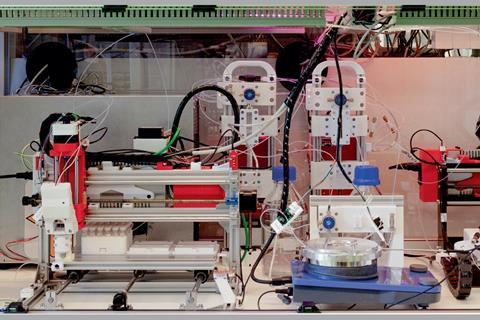
A revolutionary advancement in laboratory automation is creating pathways for economical and universal access to state-of-the-art research. A self-operating lab, featuring 3D-printed elements and allowing chemists to make use of shared analytical tools, has shown the capability to slash costs by as much as 90%. This inventive strategy not only lowers the financial burden associated with automated research processes but also improves accessibility for a broader spectrum of research teams.
Laboratory automation usually involves specialized machinery, often requiring considerable monetary and technical investments that many research teams find unmanageable. Nonetheless, Timothy Noël and his group at the University of Amsterdam are challenging this concept by presenting an affordable self-operating lab platform. Originally developed in 2024 to enhance photocatalytic reactions, the platform significantly decreases expenses without compromising quality.
The enhanced platform features a modular, ‘plug and play’ framework that utilizes readily available components, many of which can be produced via in-house 3D printing. This flexibility facilitates experimentation with a wide range of organic reactions, including biocatalysis and enantioselective catalysis, showcasing its extensive potential and capability.
Additionally, the platform’s synchronization with analytical instruments such as NMR, HPLC, and Raman spectroscopy allows for uninterrupted operation through machine learning algorithms, which independently decide on subsequent experiments. Tackling the issue of many research groups lacking direct access to such sophisticated equipment, Noël’s team designed a 3D-printed liquid sample collector, empowering chemists to conduct their analyses, thereby enhancing the system’s accessibility and cost-effectiveness.
The revamped platform is priced at roughly $5000, marking a substantial decrease from the original $50,000 configuration. This breakthrough highlights the necessity of making advanced research tools accessible and reproducible, effectively democratizing the research environment.
Autonomous flow chemist Milad Abolhasani from North Carolina State University commends this innovation, highlighting its importance in promoting accessibility and reproducibility in self-operating labs. However, he recognizes the necessity for ongoing development to tackle more intricate chemical processes and reaction conditions.
Noël’s team remains devoted to continuous advancement, investigating miniaturized, portable configurations. They have also offered resources for fellow chemists, including detailed manuals, codes, and experimental parameters, to establish similar self-operating labs, demonstrating a commitment to open access and collaboration within the scientific community.